

Because this is a Broadway history podcast, I don’t usually comment on recently opened productions, since we can’t know yet whether they will be historically significant. The exceptions, of course, are major revivals of Broadway musicals from the past... Read More
From the show: BROADWAY NATION
Featured Shows
About
Because this is a Broadway history podcast, I don’t usually comment on recently opened productions, since we can’t know yet whether they will be historically significant. The exceptions, of course, are major revivals of Broadway musicals from the past. And since I’ve been around for a while and had the opportunity to see the original 1986 London production of Chess, which ran for three years, as well as the 1988 Broadway production, which closed after only 68 performances, and a few weeks ago, the current Broadway revival of the show, I thought I might be interesting today to talk about the history of this show and share my thoughts on all three major productions.
Become A PATRON of Broadway Nation!
This episode is made possible in part through the generous support of our Patron Club Members such as Kelly Allen.
If you are a fan of Broadway Nation, I invite you to become a PATRON! For as little as $7.00 a month, you can receive exclusive access to never-before-heard, unedited versions of many of the discussions that I have with my guests — in fact, I often record nearly twice as much conversation as ends up in the edited versions. You will also have access to additional, in-depth conversations with my frequent co-host, Albert Evans, that have not been featured on the podcast. And all patrons receive special “on-air” shout-outs and acknowledgement of your vital support of this podcast.
And if you are very enthusiastic about Broadway Nation, there are additional PATRON levels that come with even more benefits.
If you would like to support the work of Broadway Nation and receive these exclusive member benefits, please click on this link:
https://broadwaynationpodcast.supercast.tech/
Thank you in advance for your support!
Transcript
This transcript was automatically generated and might contain errors.
[0:00] David Armstrong: Hi, this is David Armstrong. Welcome to another episode of Broadway Nation, the podcast that takes you deep inside the history of the Broadway musical, with a special emphasis on the immigrant Jewish, queer, and black artists who invented it. Because this is a Broadway history podcast, I don't usually comment much on recently opened Broadway productions, since we can't yet know whether they'll be historically significant or not. The exceptions to this, of course, are major revivals of Broadway musicals from the past. And since I've been around for a while, and had the opportunity to see the original 1986 London production of CHESS, which ran for three years, as well as the 1988 Broadway production which closed after only two months of performances, and then just a few weeks ago the current Broadway revival of the show, I thought it might be interesting today to talk about the history of CHESS and share my thoughts on all three productions.
[1:27] David Armstrong: First let's look at how CHESS came to be. During the 1970s, lyricist Tim Rice became internationally famous for his three blockbuster collaborations with composer Andrew Lloyd Webber, Jesus Christ Superstar, Evita, and Joseph and the Amazing Technicolor Dreamcoat. The idea behind CHESS began in 1972, when the World Chess Championship between American Bobby Fischer and the Soviet Union's Boris Spassky became world news. Rice was fascinated by both the drama of the chess matches themselves and their relationship to the Cold War tensions and intrigues being played out between the U.S. and the U.S.S.R. at that time. And the idea that this might be effective theatrical inspiration for a musical stayed with him in the back of his mind for years while other major projects were conceived, developed, and completed.
[2:20] David Armstrong: By 1979 he had written a synopsis of a story which involved the defection of a Soviet chess champion to the West immediately after his triumph over an American player. And as Rice would later describe it, I drew on more than the characters and stories of Fischer and Spassky for my tale. Victor Korchno was a real-life chess player who did move to the West, which ensured that his world title matches with Anatoly Karpov, a good Soviet who had stayed at home, were laced with political wrangling, bitterness, vitriolic abuse, situations of near farce, and even a little chess—all invaluable ingredients for a dramatic musical.
[3:00] David Armstrong: Rice brought this idea to Andrew Lloyd Webber as a possible new project for them to pursue after Evita. Lloyd Webber, however, had already begun work on his own project, which involved setting T.S. Eliot's poems about cats to music, which of course didn't need a lyricist, and said that he was therefore too busy to consider the chess idea for the foreseeable future. Rice then pitched the idea to several other potential collaborators with nobody showing any particular interest until he happened to mention it to New York theater producer Richard Voss, who had recently been told by the tour promoter for the rock group ABBA that Bjorn Ulvius and Benny Anderson, the two songwriters and band members behind the group's string of worldwide hits, were interested in writing a stage musical.
[3:47] David Armstrong: Apparently, the pressure and repetitiveness of being in such a successful group had begun to bore the two songwriters, and the idea of writing something longer than a three-minute pop song greatly appealed to them. In their words, the time had come when we felt that with ABBA we had had a very good run and it was time to try something else. But we also realized that we would have to approach someone who was extremely experienced in making musicals, otherwise we'd end up making too many mistakes. So Tim came to Stockholm, we had a nice dinner in a nice restaurant, and we talked and talked, and he had a couple of sketchy ideas for musicals, one of them was chess. And we thought, oh, this is intriguing.
We almost had a border with Russia, or the Soviet Union as it was, so we knew the feeling of the Cold War and what that meant. It was so close to us, so real. To have a musical with that background seemed intriguing to us, and so I think we more or less decided that night, let's do chess.
[4:48] David Armstrong: Did that night this incredibly talented group of artists make a fatal mistake? Was a chess championship a workable idea for a musical? We'll return to that question later. During the rest of 1983, the three collaborators commuted back and forth between Stockholm and London, discussing the show, mapping out the story, and writing music and lyrics. During early discussions, it was agreed that the musical should initially be produced and released as a concept album, just like Jesus Christ Superstar and Evita had been. Bjorn and Benny were, of course, wizards of the recording studio, and owned one of their own in Stockholm that had been built to their specifications at the height of ABBA's success. So it was only natural that this new project would take this form first.
[5:35] David Armstrong: Released as a two-record set in 1984, the album sold remarkably well, more than two million copies worldwide, and two singles from the album topped the pop charts around the world. One Night in Bangkok became an international hit, reaching number 12 in the UK but going all the way to number one in West Germany, Austria, Israel, South Africa, Australia, Sweden, Denmark, and the Netherlands. Two different versions of that song were hits in the United States, with one of them reaching the top ten. And the recording of I Know Him So Well became the UK's best-selling female duet of all time.
[6:14] David Armstrong: Time magazine hailed the album as the finest rock score ever produced for the theater, even though of course it had never yet been performed in a theater. Newsday declared that the album breaks new ground in symphonic pop, and said that Anderson and Ulvius ransacked melody styles from Plainsong to Gilbert & Sullivan to Richard Rodgers to Phil Spector to hip-hop in a rock-symphonic synthesis ripe with sophistication and hummable tunes. I personally remember the release of the concept album very well. I was a young theater artist living in New York City, and everyone I knew had the album. And I re-listened to it just the other day, and was just as captivated by it as I was 40 years ago. The songs are undeniably muscular and tuneful, what the kids today might call bangers.
And again, I got sucked into them, with my body moving to the rhythms and responding to the emotions, and especially to the thrilling vocals by Elaine Page, Murray Head, Tommy Korberg and Barbara Dixon.
[7:27] David Armstrong: And this, then and now, is despite having very little idea what is happening in the story as I listen to it, and what the songs are even really about. The songs somehow convince you that something very dramatic is happening, even during those fantastic instrumental and wordless choral interludes. Right from the beginning, the album is full of surprises. It starts unexpectedly with an operetta-style opening chorus, with happy villagers singing an ode to their picture-perfect alpine town of Murano, Italy, where the chess competition will take place.
[8:15] ♪ Musical number ♪
[9:02] David Armstrong: And this includes not only an old-fashioned whistle chorus, but also a lyric that states that living in Murano is like living your life in a show by Rodgers and Hammerstein. This bucolic opening is then abruptly, you might even say rudely interrupted, by a sudden surge of rock drums and guitar that signals the entrance of the American chess champion Freddie Trumper, a cocky, obnoxious character inspired by the American tennis champion John McEnroe.
[9:41] ♪ Musical number ♪
[10:23] David Armstrong: As the narrator of the current revival somewhat awkwardly states, this character was named Freddie Trumper 40 years ago and has nothing to do with the current president. Or does he? Trump was certainly famous at that time, and he was certainly cocky and obnoxious. Like the songs they wrote for ABBA, the chess songs are inherently theatrical in a manner that is way beyond the typical pop song. I would best compare them to the songs of the rock group Queen, and it is often just as hard to understand what these songs are about. And just like the best concept albums that came before it, such as Tommy, Sergeant Pepper, and of course Superstar and Evita, the chess concept album creates the feeling of a theatrical event during which everyone listening can fill in and fill out the story.
[11:15] David Armstrong: In their minds and imagine their own vision of the staging of the show. The songs feel dramatic, but actually contain vague lyrics and very little specific dramatic content, which is why, in the various later versions of the show, the authors have been able to move them around in the story and even switch them to different characters. Still, the CHESS concept album is, on its own terms, a highly enjoyable, very successful experience that I enthusiastically recommend. If you've never heard it, listen to it now. And, as you might suppose, such a successful album and its smash hit singles made a stage incarnation of CHESS inevitable. The Schubert organization jumped on board as the lead producer.
Their president, Bernie Jacobs, told the press that very few scores prior to production have excited me as much as this one. None, in fact, since MY FAIR LADY. Trevor Nunn was first approached to be the director, but his commitments at the Royal Shakespeare Company and his ongoing commitments to multiple productions of Les Miserables left him with no time to develop a production on the scale that CHESS was going to be. He told them he could do it in 1987, after Les Mis opened on Broadway, but not before then. So, in April of 1985, Tony Award-winning director and choreographer Michael Bennett flew to London to discuss the possibility of directing CHESS. His energy and enthusiasm for the piece soon made it clear to the authors that he was indeed the perfect man to transform their phenomenal concept album into a hit West End musical.
Bennett enlisted the help of many of his previous collaborators, including choreographer Bob Avian and designer Robin Wagner, the same team that experienced such great success on Broadway with A Chorus Line and Dreamgirls. In his book Dancing Man, Bob Avian writes that Michael Bennett saw the show as a variation on the plot of the movie Casablanca and the love triangle that is at the center of it. This idea greatly appealed to Benny Anderson, but was resisted by Rice and Ulvaeus, and the team never quite got on the same page after that. Bennett envisioned the show taking place on a giant chessboard that would rise, revolve, and tilt at different angles, and he also wanted to incorporate a great deal of video footage, with real cameras on stage broadcasting live video onto giant screens.
Working with Wagner, they devised a groundbreaking set for the show that was way ahead of its time and concept, and would push the limits of the technology of the day. In addition to the stage floor made up of 64 squares like a chessboard, all of which could be underlit in white or red or left unlit to look black, six hydraulic lifts were planned to raise and lower various other pieces of scenery, including blocks and towers that would rise out of the floor to create various locations, spaces, and platforms for the action to take place. Above the stage would hang a video wall of 64 television monitors, and two additional banks of 32 monitors would be mounted on either side of the proscenium arch.
The entire feel of the design was ultra-modern, abstract, and high-tech. Bennett and Avian also planned to have seamless choreography and movement throughout the show, and envisioned creating a ballet during the main chess games. The detailed scale model of the set that Robin Wagner created had full moving parts, including a stage floor that could lift and rotate so that Bennett and his team could map out the entire staging of the show. And this scale model was reported to have cost £40,000 to build, which would be the equivalent of £160,000 today. One thing the set model couldn't do, however, was write the script, which was still not yet complete. Then disaster struck. In December of 1985, Bennett and Avian flew back to the United States for Christmas, and were expected back in London during the first week of January for rehearsals to begin in February.
But they would never return to fulfill Bennett's spectacular vision for the show. During that break, Bennett found a lesion on his foot, and was diagnosed with Kaposi's sarcoma, a cancer associated with AIDS. In those early days of the AIDS epidemic, there was such fear and social stigma surrounding the disease that Bennett decided to keep the news private, only sharing it with his closest circle of friends and colleagues. The chess team received the devastating news that Bennett was seriously ill with heart trouble, and as it would be impossible for him to endure the strenuous and exhausting rehearsal schedule they had planned, he would have to withdraw from the project. When the news became public, there were rumors and speculation in the press that it was artistic differences that were to blame, and that Bennett had fallen out either with Tim Rice or with star Elaine Page, and it would not become public knowledge until the following year that he was a victim of AIDS.
By this time, over 1.5 million pounds worth of tickets had already been sold for the London premiere of Chess, so they needed to find a director who could and would be willing to take on a show that was already cast, designed, and scheduled to begin rehearsals less than three weeks away. The producers and authors again reached out to Trevor Nunn. Now, because he would only need to devote three or four months to the project, he was able to say yes, but it was a daunting challenge to take on. He would have to take over someone else's concept, set design, and cast, and an entire production setup that wasn't his. The moving, rising, revolving set that Bennett had conceived would have taken weeks to fine-tune and make safe for the cast to work on, and this had been reflected in the extraordinary number of rehearsal weeks and preview performances that were originally planned for the show.
So, the set designs were modified to reduce rehearsal time and match with Trevor Nunn's newly revised vision for the show. The video walls would remain, but five of the six hydraulic lifts were eliminated. During the second week of April, the cast was at last able to move into the theater to begin rehearsing on the actual set. A few days later, however, they were back in the rehearsal hall or any empty space that could be found. The computer that was supposed to operate the stage floor did not want to talk to the hydraulics, and after many all-night programming sessions, the computer still could not be coaxed into cooperation. Without the floor working, it was impossible to continue with the technical rehearsals.
But, eventually, they solved most of those problems, and the show did go on. The production of Chess that opened at the Prince Edward Theatre turned out to be much more traditional than the high-tech, extremely minimalist production that Michael Bennett had conceived. Overall, the reviews of the London production were what the theater world calls mixed. Some reviewers raved about certain aspects of the show, while others criticized and dismissed many of those very same aspects. On the positive side, the Daily Telegraph found the show to be gift-wrapped and gorgeous. Today called the show nearly a major triumph, and the stage declared that Chess does convincingly prove that the modern musical, which could be said to have started with Jesus Christ Superstar, has come of age.
The Times called it a fine piece of work that shows the dinosaur mega-musical evolving into an intelligent form of life, and the London Standard described the music as relentlessly tuneful, running through the action like an operetta, and already proving its popularity. However, much like watching an actual chess game, the Mail said the show was giving boredom a new dimension. Although it was 40 years ago, I still have vivid memories of that production, which, although it did not live up to the promise of the concept album, was by far the best stage version of the show that I've seen. The production was impressive, but also very cold and stately. Remember, this was the era of MTV and the music video, and the best way I can describe that production is sort of like a long music video of the period put on stage.
The performances were sensational. Among my most vivid memories are the opening sequence, The Story of Chess, featuring dancers in elaborate human chess piece costumes that reflected the game's original Hindu origins, and seeing them move over the lit-up chessboard show deck. It was strikingly beautiful to look at, even if the choreography itself was not very distinguished. This long song, however, which is unrelated to the story or characters, had been included on the concept album about midway through as sort of an entree act. But now, moving it to the top of the show, and then following it with Murano, gave the show two opening numbers, and delayed the entrance of the central characters and the actual start of the story for nearly 10 minutes.
And I remember even at the time feeling like the show was treading water. When is the story going to begin? Perhaps my most vivid and most positive memory is about halfway through the first act, when the orchestra segued into this beautiful, shimmering music, and the entire stage somehow suddenly and thrillingly, and I think for the first time, began to tilt and revolve to create the side of a mountain where Florence and Anatoly meet for their mountain duet.
[21:46] ♪ Musical number: "Mountain Duet" — performed by David Armstrong ♪
[21:58] Now she can't be working for them, I mean us. She seems so very straightforward, but where is he? He has to come back, he wanted this meeting, well didn't he? Maybe he's scared, just as scared as he was in the game.
[22:30] David Armstrong: This scene came off as the centerpiece of the show. It was beautifully performed and wonderfully staged, and it felt like an exciting, impressive achievement in modern musical theater writing. The experience of which was you felt like this is why we are here. This is what the show is trying to do. In this idyllic, well-produced scene, all I can say is moments ago, he was right here, ready and waiting. So, of course, I had great anticipation as it was nearing time for that scene to take place in the current production. More on that later. I also remember having a very negative reaction to the Arbiter and finding that character and his recurring song extremely off-putting and annoying. And it was accompanied by very unappealing choreography.
Throughout the show, in fact, the dancing felt like it had come from a cheesy music video or, for those who remember it, from the TV show Dance Fever. And it certainly made you long to see what Michael Bennett would have done with it. Overall, I remember being happy to be there, but not understanding the story and having the distinct impression that no one involved was very concerned with telling a coherent story. It felt more like impressionistic scenes from a musical rather than a fully realized musical. The biggest problem with Chess then and now is that both acts have to climax in a chess game, which is almost impossible to make effective on stage. And none of the three productions solved this problem.
In the original London version, the chess champions sat center stage facing each other across a chess table while the moves of the chess game were illustrated on the bank of video screens behind them. So even though, in theory, audience members who knew how to play chess presumably could follow along with the game, it was still very unsuccessful as either a dramatic or musical event at the center of a stage musical. It's hard enough to make a chess game involving and interesting on film, much less on stage. And in the musical Chess, they have to do it twice as the climax of both acts.
[26:29] David Armstrong: Don't go away, I'll be back with more on the Broadway productions of Chess right after this quick break.
[26:39] David Armstrong: Hi, this is David Armstrong, and if you're enjoying this episode, I strongly suspect that you will want to read my new book, Broadway Nation: How Immigrant Jewish Queer and Black Artists Invented the Broadway Musical. On sale now wherever books are sold, and I'm very happy to report that the early reviews have been terrific. The esteemed author Jeffrey Bloch says that Broadway Nation is a fascinating, comprehensive, and timely gem of a book that more than lives up to its promise of delivering no less than five books in one. Kudos to David Armstrong. And Tony Award-winning lyricist David Zippel says that David Armstrong's insightful history of the evolution of the Broadway musical and its creators is captivating and comprehensive as well as indispensable.
The book is of course available on Amazon, but I recommend that you go to the publisher's website, bloomsbury.com, where you will currently receive a 10% discount. Again, like the podcast that inspired it, the book is titled Broadway Nation: How Immigrant Jewish Queer and Black Artists Invented the Broadway Musical. Now, back to the show. I have much less vivid and specific recall of the 1988 Broadway production, aside from my overall impression that it was dull, drab, and pretty boring. In fact, unlike the London production, with this I had to go back and watch a bootleg video and b-roll of the show to refresh my memory. This version introduced a new book and a much revised story by playwright Richard Nelson, who tried to ramp up the drama and intrigue and better define the characters.
On the positive side, Nelson is a talented playwright, so in and of themselves the scenes were well written and the story was now much more complete and comprehensible. However, the addition of these lengthy book scenes tended to suck the life out of the show and made the running time way too long. It was like what I would imagine would happen if you inserted long book scenes into Evita. The flow and energy of its sung-through composition would be ruined, and instead of these new scenes providing dynamic launching pads for the songs the way scenes are supposed to, we still failed to get involved in the story or really care about these newly fleshed out characters, who overall were just made more unpleasant.
As the New York Times described it, the show is a suite of temper tantrums, all amplified to a piercing pitch, and for over three hours the characters yell at one another to rock music. I would say this was indeed the effect of the show. The singing, however, of the incredibly talented young cast, including David Carroll, Judy Kuhn, Philip Kasnoff, and Marcia Mitzman, was fantastic. These were state-of-the-art 1980s pop Broadway vocals as can be heard on the original cast album, and they are sensational.
[30:04] ♪ Musical number ♪
[31:16] David Armstrong: As good as they were, the cast couldn't quite equal the star quality of the original London cast. And they were not served well by the new book. Trevor Nunn again directed, and to suit his vision of the show, Robin Wagner created an entirely different new set design that was the polar opposite of his London set design. And unfortunately, the result was colorless and unappealing, and perhaps to echo the Cold War theme of the show, it seemed to echo the brutal architecture of the Soviet Union. It utilized a turntable and several large wedge-shaped towers that would rearrange themselves to define the space. Unfortunately, to make this happen, they had to have stagehands positioned inside them who would maneuver the units into their various positions.
I remember that being very awkward and clunky, since the stagehands, who in essence had to execute choreography, weren't very musical in the timing of their moves, and apparently couldn't see where they were going very well, since I distinctly remember two units colliding with each other at center stage. The change in the story's locations from Murano in the first act and Bangkok in the second act to now Bangkok in the first act and Budapest in the second act did not help. But the root of the problem with the set is that most of the action of the story takes place in generic conference rooms, hotel rooms, corridors, and restaurants, which is deadly for a musical. Recognizing this problem, no doubt, Bennett's idea to make it all very abstract and to at least briefly find a spectacular way to take us up on the side of a mountain was very smart.
In the Broadway version, since there are no snow-capped mountains in Bangkok, the mountain duet was reduced to a terrace duet, and the effect was reduced as well. While still amazingly sung, it had lost much of the impact that it had in London. Once again, for the climactic chess game, Freddy and Anatoly sat at a chess table center stage, facing each other, as the movement of the chess pieces was illustrated on a video screen behind them, and the characters themselves described what moves they were making in twin soliloquies. This, for me, again lost my interest about halfway through, no matter how exciting and bombastic the orchestration was. The big problem was that none of the changes
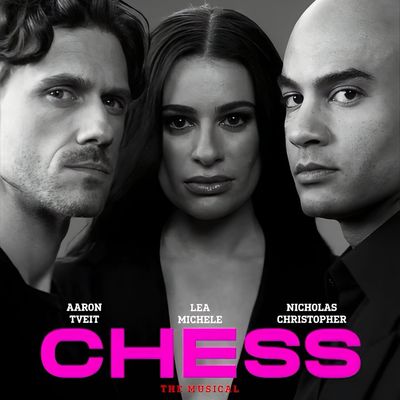
[33:45] David Armstrong: The new book, the new set, the new cast made me care more about any of it. Critic Frank Rich's New York Times review of CHESS was unnecessarily mean and dismissive of the show's creators, but not inaccurate. This brings us to the current Broadway revival of CHESS, which opened earlier this season, and of course the big event here is the cast, with Aaron Tveit as Freddie Trumper, Lea Michele as Florence Vassi, and Nicholas Christopher as Anatoly Sergevsky. And this may be controversial for some people to hear, but this cast was the least effective of the three that I've seen. They are, of course, very talented performers, but for me at least they did not create interesting characters or give dynamic star performances.
And in fact, some of Lea Michele's acting was quite weak. And musically, the show is not very exciting. I found the vocals to be very careful and safe, and perhaps this is a reaction to the criticism of what was viewed as over-singing in the original Broadway production. The show has been given an entirely new book by screenwriter Danny Strong that attempts to turn the show into sort of a Netflix Cold War spy drama. And although it is tighter and shorter than the Richard Nelson version, this new book still has much the same effect and creates many of the same problems, stopping the flow of the music for far too long and not helping to contextualize the songs in an effective way. For all of its supposed intrigue, there is very little dramatic tension, in spite of even the threat of the world coming to an end.
And again, it doesn't create enough emotional connection to the story or the characters. Really disastrous is the use of the Arbiter, who granted has always been a problematic character, but here they use him as not just the Arbiter in the story, but also the narrator and host of the entire evening and have him constantly commenting on the action and the characters and making cheap jokes throughout. It really doesn't work, even though Bryce Pinkham is doing his best to make it work. Another very weak aspect of the writing is that at the climax of the first act, Florence is pressured by both the KGB and the CIA to affect the outcome of the chess match, to basically betray Freddie. And then in the second act, that exact same event happens again, and you just feel like we saw this already in act one, why are you repeating it in act two?
The show is directed by Michael Mayer, and the staging and set design is much like an Encores! production, with a basic scaffolding bridge and the orchestra arranged on stage, none of which seems to serve any purpose in informing any aspect of the story. It's very similar in many ways to the Broadway production of Chicago, which originally came from Encores! right down to a large neon sign that flies in and out and says chess rather than Chicago. The mountain duet, again for me, was very disappointing in the way it was put on the stage and has almost no effect and indeed none of the magic that it had in the original London production or even on the concept album. The use of the ensemble was very confusing and did not help the show in my opinion.
It was hard to discern the point of dressing them in gray business suits and keeping them on stage throughout most of the show. I was later told that they used pocket handkerchiefs, blue and red, that they would switch back and forth between to help us understand whether they were voicing the thoughts and feelings of Americans or Russians, but I was watching very closely and wasn't aware of any of that. Again, they were on stage through most of the show but not all of the show and that inconsistency was also confusing. Why were they there? Why did they leave? And why did they come back? Most importantly, what was their role in the story? Again, chess's biggest problem is that both acts have to culminate in a chess game.
Here, they clearly knew that was a problem, so instead of having them sit at a table and play chess, they confusingly stood at microphones facing front and narrated the chess game without any attempt to dramatize the chess game. This was confusing and I know talking to someone who had seen the show before I did had reported to me that there was no chess game in the show. Of course, there is. The action still revolves around a chess game. They just chose not to stage it to the point where some people didn't even know it was happening. I worry that I'm sounding harsher than I perhaps ever have before on this podcast, but I was very disappointed in this production. And of course, I can't blame that all on this particular staging of the show or this particular cast because, of course, they are dealing with material that is problematic and time and time again, no matter how much revision happens, the show refuses to really work.
I know that there are many people who are enjoying this production and are thrilled to see this cast on stage and feel like it is musically exciting, but all I can say is go listen to that original concept album, hear those performances, which were then recreated in the London production, which in my mind are definitive. Am I refusing to appreciate something new because I have such strong connection to the show from the past? Maybe, but I don't think so. I just don't believe that this production or perhaps any production can make this show fully work for two reasons. Number one, because it was originally conceived as a concept album where it works very, very well. But each time they try to fill in the plot and fill out the characters, the show loses impact.
It's a musical event. And by adding these book scenes, you suck the air out of it. Unfortunately, the musical event is not dramatic, so it doesn't really take hold on stage. And this brings us back to what I see as the original fatal flaw of chess, which is that it is indeed about a chess game. How can it not be? That's the concept for it. But ultimately, you have to put a chess game on stage twice in this case, and it just cannot work. Interestingly, there's another musical about a chess game that's just about to open off Broadway called The Opening, and we'll see if they somehow are able to solve this problem. So my suggestion is, is if you are interested in the musical chess, you may want to go see this production, but you will be best served by sitting in a chair, putting on your headphones, and listening to the original concept album.
Before I go, I just want to acknowledge that I'm indebted to the website Chess the Musical for much of the information and the quotes that I used in this episode, and also to Bob Avian's terrific book, Dancin' Man. Broadway Nation is written and produced by me, David Armstrong. Special thanks to Pals Mox, who helps me with editing many of the episodes, and to everyone at the Broadway Podcast Network.
[41:28] ♪ Musical number: "Knowing Me, Knowing You" — performed by Lea Michele ♪
[42:42] David Armstrong: If you love this podcast and would like to delve even deeper into the world of Broadway musicals, I invite you to become a patron of Broadway Nation. For as little as seven dollars a month, you can receive access to a whole world of exclusive features, including new original episodes not available anywhere else, including a five-part series on the Broadway musicals that receive the Pulitzer Prize for Drama. And all patrons will receive on-air shout-outs and acknowledgements in recognition of your vital support. To join, simply go to broadwaynationpodcast.supercast.tech. That's all one word, broadwaynationpodcast, s-u-p-e-r-c-a-s-t.tech, or simply click the link in the show notes to this episode. Broadway Nation is written and produced by me, David Armstrong. Special thanks to Pals Mox for his help with editing this episode, and to the entire team at the Broadway Podcast Network.
© Broadway Podcast Network, All Rights Reserved