

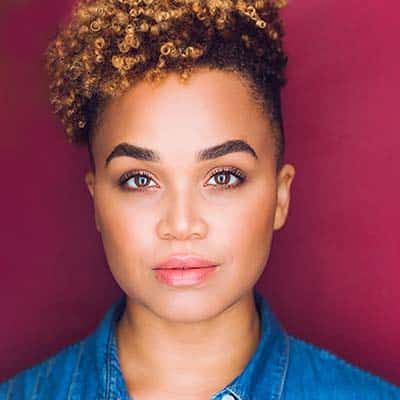
Can now be seen starring as Alpha Smith in the Broadway premier of the Louis Armstrong bio musical, A WONDERFUL WORLD. You also know Kim from being the longest tenured Nabulungi in BOOK OF MORMON Broadway. Instagram: @kim.exum... Read More
From the show: Built For The Stage Podcast
Guests
Featured Shows

About
Can now be seen starring as Alpha Smith in the Broadway premier of the Louis Armstrong bio musical, A WONDERFUL WORLD. You also know Kim from being the longest tenured Nabulungi in BOOK OF MORMON Broadway.
Instagram: @kim.exum
To try a free Broadway Fitness program from Built for the Stage, go to
Transcript
This transcript was automatically generated and might contain errors.
[0:00] Joe Rosko: Hey, what's going on? Welcome to Built For The Stage Podcast. This is Joe Roscoe, founder and host of Built For The Stage, Broadway's number one fitness platform with clients in over 20 Broadway shows, clients on the West End, Tokyo Disney, Australia, collegiate theaters across the country. We are your one-stop shop for all things theater and fitness. Check us out at BuiltForTheStage.com if you want to try a free Broadway fitness program via an interactive fitness app. All right, let's get on to our special guest. Super grateful that our guest is joining us because they're in the midst of preview craziness. Lots of changes going on and changes are not always busy times when you're about to open a show on Broadway.
Our guest is currently in previews for A Wonderful World, the Louis Armstrong musical. But you actually recently just saw them in the Book of Mormon. Our guest plays Alpha Smith, one of Louis Armstrong's wives. And I'm super excited to jump in like that angle of how the story is told. So without further ado, please welcome to the podcast, Kim Exum. Hi, Kim.
[1:27] Kim Exum: Hello.
[1:28] Joe Rosko: Thank you so much for being on the podcast. I know that, yeah, wild time. So can't wait to jump into that. But yeah, so what has a day in a life been looking like? Do you have rehearsals pretty much every day before previews? Or what's that been like so far?
[1:44] Kim Exum: Um, so yes. So for me, I have a daughter and every morning we have to wake up and go to school. So yeah, okay. Yeah. So waking up at like seven o'clock, getting her ready for school, taking her to school, and then coming back, sleeping a little bit or going overs and stuff. And then I'm having rehearsal around noon, and then a show around eight. And then it repeats.
[2:18] Joe Rosko: Well, how old is your daughter?
[2:20] Kim Exum: She's six.
[2:22] Joe Rosko: Six. Okay. So yeah, even busier at times. Wow.
[2:26] Kim Exum: Yes. Thank you. Thank you even more for being on the show right now. I'm sure a minute to yourself is hard to come by. So yeah, thank you for that. So okay, yeah, you were saying before we hit record that it was January, you said what 29th you had recently left this year, September, like September,
[2:45] Kim Exum: yeah, September 29. Yeah. So how long were you with Book of Mormon?
[2:52] Kim Exum: I my first show with Mormon was actually election day of 2016. Okay, that was my first show with the Book of Mormon circle full circle. And I was there covering the actual novel and get the time her name was Nikki Renee Daniels. I was covering her maternity leave. And then so I covered that I went to the tour for a little bit. And then I came back to Broadway in August of 20. Wait. Yeah, I left for the tour in August 2017. And then I came back to Mormon on Broadway in August 2018. Yes.
[3:34] Joe Rosko: Got it. Yeah. Okay. So yeah, long stint there. What a ridiculously funny show. What was that like? Stepping up on that stage, doing this show for that long? Did? Did it ever seem normal? Or did you just night in and night out be like, I can't believe the absurdity going on right now?
[3:50] Kim Exum: It becomes normal until you see like a five year old sitting in the front row. And then actually, like, towards my last show, my daughter came to see the show because she wanted she'd never seen it. And that's when things you're like, you're the absurdity is amplified, because you forget that there are certain images and words that are said that become so normal to me. But then I'm like, Oh, my gosh, there is a little kid hearing FU God and all these other different things. So it kind of becomes normal. But then there's some things that snap you back into the reality of how outrageous it really is. The first time I saw the show, I was on the West End. And there's a mom and a dad with a daughter.
And you could tell the boy sitting by her was like a boyfriend. It was teenagers. And it was like one of those things where they didn't know what they were getting into. So it was enjoyable to see the show, but also like keep an eye on them and see like the cringe going on from the parents and then like the uneasiness of like the daughter and all that. So it was a whole other like show within a show. But um, okay, so we're on a totally different show. For prepping this, like, what kind of research did you do about Alpha Smith?
[5:21] Kim Exum: I did some of my own just their stories aren't told enough, or at least like in the blatant, like public eye of the history of Louis Armstrong. So what was that like getting to dive into this woman's life?
[5:34] Kim Exum: It was interesting, because there really isn't that much literature out there about her. She kind of like pops in and pops out. So in some ways, it was frustrating, because some of the other wives have a lot more to grasp on to their recordings of them talking or playing music, or there's just more of a history there. Whereas Alpha is just a little more, I guess, obscure in that way. So in some ways, it was cool to learn like what she actually did and to imagine her motivations behind these things. And in other ways, it's like I had to make it up.
[6:20] Joe Rosko: Yeah. Yeah, I was looking, when I was reading up, it was just like, you see, I don't know if it was a marriage certificate or some type of recording. And that's kind of how it was like, oh, he got married again. Or is that how that kind of went down? Or?
[6:39] Kim Exum: Well, she actually, so he was married to his second wife, Lil Hardin, who was a musician. And they were living in Chicago. And there was this young lady who was Alpha, who used to come to the shows, and she was a big fan. And I guess she befriended Louis, and he would come back to her apartment, where her mother lives, and they would cook for him and make him feel right at home. And he felt super at home there. And then he ended up leaving Lil, who in real life, I believe, Lil was having an affair as well. So Louis and Lil, his second wife were having affairs on each other. And so he takes Alpha over to Los Angeles, he's still married to Lil. And Alpha, I believe, sued him or threatened to sue him because he promised to marry her. And then that resulted in him getting a divorce from his second wife and then marrying Alpha.
[7:32] Joe Rosko: Got it. So if we're to expect anything going into the show, is it kind of are the wives acting as narrators? Or how is that story being told about this man through the wives point of view?
[7:53] Kim Exum: So I would say that it's we're not narrators in other versions of the show that happened in the out of towns. I believe the wives were more so narrators, but I wasn't a part of those. So I can't verify exactly what that was. But you're delving into the personal life of Louis to see how the decisions he made via those relationships impacted and created the man that we know as Louis Armstrong.
[8:19] Joe Rosko: Yeah, got it. Yeah, essentially that. And you're any of your songs like ones that any of our audience would be familiar with or that were like favorites of yours or no?
[8:33] Kim Exum: Nope, not mine. You're gonna hear favorites in the show. But mine are a little more obscure. So unless you're like a super Louis Armstrong fan, like you ain't never heard of them.
[8:46] Joe Rosko: Yeah, I mean, I can I can get around that too. Because I like that the era like the crooner era, Louis Armstrong, whatever the classics of standards, Ella Fitzgerald. So when I hear a song that I've never heard from them, I dig it because you always hear the standards of like what they are known for per se, but okay, so your experience with the previews, anything crazy happened so far with you were scenes, lines, songs, anything changed last second and put you in like a tizzy of Oh, gosh, I'm about to do this?
[9:21] Kim Exum: Thankfully, like, I don't know, I've been relatively chill throughout the process as far as like getting new material and executing it. But like I had in one of my numbers, I have two songs. And in the first one, there was a whole fantasy section that is now no more. So if you came to see the show in the first week of previews, you saw something that no one else will ever see. There were also adjustments to scenes, there's all now in my second song, we just adjusted it to include a scene in the middle of the song. And that kind of changes the character. So the most interesting thing about this whole process is how a subtle change is not really that subtle unless it's like, don't say that line, or, you know, I don't know, some alteration of an actual line, changing the positioning of things, changes the intention of things, or taking something out completely changes a number.
And so you have to change with it. And I think that's been the most you as a character have to change with it. And that's been kind of the most difficult part is figuring out who I was, and then a change coming and say, Oh, okay, wait, I'm not that anymore. Let me change into something different, or then or trying to make something work that you know, is going to change. And then you finally you're like, Eureka, that works, but it's going to change. So then you have to change again.
[10:59] Joe Rosko: Yeah, understood. Understood. Yeah, it's wild. How just a show like this has been, you know, you have your workshops, or you're out of towns. But even still, when you're just weeks away from opening, things are still being changed in a very dynamic way. So yeah, crazy. All right, before we jump off of the wonderful world train here of our conversation, any like thing that why should someone come and see the show? Or what does the show represent to you? Or like, what's like on the forefront of your mind about like, this show in general?
[11:36] Kim Exum: I think that in this, this era of make America great again, and the election and all those things that are popping up, I think it'll be refreshing and grounding to see a story about America's past. And how challenging that was for people of color, and for musicians that we know and love and that represent a certain type of American this and getting beneath what that American is actually means. I think people should come out to ensure that history isn't erased. You're learning a quintessential American story that isn't all sunshine and rainbows. You're learning about a man who made it despite adversity, despite systemic racism. And women, in many ways, I think it's a, I don't want to say a feminist story, but
[12:38] Kim Exum: So a story that celebrates how women who are often put in the background are able to still contribute to the story of the man at large, the man that's in the center. I think that it's important to remind ourselves of what the history actually is, because a lot of times we look into the past like, oh, I loved how it was in the 30s and in the 40s. And it's like, wait, did we? Did we? Like when you go see Louis Armstrong, you see A WONDERFUL WORLD, you're going to see a woman who, had she had been alive during this time, would have probably been a big star. But because of the constraints during the time in which she existed, was not able to, had to hide behind the shadows of a man, had to push a man into the spotlight. So I think reminding ourselves of the richness of our history, and how that includes all of these, I guess, negative things, I think that adds to our character as people and as Americans at large. So, yeah.
[13:43] Joe Rosko: Yeah, we always have just the Hollywood version of things and like, the glitz and glam. But when you actually dive into what was going on, it's a whole different world. Okay, so, okay, first, can't wait to see the show. I'll be back into this in the city in January. So I'll be hopping in. Then when's your official opening?
[14:06] Kim Exum: November 11.
[14:07] Joe Rosko: November 11. Okay, great. So yeah, about 12 ish days away.
[14:13] Kim Exum: Mm hmm.
[14:15] Kim Exum: It's gonna be great. I can't wait. It's gonna be great. All right. So let's, yeah, let's hop off the Wonderful World train. Let's get into who is Kim Exum. Where are you originally from, Kim?
[14:26] Kim Exum: I'm from Baltimore, Maryland.
[14:29] Joe Rosko: Baltimore. Yeah, nice. Okay, great. And then arts are like, a part of your life from the jump? Or when did that all happen?
[14:37] Kim Exum: Hell no, no. So my mom always made me do extracurricular activities. When I was coming up, I wasn't really into sports. Like, I never did like a team sport or anything like that. I was a little late as early. But I used to swim. So I swam and swam and swam until they were like, okay, you're at the point where you should join a swim team. So I was like 12, I think. And we were going around to different teams. And they gave my mommy information of when I was supposed to swim or the days during the week. And my biggest concern was like, getting my hair done. I hated getting my hair washed. So I was like, I don't know if this is for me. Like, I don't want to get my hair washed three, four times a week, or have to wear braids or something like that.
And so she was like, all right, well, you got to do something. So a cousin of ours who was an adult, he used to do shows at this community theater. And he was like, oh, there's this youth theater thing. And my mom was like, so you either can go do the swimming, or you got to do the theater, but you got to pick one. I was like, I'll just do like the play or whatever. And so I did the play and I didn't like it. I hated it. And then I did the second one that was in the package that she paid for and I was it was okay. And then there was like one that you auditioned for and I auditioned for it and I got in it and I was like, huh, all right. And then we did it and I started making friends and then the rest is history. Then I just kept doing it. And then I didn't discover that I actually wanted to do it as a career until like late in high school.
[16:24] Joe Rosko: Wow. So late in high school. So you, did you go, you went to college for, for performing for theater?
[16:30] Kim Exum: Yes. I went to VCU, Virginia Commonwealth University for theater performance. So just an acting program. I got a BFA there. My parents weren't really into it, but I'm a very insistent person, very stubborn. And when I get my mind on something, I'm doing it. So I did it and got the loans and all that stuff.
[16:58] Joe Rosko: Yeah. Okay. Okay. So you go to VCU, do you, after graduation, do you hop straight to New York or what was like your trajectory like after college?
[17:05] Kim Exum: So I always wanted to end up in New York, even before I wanted to be an actor. I loved New York City. My grandfather used to live in Edgewater, New Jersey. So we would visit and come to the parade and all that. And I loved it when I was little. So my goal was always to come to New York. So after I graduated, I didn't have any money of course. And I didn't know how to move to another state, but I was like, I'm moving, I'm moving. And a friend of mine who also graduated with me that December. So we walked in May. I stayed in Richmond on a friend's couch because I was like, I move into New York and I'm not signing a lease. So I stayed on the couch. And I remember she called me one day and was like, Hey, my older cousin did a, is doing a job in Atlanta.
He needs a sublet. Do you want to sublet this apartment from him? I was like, all right. She was like, that's it. I was like, yeah, when, when is it? And she was like, we're going to move in December at the end of December. I was like, all right, bet. So I got my little thousand dollars for my job. I was working at a restaurant called Texas Day Brazil at the time. And then I was like, all right, I'm moving to New York. Let me tell everybody what's going down. And then we moved up here in the middle of a blizzard. And that was it.
[18:31] Joe Rosko: Okay. So you moved to New York. Do they roll out the red carpet and you make your Broadway debut or tell us a little bit about that. I'm sure the trials and tribulations of getting to that debut part.
[18:37] Kim Exum: I moved to New York in the middle of the winter. So it was, I mean, in real, it was real winter still back then. It's like 2010. So the, I remember this, it was like never ending snow. It was snow one day and it was snow another day. The snow was so high that apparently like people were, I don't know if they were suing the New York, the city, or they were, they were pretty much because Bloomberg was the mayor then. And they were, people were upset because ambulances and vehicles couldn't get through Brooklyn because they didn't have time to like pay the streets. Like that's how wintery it was. It sucked. And I didn't really like it. I was like, wait, this is not the New York I had in my mind, but I was like, let me just stick it out.
I missed Richmond where I went to school so much. And I was like, let me stick it out. I started going to auditions and open calls, figured out that theater is, it matters where you went to school. You know, everybody went to these schools. I never heard of Michigan. I heard of maybe Carnegie Mellon. I heard of Juilliard and stuff, but I never heard of Michigan, never heard of all these other places that people talking about. And it really hard to get my foot in the door. I got an agent, which is great because we did have a showcase. So I had an agent and I just started hitting the pavement and then working in restaurants and I worked in restaurants until about, I guess, oh, I got a theater works tour.
I remember that I got a theater works tour in 2011. That's how I got my equity card, which is like a children's tour. And then, oh, I did a regional gig, Nymph, rest in peace, they don't exist anymore, but the Nymph Festival. And yeah, so I did gigs here and there while waiting tables and catering and cleaning houses. And then I got Mormon in 2016, which is six years later. So yeah.
[20:36] Joe Rosko: Yeah. Okay. So was there ever a time where you're doing the catering or the nannying or doing a children's show tour or any time within those five, six years where you're like, this ain't it, I'm going to do something else?
[20:46] Kim Exum: There was a point in time where I got, so my agent dropped me and I was in the middle of a shift and an assistant actually called me, which sucked. And I had a polyp on my left vocal cord that I just found out about from waiting tables because I worked in a sports bar. So I was really kind of like depressed and I was like, I'm quitting. I'm not auditioning anymore. I'm done. So I just was done. And then a casting director, Jason Stiers, contacted me and said that there was a cruise ship that wanted to see me. And I was like, whatever. And I went and I booked it. And that's how I restarted my engine, I guess. I forgot about that ship. So the ship happened in 2014 and that was a pivotal moment. But yeah, I quit in quotes for like six months. But I didn't know what else I was going to do. I was just kind of chilling and waiting the tables and collecting the tips.
[22:12] Joe Rosko: Yeah. How about rewinding to the going, going to school matters. How when you in your spirit or heart knew like, I belong wherever in some show, but this seems to be a wall set up for me to have to hurdle over that isn't even legit, like doesn't really matter. But if in this political game, it does. How were you mentally like, just, hey, I just got to keep showing up, my time will come, my time will come. What was that like?
[22:57] Kim Exum: Um, it was it was difficult. I think even now, it's still difficult, because it always matters. It's like if you go to a school that matters in quotes matters, then it always kind of matters because it begets more opportunity. So you're coming into New York and no one's heard of you. No one's heard of your school. None of their none of the people casting have really heard of your school. And they're saying you're too green, you're too this. And in a lot of ways, I didn't necessarily have the tools I needed to go into this industry, because I didn't go to one of those schools. Like I had acting training, which is great. But yeah, you know, people from Telsey casting didn't come to my school and evaluate what I'm doing.
You know, the top casting directors didn't come to my senior showcase. My talent wasn't crafted in a way that was necessarily like consumer friendly, like right off the bat. So that was challenging, because it felt like some secret code, like someone says you're green, and you don't really know that is because like you just cast somebody who's 18 from Michigan, but I guess they're not green because they went to Michigan, which is great. Those kids are talented, you know? No, I understood. But it's, in many ways, it was kind of like trying to crack the code. And even now, I mean, now it's easier, of course, because I have a broad, I've done a Broadway show. And now I'm doing a new one. So hopefully that makes more opportunities.
But there's a whole network in those schools that I don't have access to. So I've had to like, you know, create my own and just really be persistent and try and be confident in what it is that I have, as opposed to comparing what I have or what I don't have to those who do have it.
[25:00] Joe Rosko: Yeah. Okay. So any like, college kids or maybe younger kids that have your experience? Is there any other type of like, advice you would give them if they're in a similar situation?
[25:06] Kim Exum: Um, I would say, you've got to know what you want to do. Because in going to a smaller school, they weren't confident that we could come here and could
[25:16] Kim Exum: They were very vocal about that, which I understand because if we're being realistic, we're not. I was not equipped to come here and compete with somebody who's in dance classes and vocal lessons and all that stuff and is being trained to be a competitor in the New York market and is coming here with contacts and maybe a heavy hitting agent. So in a lot of ways, I get why they said that. But personally, I knew that this was an option for me. I don't know how I knew it. I didn't know how. I knew that I was going to get to where I wanted to get, but I knew. And I had doubts a lot of the time, but there was still this voice in me that was like, just keep going. It's going to happen, you know. So if you know, you know, you know, and follow that voice that's telling you that you can do it and keep pushing through.
[26:17] Joe Rosko: Okay, so if you went to school where it was primarily just an acting track, what did you do once you got to New York as far as like the singing or the dancing? You obviously put work in, so what what? Yeah, how did how did you start that process?
[26:36] Kim Exum: Well, thankfully, I could sing and I knew that I could sing. So I just started singing. So I had to get like we had like one little musical theater class. It was like a semester or was it two semesters? I think it might have been a semester of a musical theater elective class. But yeah, I went to the auditions because the thing was, is that once you get to New York, you realize that all the auditions for the most part are for musicals. There are play auditions, but not as many. And then with plays, it's also so much more niche because you're dealing with like an ensemble of five. Is there a woman in it that fits my age range? Or is there a person of my race in the same? So it gets very, very small.
And then on top of that, you start discovering that the industry only thinks that some people can do plays. So unless you went to Juilliard or Yale, because even if you went to Michigan Musical Theater, you that's not they don't know. So that's an even smaller sect of people. So I'm like, let me just audition for musicals. So I was doing the singing. And then I realized I didn't really have any audition technique. So I took classes at like Actors Connection, I did the Growing Studio. And then dance, I used to like, go to Ailey at least two times, maybe one to two times a week, trying to do three to do classes. And that was interesting, because like I started at BBC, I didn't really like the culture there, because I'm not like a dancer dancer, and it felt intimidating.
So I went, I went to Steps, and I went to Ailey, and I tried to dance more, while still auditioning. So I kind of like the deficits I had in my education, I tried to make up for once I got here. But thankfully, I had a strong foundation in like storytelling, which is where acting training has been really important in my success. Because even if I can't hit the step, at least I can tell a little story.
[28:47] Joe Rosko: Yeah. Okay, last, to be respectful with your time last question. So we just had Lily Thomas on the podcast, who's going to be Miss Mazepa in Gypsy. She's also a mother, and we've had lots of actresses who are mothers on the podcast. So I just love to always ask this question, because there's new moms in the industry, you know, coming up all the time. And I think that you all have a very tight and unique and special group of you, I guess. So I just like to open up with like, I guess you're if your daughter's six, you had her around 2018 or something like that. Okay, so how's that experience been from then until now? And the navigation of how do you make it work? And yeah, I just other new moms popping in my head right now that I think would love just hearing your experience.
[30:01] Kim Exum: It was hard. I am not married, which is different than being married. And I got pregnant unexpectedly, which is different than being pregnant expectedly. So when I found out I was pregnant, I was still doing Mormon on Broadway. And I knew that I had the tour coming up. And so I did not tell the company because I was afraid that they would take the tour from me. And I needed the tour because I needed the money because I knew eventually I would have to leave. So once I got to tour, I told company management there and I was so afraid. I felt like I was like a 13 year old or something, you know, meanwhile, I'm in my late 20s. But I felt like everybody would be disappointed in me and they would chastise me.
And now thinking back, that's totally like, why would anyone do that? But that's what I thought. They were the complete opposite. They were so warm, welcoming, understanding, embraced the fact that they were all going to have a new baby, you know, as a company. They informed the Broadway company, they sent me Amazon gift cards and gift baskets. And I mean, it was just a huge outpouring of love at the Book of Mormon just across the board. The creatives, I remember in D.C. and like Stephen Remus and Casey Nicholaw, they came to see us in D.C. and they knew, but the company, the cast didn't know yet. So they're just like, oh, my goodness, like, this is so exciting. And it felt really good to have that type of care and love being like formed around me by the people who I work for.
When I had the baby, it was difficult because you don't get, we don't have any paid maternity leave just industry wide. So unless you were planning for the baby, or you're just really, really good with money, you're kind of asked out, you know, you get on unemployment. So it was a lot of budgeting. And then at the time, I thought I was going to go back to the tour of Book of Mormon. So I was prepping to take this baby on the road, because this is my only option. And thankfully, Mormon came through and was like, we would love to have you back on Broadway. So they were really instrumental in making my pregnancy a lot more seamless than I thought it would be. Even when we like post pandemic pressing to negotiate for more funds on behalf of the fact that like, I'm parenting my daughter primarily a look like, you know, in my in the house alone, her father's very, very, very, very much involved.
But as far as, you know, her being in the house with me and me having to produce these funds, they were, they were very receptive with that as well and taking care of me and the village surrounding me in taking care of my kid. And I got really lucky in regards to that. So I guess my advice would be lean on the people around you. I know not every Broadway company has the resources that Mormon has. But I do believe that there are good people in this business who will rally around you and form community. And I don't think that this business should be a deterrent to start a family. In all things, you know, again, that little voice in the back of my head told me that it's all it's gonna be okay. You know, like, just have the baby, she's gonna be great.
I need to know who she is. And as is, once she's out, everything's gonna be okay. So, so far, things have been working out. But yeah, you just kind of gotta hustle, trust the people around you that you that love you, that they're gonna love your baby just as much as they love you. Let people help you take your kid, I've taken her to auditions, my friends have sat with her.
[34:09] Joe Rosko: I was gonna ask if she is she taking after mom? Is she a little actress over there?
[34:13] Kim Exum: I don't know. She does a little bit of stage fright. I tried to get her to do a cabaret and she was like, I'm too scared. Maybe wait till I'm seven. But, but she loves the theater. Like, I would take her to Mormon on Fridays, and they would call it as the Fridays. And she would go all around the building to say hi. And this is from when she was like a little a little baby to a toddler. So and even in a wonderful world, I've had to bring her in to the rehearsal space. And she sits in the theater at tech. And there's another wonderful mother there named Jenny Harney Fleming. She has two girls. And so being more open, I think with the fact that you have a kid, and because you have a kid, you have different needs, I think really makes a difference. So like having another mother there has made it easier for me to say, hey, my kids sick, can I bring them in and stage management has been like, okay, you know.
[35:08] Joe Rosko: So yeah, long winded way to say.
[35:10] Kim Exum: No, no, that's awesome. That's awesome. I wonder if there I know there's a I don't know if they still are active. There was like a Broadway babysitters group called Broadway babysitters. And it was primarily a babysitting run group for moms on Broadway. But I wonder if there's any other like, I don't know, like, fraternity or sorority, whatever you would say, like, we have a group on Facebook called Baby Mamas. And so they're like, we'll, we'll swap items or bait or sitters or information like that. But yeah, that's probably the hardest part was to find childcare. So I had a good friend who's also in the industry helped me find a nanny who's also an actor. But Sarah, our nanny has been great.
So like throughout the tech process, like she picks up from school and brings her home and takes her activities and cooks and all that. But yeah, I think like, if you're gonna have a family in this business, like you have to have people you trust. And, and we are in an industry where even though there's lots of things like wrong with it, when we really get down to the nitty gritty of having casts and like building bonds, like we have the luxury and the privilege of being able to form like tight bonds. Yeah, you know, the business side isn't always the greatest, but as far as the heartbeat of the people in the community. Yeah, most of the time, you could always be counting on some good people to cross your path.
[36:47] Joe Rosko: Oh, for sure. Some of the best people I've met in my entire life have been in the Broadway community or the theatrical, theatrical community.
[36:51] Kim Exum: Yeah, absolutely. All right, Kim, thank you so much for being on the podcast, giving us your time during this crazy busy window of time as you're prepping to open on November 11.
[37:04] Joe Rosko: Yeah, November 11. All right. Well, okay, everyone, go run to a wonderful world. Go see Kim and the rest of the cast in in their show coming up November 11. Thanks, Kim.
[37:12] Kim Exum: Thank you. Bye.
[37:20] Joe Rosko: All right, that was Kim Exum from the cast of a wonderful world where she plays Alpha Smith. Super excited to go see the show. And yeah, Kim was awesome. Make sure you support her. We're going to put her Instagram handle in the description of the episode. So give her a follow. And yeah, see what she has going on as she dives into this new show on Broadway. I'm Joe Rosko with Built for the Stage. Actors are athletes. Train like one.
© Broadway Podcast Network, All Rights Reserved