

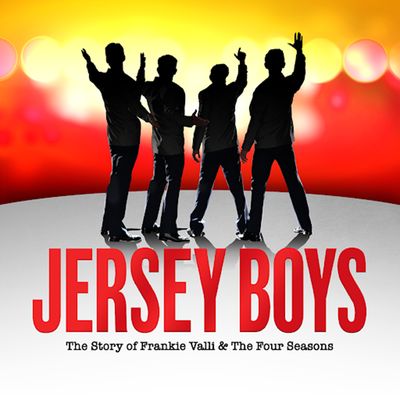
JERSEY BOYS. COMPOSER: Bob Gaudio. LYRICIST: Bob Crewe. BOOK: Marshall Brickman, Rick Elice. DIRECTOR: Des McAnuff. CHOREOGRAPHER: Sergio Trujillo. PRINCIPLE CAST: Christian Hoff (Tommy), Daniel Reichard (Bob), John Lloyd Young (Frankie) OPENING DATE: Nov 06, 2005... Read More
From the show: Fifty Key Stage Musicals: The Podcast
Guests

Featured Shows
About
JERSEY BOYS
COMPOSER: Bob Gaudio
LYRICIST: Bob Crewe
BOOK: Marshall Brickman, Rick Elice
DIRECTOR: Des McAnuff
CHOREOGRAPHER: Sergio Trujillo
PRINCIPLE CAST: Christian Hoff (Tommy), Daniel Reichard (Bob), John Lloyd Young (Frankie)
OPENING DATE: Nov 06, 2005
CLOSING DATE: Jan 15, 2017
PERFORMANCES: 4,642
SYNOPSIS: The rise and fall of The Four Seasons, a real-life band that dominated the 1960s music scene, is told through rotating narrators, who all offer their own theories as to why the band succeeded and subsequently dissolved.
The early 2000s saw an onslaught of failed jukebox musicals which aimed to capitalize on the disposable income of former rock fans by luring them to the theatre with familiar songs. Jersey Boys was successful because it tells the true, engrossing story of the Four Seasons and juxtaposes the violence of the narrative against the sterile, cherry tunes for which the band was known. Rick Elice examines how contradicting stories from the three living band members lent the show a multi-perspective narrative frame. The show set the standard for jukebox musicals which tell the story of the artists behind the music and led a fleet of such shows to Broadway for decades such as Beautiful and Tina.
Rick Elice co-wrote Jersey Boys (winner 2006 Tony Award, 2007 Grammy Award and 2009 Olivier Award for Best Musical) with Marshall Brickman. His play, Peter and the Starcatcher, received nine 2012 Tony Award nominations (including two for Rick) and won five, more than any play of the season. It’s currently playing in New York and on tour across North America. Also on Broadway, Elice wrote The Addams Family (with Marshall Brickman, music and lyrics by Andrew Lippa), currently touring North America, with productions in Europe and South America. In 2014, the Old Globe Theatre in San Diego presented the world premiere of his new musical, Dog and Pony (music and lyrics by Michael Patrick Walker). Rick is currently writing a musical for Disney Theatricals with Benj Pasek and Justin Paul, based on the film Make Believe, and Super Fly (co-written with Seth Zvi Rosenfeld), directed and choreographed by modern dance legend, Bill T. Jones. Heartfelt thanks to those whose work in the theatre makes him grateful for the day he was born: Sondheim, Stoppard, Bennett, Prince, Fosse, Robbins, Nichols, Tune, Nunn, Laurents, Stone, Kushner, Taymor, Papp, Schumacher, Schneider, Coyne, Brickman, Timbers and Rees. Rick thinks about them a lot. He never thought about Jersey much. He does now.
SOURCES
Jersey Boys, Original Cast Recording. Decca Records (2005)
Jersey Boys starring Erich Bergen and John Lloyd Young, directed by Clint Eastwood. Warner Brothers (2014)
Jersey Boys: The Story of Frankie Valli & The Four Seasons by David Cote, published by Broadway (2007)
Transcript
This transcript was automatically generated and might contain errors.
[0:08] Robert W. Schneider: Hi, I'm Robert W. Schneider and welcome to Fifty Key Stage Musicals: The Podcast, a companion piece to the Routledge Press publication, Fifty Key Stage Musicals, which is available for purchase by going to Routledge.com or clicking the link below in today's show description.
[0:23] Robert W. Schneider: Today's episode focuses on chapter 45, the 2005 production of JERSEY BOYS.
[0:29] Robert W. Schneider: And with us today is Rick Elice, co-author of JERSEY BOYS.
[0:33] Robert W. Schneider: Rick co-wrote JERSEY BOYS with Marshall Brickman, which was the winner of the 2006 Tony Award for Best Musical and the 2009 Olivier Award for Best Musical.
[0:42] Robert W. Schneider: His other credits include Peter and the Starcatcher, The Addams Family, The Share Show, My Very Own British Invasion, and is currently working on an adaptation of The Princess Bride.
[0:52] Robert W. Schneider: He holds an MFA from Yale and was a teaching fellow at Harvard.
[0:56] Robert W. Schneider: Rick, thank you so much for joining us today.
[0:58] Robert W. Schneider: Rick, how did you go from Sereno Coin to becoming a book writer?
[1:04] Rick Elice: You may be surprised to know that I didn't spring fully formed the day I started working as a copywriter. I actually, um, I actually, uh, was born here in New York City. Um, born and bred New Yorker. Uh, my parents courted and married, uh, here as well. And so they used to go to the theater a lot. Uh, this, of course, was when you could go to the theater for 90 cents. And, um, which believe it or not, uh, you could do until about 1971. Uh, and, uh, so you know, when my brother and I came along, uh, my parents started taking us to the theater when we were little kids. So I saw my first Broadway show when I was three, uh, My Fair Lady, at the Mark Hellinger Theater, now the Times Square Church.
Um, and, uh, my mother said it was the first time in my long three-year life that I had ever actually shut up. So, um, so she thought, oh well, a theater ticket at 90 cents was probably less than 90 cents back then. Um, a theater ticket was cheaper than a babysitter. So she would take me to the theater, put me in my seat, and then, you know, I think she would go and do some shopping and come back and pick me up at the end of the show. And, um, she started doing that a lot. So I started to see a lot of theater. I grew up loving the theater, thinking that it was, you know, everything that I wanted to be part of in my life. And, uh, and then I auditioned at a ridiculously young age for the Yale School of Drama, now the David Geffen School of Drama.
Uh, but it was actually called the Yale School of Drama in those days. And it was, uh, improbably, um, somewhat impossibly, I was accepted into the class with no resume or acting experience. Um, uh, and I so I went through the Yale program for three years and got my master's degree from, uh, Yale, and came, you know, and came back to my hometown, New York, uh, with my love of Broadway, now paired with my love of the classics and of all aspects of theater writing.
[3:17] Rick Elice: So I earned my living for a while before I started at Sereno Coin. I was earning my living just barely as an actor here in New York, um, acting and singing and dancing, and, uh, not having to wait tables, I'm proud to say, although I would have if I had to, but, um, I was mysteriously asked to, uh, at the opening night of a musical about the Red Baron, the German flying ace in World War I, uh, written by this, uh, written and directed by this crazy, uh, talented Canadian guy named Des McAnuff that Joe Papp produced at the Public Theater. And, uh, I was in that cast, and, uh, on opening night I was standing next to the food buffet, uh, on one side, and on the other side, the guy who handled the advertising for the Public Theater named Matthew Sereno, and we were just chatting while we were waiting for the pasta to become available, and, uh, he thought I was amusing.
And it turned out that his, um, partner and creative director, uh, Nancy Coyne, was away on holiday and he needed some funny headlines. And so he said, um, do you, uh, would you like to write some funny headlines for me? And I said, I can't write funny headlines, I'm an actor. And, uh, he said, well, oh, oh, that's too bad, because I would pay you $100. Now, I was making $149 at the Public Theater, 149 dollars a week plus an extra $20 because I was the dance captain. But I would have, you know, I would have, uh, you know, I would have, uh, hammered nails if it was another $20. I mean, it's hard to live, even then, it was hard to live in New York on 149 dollars a week. And, um, I stayed at the advertising agency for 20 years, eventually becoming the creative director and an equity holder in the company and all of that.
And we grew that company, uh, you know, over those years, um, to become, you know, sort of a big player on the theater marketing scene, which was, you know, a great delight and challenge. And I worked on 310 musicals. So it wasn't out of the blue that I was intrigued when the phone rang in 2002, uh, Mama Mia having just opened on Broadway, with, uh, somebody from the music business who had been a client of mine when I was in advertising, um, to say, I have the rights to the Four Seasons catalog. The, I have the rights to the Four Seasons music, um, is what he said. And, uh, you know, do you think you would have any interest in writing a show about it? And I said, well, I love Vivaldi, but do you really think that there's a whole musical in there?
And he said, no, you schmuck, not the Four Seasons, the music for the Vivaldi, the Four Seasons, the group, the Four Seasons, Frankie Valli and the Four Seasons. And I said, oh, the guy with the high voice. And he said, yeah. And I said, well, what, why? He said, well, Mama Mia is so successful. I said, yeah, but somebody already did that. But, you know, there's a great herding instinct amongst the producers on Broadway. And, um, you know, so he thought, you know, we'll do the same thing, but with the Four Seasons music. And I said, it's not really, that's not actually very interesting to me. And then he said the magic, one of the two magic things, you know, the most important magic thing a producer ever says is the one word, yes, one syllable.
But the second most important thing is, would you be willing to have lunch? Because, you know, if you work in the theater and you have no money, um, it's every now and then you can get a free meal from somebody to talk about something. One never turns down a free meal. So, um, he said, would you be willing to have lunch with Frankie Valli and, uh, Bob Gaudio, the principal songwriter of the group and one of the original, um, quartet? And I said, can I bring, can I bring my, can I bring a friend? And he said, sure. So I called my poker buddy, uh, Mr. Brickman, the legendary Academy Award-winning screenwriter, Marshall Brickman. Um, we had been flirting with the idea for a couple of years of writing something together, which we both, I guess, assumed would be a screenplay.
But I called him and I said, how would you like to write a Broadway musical? He said, I've never written a Broadway musical. I said, neither have I. But, um, what's the worst that can happen is we'll waste our time, but maybe we'll have some fun. Anyway, meanwhile, he's a big music guy. So I said, you know, you'll get to have lunch with Frankie Valli and Bob Gaudio. So the two of us went skeptically to this lunch.
[3:57] Rick Elice: And, uh, while we were waiting for the, uh, you know, I, which we had on at the back of a dark restaurant on 46th Street, and, uh, while we were waiting for the Caesar salad to arrive, um, we said, so what was it like to be you growing up in, you know, in JERSEY? And they started just throwing us all these, I guess, what you would now call anecdotes, but of course, you know, they were just answering the question. And what they, and there was Marshall and there was me, and, uh, we both started doing what audiences do when they start hearing a good story, or 10 or 20, which is lean forward and get real interested. And, uh, by the time the food came, we said, guys, you know, forget the fictional story with, uh, um, soundtrack, which was the Mamma Mia gag.
Um, what about doing a, you know, what about this? What about what you're telling us now? And they said, oh, well, yeah, but we don't want it to be like Guys and Dolls, we don't want to be like cartoon characters in a Broadway show. And we said, well, suppose we don't write you as cartoon characters. It was just so interesting. You know, The Sopranos was very big on television then. They were talking about ties to the mob, they were talking about pressure from the mafia, and they were talking about, you know, how hard it was to be that, to sort of navigate those shark-infested waters when they were growing up, um, and still want to be musicians, how hard it was to get out of their neighborhood, um, you know, which you could only do if you joined the army or if you got, uh, mobbed up, or if you, you know, became a Frank Sinatra or Bruce Springsteen, you know, those were the two guys from JERSEY that I knew, you know, and they said, well, we were actually, you know, between Sinatra and Bruce Springsteen, there was us, and, uh, and we wanted to make something of ourselves, and the only way that we had open to us was not gonna be through education, because that wasn't an issue, and it was not gonna be, um, a war because there wasn't one.
Um, so how were they gonna get out? They were gonna get out by becoming musicians. And, uh, we thought, well, we've hit, I mean, Marshall, who was an actual writer at the time, and me who was just sort of there sniffing around, I thought, well, this is like the mother load. And Marshall said, yeah, this is, you know, those movie posters that say based on a true story. Well, this wasn't just based on a true story, it's based on a good story. And it was not just a good story, but it's an untold story because these guys, these guys did not have the cultural elite in Manhattan behind them. You know, they, they weren't written about like the Beatles were, because they didn't come from across the ocean and they didn't have long hair and exotic accents.
They came from across the river and they looked the way they looked, and they were sort of like downmarket in the eyes of the people in Manhattan who wrote magazines and who published them. So they, they just weren't considered worthy, and so they were never written about. So here was a true story, a good story, and an untold story.
[11:31] Rick Elice: So we said, that's what we'd like to do. And they, because they had no risk, um, said, you go ahead, knock yourselves out. You know, write something so that we can get an idea whether we want to be in business with you. So we did, and they liked what we did, and then they said, now what do we do? And because I had done, I had led the life that I'd led with at the ad agency, I said, well, you know, these are, we have to find a producer, and these are the people that we should go to, and this is the order that we should go to them in.
[12:00] Rick Elice: And um, uh, and uh Marshall and I took a, you know, a CD of their songs and some and a couple of scenes that we wrote and uh and shopped it until the Dodgers, bless their hearts, said, Oh, yeah, these guys sold 125 million records to people who now are right in the sweet spot of the people who buy tickets to the theater. So, sure.
[12:27] Rick Elice: Um, who would you like to direct it? Well, I remembered this guy from 1982, the great, you know, Des Mackinoff, who um, you know, whose subsequent Broadway musicals um and plays I had done the advertising for. So Des was Des was never not on my radar.
[12:46] Rick Elice: And I knew from my time, you know, on the Red Baron musical that he was really sort of, he wanted to be a rocker and he had rock and roll inclinations. And best of all, he had been at one time an actual member of the Dodgers. So he um he seemed like a great person to go to, especially because at that time, it now being 2003, um he was the artistic director of the La Jolla Playhouse and had been for some time. And it's always it's great to find a director who's also the producer of a theater, you know, because he can he could say, as in fact, Des did say, um, oh, I love the four seasons. The first LP I ever had when I was a kid growing up outside of Toronto was Sherry and 11 other hits by the four seasons.
[13:35] Rick Elice: I uh do you think you could have this show written in a couple of months? Because I have a slot this coming summer, and meaning the uh the summer of 2004. So we said, sure, yeah, we can write it in no time. And because we didn't know that you were you're not supposed to be able to do that. So um, so we did. Uh we did. We wrote it and uh we had auditions that spring, and to which hardly anyone came because everyone thought a musical about Frankie Valley in the four seasons, that just sounded daft. Um so uh we had auditions here in New York, and Des had auditions out in California with actors that some actors that he knew, uh principally someone who had been in Tommy for him in in '92.
[14:24] Rick Elice: And uh the next thing, and and then he called us and said, Okay, I you're gonna have to trust me. I I there was no money to be flying back and forth for auditions or anything like that. There was no Zoom in those days. So um uh, you know, you'll have to trust me, and we did, and we came out in the summer of 2004 to La Jolla Playhouse with our little suitcase and our little typewriter and our yellow legal pads, and um, and showed up at rehearsal. The very first time we ever heard the script to JERSEY BOYS allowed, uh, was the first day of rehearsals at the La Jolla Playhouse, um, which is not your listeners should understand, which is not the way it usually happens, and not the way it's ever happened since. But again, because Des had ran the theater and we had the slot, we it's just the way it happened with JERSEY BOYS.
[15:19] Rick Elice: And a couple of questions for you, going back a little bit. Do you remember what you and uh Marshall wrote that you turned into the uh the four seasons? Was it an act? Was it a scene integrating song? Do you remember what you turned into them to make them say, yeah, we want to go forward? It was a treatment of um, it was a treatment, I guess it was a treatment for a musical, and uh there was a lot of stuff in there that was just uh not what Des was interested in.
[15:51] Rick Elice: Um, but there was a long section in it uh which was written which went into the show pretty much verbatim and is still performed in the show the way we originally wrote it, which is the again uncommon for a Broadway musical. But in the in act two, there's uh you know, like a 15-minute scene, uh, the sit-down, we call it, which is you know, where the group is in trouble with the mob and uh and there has to be a negotiation between the big mob boss, Gyp DeCarlo, who was sort of their protector, uh, and uh and a Brooklyn mob guy um who was looking to uh for some uh comfort uh because the band had run up a tremendous debt.
[16:33] Rick Elice: And uh we wrote that as a scene because of course we the songs uh appeared in the show uh in in essentially chronological order, uh, because it was the story of the band coming together. The show opens um with music that's not four seasons music until the actual quartet is formed about 40 minutes into the show, and then suddenly this barrage of hits comes, which is faithful to pretty much what happened to them in 1962. Um in act two, we start playing with the chronology of the music a little bit so that the songs could um comment on the action of the story, but there was no song to function the way a book number works in a musical, uh, in uh in terms of driving the plot.
[17:20] Rick Elice: So we had this very large long scene uh that Bob and Frankie loved and that uh and that uh and Des made the sort of the vocal point of the second act. And um uh and uh so yes, there was a the the largest part of what we submitted to them as kind of a spec treatment um ended uh you know ended up in the show almost verbatim wow okay and so then when it became time when it came time for you and Marshall to start writing this yeah was it this moment happened to them let's see a song from their catalog that can fit that emotional moment or was it here's a song what's the scene that we can write around that particular song or was it a mixture of both?
[18:09] Rick Elice: No it was neither we wrote we wrote this really as a play the because because about four guys who made something if they made automobile tires um the the the score might have been the same but it would have been less impactful uh because the thing that these four guys made were records the uh the records uh asserted themselves um by way of following the story but we we wrote we wrote the show as a play and in each scene that we wrote each moment that we wrote little scenelets or little split scenes there was there was a s there was a song or songs that could have been um nominated for each you know to keep the keep the key to keep music being the um uh engine of the story um uh and we uh tried to be cunning in terms of our selections of which songs appear appeared where but the songs did not, we never said, Oh, well, you have this song, let's write a scene around the song that that wasn't our process.
[19:21] Rick Elice: We wrote a play with songs, and uh and that kind of hadn't really been done. You know, the so I think that's why people were rolling their eyes at the expectation of a show, the show that we were writing, because this pejorative term jukebox musicals had come into fashion. Uh little sidebar. The jukebox musical is a is a misnomer. Um there were jukebox musicals before there were jukeboxes. Jukeboxes came in around 1937. Not that I've looked this up or anything, but um, you know, uh the uh the idea of taking popular songs and uh inserting them into other vehicles to repopularize them was uh was uh older than 1937.
[20:13] Rick Elice: I mean, the you know, the Follies did that, the Ziegfeld Follies did that, the the scandals in the 20s did that. Uh Irving Berlin built the music box theater still running on 45th Street in New York, specifically to house the music box reviews because Irving Berlin wasn't just a composer, he was his own publisher, and he thought, oh, well, you know, the show that I, you know, and his his money was made by selling sheet music to his songs in the 20s, you know.
[20:42] Rick Elice: And um, and he he the songs would become popular in shows, but the shows would run for two months, and then the song's popularity would wane. And he said, Well, you know, I I want to sell more sheet music, so I'm gonna create other shows, other vehicles for these songs, so that these songs are constantly being heard by audiences, and I can sell some um uh some uh sheet music. And then he said, and and it worked with the music box reviews worked, and um, and he said, Oh, you know, I'm gonna go out to Hollywood and do this on a much larger scale.
[21:15] Rick Elice: And so he invented the film version of the jukebox musical, Holiday Inn, I'm thinking, you know, everyone's idea, everyone, everyone's favorite musical, movie musical, um, singing in the rain, was in fact a jukebox musical. Uh Arthur Freed, who was the producer of the film, and his uh and uh and Herb Brown, his uh his um uh songwriting partner had written these songs decades earlier, summoned Comden and Green out to Hollywood to work with Gene Kelly and Stanley Donan, who had already come out from Broadway to Hollywood to say, hey guys, here are these songs, here's our trunk, listen to all these songs, come up with a story, singing in the rain.
[21:59] Rick Elice: And um, so nobody nobody ever talked down singing in the rain because it was a jukebox musical. Suddenly in 2004, everybody or 2003, the run up to our show, everybody was doing it because it it was sort of like the it was the the hook of of pejorative reviews, you know, um, demonstrating creative bankruptcy, I guess, you know, and um, but it's actually more like walking into a museum and saying, Oh God, not another rectangular painting.
[22:29] Rick Elice: Yeah, you know, that you the attacking an entire genre. I, you know, are there comedies that are so funny you piss yourself? Yes. Are there comedies where you don't crack a smile? Yes. Are there war movies that make you want to run out and enlist? Of course. Are there war movies that put you to sleep? Yes. Uh there's there are examples of genius in most genres, and there are examples sadly, of failure in in genres too. Nobody sets out to fail, but you know, yes, you take your shot, but to say to make these sweeping judgments like jukebox musicals are a plague on the, you know, on the creative act is I, in my view, absurd.
[23:11] Rick Elice: Uh, but I suppose that prejudice uh gave us a chance while working in a basement in San Diego to work so far under the radar that nobody nobody cared, nobody paid any attention. So uh Des and the rest of us were able to craft a show. I mean, nobody, including by the way, Bob Gaudio and Frankie Valley, who kept arm's length from the from the production because, of course, if it sucked, they wanted to be able to say, well, we had nothing to do with it.
[23:47] Rick Elice: Yes. Um, you know, we came so we came into the La Jolla Playhouse with this show that nobody really paid attention to or thought about for even a second. And then people started to, you know, people started to come and enjoy it and, uh, and go nuts for it. And so word came back, it was never, it was never something that there was never any hype about it. The reality is what came back east. Was there a moment in that basement where you thought to yourself, oh wow, we really have something here? You know, I should say that, uh, it didn't matter what I thought because, uh, because I had no, I all I had was my own opinion, you know. I mean, yes, it seemed to be the first day that they read it was the first day that we heard it, and people were laughing at the laughs and they were, you know, we were listening to the music and it was like, oh, this is, this was, this two hours flew by.
I mean, I knew that I felt that way. I knew that, um, I knew that as Des put it together up on its feet, I knew that there were some real great goosebump moments in it, which you always want your share of. Um, but of course, when an audience comes, the audience is collectively the smartest person in any room. So we didn't really, I didn't allow myself to think anything in terms of success. I just thought, you know, let's see what happens when an audience comes and the, from the first audience onward, the, you know, the reaction of the audience to the show was so, um, enthusiastic and, um, not just their response in real time to the show, but the next day at the box office suddenly they, you know, there were all these people buying tickets again and, you know, their actions speak louder than words and the actions of those audiences, we very quickly started to see people coming back and back and back as we, you know, stood in the lobby of the theater.
We would recognize people coming, usually men, usually bringing different women, and we thought that was when I thought as a marketing guy that was when I thought, oh, we may have hit a nerve here, which is a very, uh, a very different kind of audience, you know, an audience mostly of guys who were who want to show this show to the women in their lives because it was sort of a sexy thing for them to do.
[26:28] Rick Elice: And, um, and that was especially interesting to me as somebody who, um, appreciated what a difficult niche that is to reach in terms of musical theater. Did the show change a lot in, uh, from previews in San Diego to eventually what got to Broadway? It's this is a shocking answer because things do change and should, um, as you get the information from the smartest person in the room, an audience coming. I mean, you know, I remember standing in the back of a play that Neil Simon wrote, uh, and he had his yellow pad and he was making notes and making notes, and you know, me, the young idiot came over and said, um, what, why what are you doing? And he said, uh, you know, I, you're Neil Simon. Like, aren't you?
And he said, if you had the chance to take a test every day until you finally got an A plus, wouldn't you, wouldn't you just keep working? And I thought, I felt like such an idiot, you know, because there was the great Neil Simon like saying, yeah, well, rewriting. Many years later, Arthur Lawrence, the great, um, uh, you know, uh, librettist, uh, and screenwriter said to me, writing in the theater really is rewriting. So we were prepared. I was prepared. I mean, I came out there really with, you know, one shirt, one pair of pants, a couple of changes of underwear, and a suitcase full of pads. I mean, writing pads. And, uh, and, uh, but the audience, yeah, we kept waiting. We kept going to Des saying, well, what do you think about they said, well, it's, you know, you wait for the audience to identify the parts that you need to change.
And, um, and the audience wasn't demanding change. The audience was demanding seats to come back and see it again the next day. Okay, great. So the show that opened on Broadway, there were some changes. We changed the order of a couple of things that happened in Act Two, uh, which we thought would be a more dramatic upswing to the, you know, to big climax of the second act. Um, but the show that opened on Broadway was essentially the show that played in La Jolla. It very, very rarely does that happen. But, uh, you know, and we were very, uh, we were very lucky to have that happen on our first show, Marshall and me. We were always ready to do the rewriting, but it just, it just didn't seem, uh, necessary for this particular show.
[29:02] Rick Elice: Did you have to get the approval of each of the living members of the Four Seasons? Or did you? Nick Massey, the bass of the group, had passed away in 2000. Um, Tommy DeVito, uh, who was the sort of like the guy who put the group together in the first place, you know, the various groups that Frankie and he were in before the Four Seasons came to be. Um, uh, we spoke to him, we interviewed him. Um, but, uh, Bob and Frankie had already made a deal with him for his life rights. So it was Bob and Frankie's, uh, uh, approval and, uh, uh, of everything that, uh, that, uh, that we needed. And, um, and sometimes they gave it wholeheartedly, and sometimes it was a real negotiation. They, they were able, they had the contractual right to insist, uh, on things, but generally speaking because the four of us got along, I mean, Marshall and me and Bob and Frankie got along, um, we were able to negotiate pretty much, uh, with them on the, on some various things.
But there were, there were a couple of things that really bothered, um, that really bothered them, um, but those were addressed before we, uh, went into rehearsal in La Jolla. And if you don't mind my asking, what were some of those things that bothered? Well, because they, because they, because we were doing a musical biography, they, they generally bought it, generally bothered them if things that we wrote involved people who are still alive and, um, who didn't ask to be represented in a show. So, um, uh, so I'm not going to tell you what they were because that would defeat the whole purpose of, of their asking that they not be included, um, in the, in the presentation of the show. But, but no, but nothing that puts them per se in a negative light.
It's protecting other people. Oh no, no, no, they were happy. They were very happy with the works and all approach that we pitched them as long as they didn't come off as cartoons. Yeah, and they didn't feel that they were cartoons. I mean, you know, because, uh, from the, from the beginning the four guys who portrayed them in La Jolla, three of whom came to, uh, to do it, uh, in New York, um, you know, they played it with real, um, with real chops and real gusto and, and, um, and real truth. So their, their fear, uh, their, or their apprehension, I should say, not their fear, uh, because they're pretty fearless guys, but they, you know, they were apprehensive about how they would be portrayed, um, and if they would, if they would sort of be caricatures of, you know, sort of the JERSEY cliché, but they, uh, because they weren't, um, they, uh, they didn't have objections like that.
It was really just to, it was really just in terms of, um, other people who were not part of the group and, um, and out of respect for their request, we, uh, we fictionalized some, some things, um, because after all we're not telling a documentary, um, we're telling a story. And, uh, in some cases, uh, we made some choices, uh, that, um, telescoped, uh, several people who were in their real life into a single character or created a character who represented somebody that they preferred we not actually include, uh, from real life and, uh, and some chronological events, uh, in terms of the history of the group. Uh, but, uh, those were the only, those are the only, uh, um, those are the only things that they, uh, wanted us to, uh, to change.
[32:57] Rick Elice: And would you talk a little bit about your collaboration with Marshall Brickman? Uh, how does your collaboration work and what do you bring to the table and what does he bring to the table? Um, well, Marshall, uh, is a, uh, older, somewhat older than me and has lived a, you know, a very, very, uh, um, colorful and impressive artistic life, um, musically and, uh, literarily. Um, the principal creative relationship in his, in his filmmaking career, um, was, uh, as a collaborator with, uh, with someone else, Woody Allen. Um, and so collaborating was something that he understood in his bones and I, being someone who didn't have any experience as writing anything longer than 30 seconds or 60 seconds, the longest thing I ever wrote at the, at the ad agency was a, you know, three-minute movie trailer.
But, you know, to write a whole show, I thought, well, okay, uh, let's see how this is gonna work. And what I learned from Marshall is that, you know, you, uh, a show is something, a story is something that you can talk into existence. You can talk to yourself, but it's more gratifying to be able to talk to someone else because you get someone else's point of view. And, uh, our collaboration, uh, began, uh, it was sort of two-phased. The first phase was we were functioning sort of as, um, journalists. We, and, you know, so we, because we were writing about real live people about whom, um, there was a lot of information to read. So we read as much as we could and, um, watched as much as we could from, you know, American Bandstand shows that, you know, we were off, we, we trucked off to the Museum of Television and Radio and spent an afternoon there looking at old things, old clips and stuff, and spoke to them, Bob and Frankie many, many, many, many, many, many hours, um, at Tommy DeVito for several hours, um, getting the, you know, general information what life was like in that neighborhood, uh, narrowing, irising in on, you know, what specifically was it like that day in the studio, what, what did this person say?
What did you argue about? You know, how, how did it actually work? Where were you standing even? So that we really got an idea. That was the journalist phase. Then we swapped hats and became, went into the dramatist phase, and that was when we started talking with each other.
[35:44] Rick Elice: We would take very long walks in Central Park, because we live in both of us live in Manhattan. Um, we would take long walks in the park and sort of argue back and forth what's what the progression of scenes could be, because we had a thousand disparate anecdotes, right? So we needed to invent principle of inclusion, principle of exclusion, organizing principle, which informs both of those things. What was the organizing principle going to be? Well, we're gonna tell it in four acts. Uh, it's very handy that it's called the four seasons. There's four seasons, Mother Nature has given us those two. So we're going to assign a privileged relationship between each member of the band and the audience.
Usually, a play or a story has a single narrator, usually, not all the time, but usually, and that single narrator has the privileged relationship with the audience, and therefore the audience assumes that everything that that voice tells us is the true way things actually happened. What we learned from talking with Bob and Frankie and Tommy and Bob Crewe and other people who knew the group was that we would hear different versions of the same event from different people. And sometimes we hear different versions of the same event from the same person. And we found that to be very intriguing. And for a while we asked ourselves, well, who's actually going to be telling the how do we know what really happened?
It was Tommy DeVito who said to us on the phone, oh, don't pay any attention to what Bob and Frankie said. I'll tell you what really happened. And that was the light bulb moment for us because it was like, oh, wait a minute, we don't need to decide. We ought to decide. We should present a character that the audience believes. And then we should have another character step forward and say, Don't listen to him, I'll tell you what really happened. And then a third one who says, Don't listen to either of them, I'll tell you what really happened. And then end with Frankie because Frankie's the front man. And Frankie says, Here's my version. And that way would present sort of a Roschimon idea on stage, which we thought was an exciting way to structure the play.
And because of Mother Nature, we thought, okay, well, Tommy who puts the group together, there's sort of the birth of the band. Tommy will become the narrator for the first act, spring, and Bob, who was the person who was added to the quartet, at which point they became successful. That would be sort of the blossoming of the group, which would be summer. Um, then Nikki, who was the, you know, we posited would be, you know, the person who would sort of preside over the dissolution of the original quartet, which would be the fall of the group. And then Frankie, the winter of Frankie's discontent, as it were, you know, I because I think you know Shakespeare always has the answers. And we would end with Frankie.
And that would dividing the show into four acts like that would inform everything. The color palette of the show, the way the costumes were created, the way the music was presented, the way the show was lit, and we would until we gradually ended up with something that was very small and very, very personal, representing a tragic event in Frankie's life at the peak of his success. And you understand something about this guy, you understand something about these songs, a context that we never had before, right? We all had our individual contexts with the songs, if we knew them. Oh, that was the, you know, that I used to hear that, you know, when we went bowling, or I used to make out with my girlfriend in the back of the car with that playing on the radio.
But we would have a show, a story that would present what was happening with the group when these songs were coming out, which would be new information. And as we wrote that, the anecdotes that we had heard from the three of them that we needed to jettison became very clearly not necessary, and the ones that we needed to keep became clearly necessary. Um, and it was those were those long discussions and that we long walks that we took until we were finally able to write it. And we what we had, what I realized we were doing also was we were sort of voicing the characters as we talked so that when it came to actually writing, we were able to say, okay, I'll write this one, you write this one, I'll write this one, you write this one, and then we'll swap.
And eventually that's what we did. But the actual sitting down going like this with our fingers took the least amount of time. The most amount of time was talking it into existence, which is I think an important thing to understand. And it's one of the great reasons why I like doing this as opposed to writing a novel, which would be a much more solitary experience. I love the collaborative part of making theater.
[41:09] Robert W. Schneider: After JERSEY Boys opened, and it was such an artistic as well as a commercial success, there were so many other musicals that in some way tried to copy the template of what JERSEY BOYS had done. My question for you is, why do you think, what is the secret ingredient, if there is a secret ingredient that made JERSEY BOYS successful while some of these other shows were not as successful? And not necessarily the quality of the music, but is there something missing in the structure? Is there something that you gave your characters that you feel that maybe some other biomusicals do not?
[41:48] Rick Elice: Well, I mean, I don't know that that's a fair question for me to answer. I don't want to, it's not my place to criticize what other people do. Um, so I'm not gonna do that. But I what I can tell you is that I mean, I'd like to say, oh, Marshall and I were and Des were so we were so clever that we hit on the we figured out the universal. And um, and that's why JERSEY BOYS was a success. I mean, the reason that Fiddler on the Roof was the longest running musical in the world for a while wasn't because it was about Jewish people or and it wasn't about it wasn't because it was about pogroms and Jews being chased out of Europe. It was about, I believe, a kid saying to a parent, I don't care how you did it, I want to do it my way.
Because there's no one alive who hasn't at some point had that conversation or wanted to have that conversation with a parent. Because so many of us know what it's like to stand in front of somebody else and say, okay, I'm putting myself on the line here. Give me, I please give me this job. I want this job. So the audience connects with that, whether they've ever danced or not. At some point in our lives, almost everybody's been part of a group. You know, it's a band or a ball team or a cast or some, you know, a company, a think tank consortium, what have you. And these groups tend to become second families, sometimes very dysfunctional families. Sometimes the bonds are stronger than the families that we're born into.
And I think sometimes we take those families for granted, sometimes we screw them up. But the bonds in those families are like iron. And I think JERSEY BOYS tells the story of this particular band, sure. It's hard not to be touched by the, how shall I say, the eternal issues of wanting to belong, wanting to achieve, wanting to be respected, wanting to find home. And I'm nothing like these guys. You know, I grew up in New York thinking really looking down my nose at people from New Jersey, and then I met these guys, and I realized that I'm nothing like them, but I recognize what happens to them because I recognize something about my own version of what happens to them. And I find that very moving and frequently, you know, very funny too.
And the audience response from the very first day indicated that that was true for a lot of people in the audience. We hit on a universal theme, this idea of everybody's place in a group of some kind, or most people in their life experience, and male or female, people are able to respond to that in an emotional way, and I think that's what happens, that's what makes a show. When a show can hit a nerve like that, those are the shows that run for a long time.
[45:40] Robert W. Schneider: So if I can flip the question. So if I were to come to you and say, hey, I've got a catalog of someone's songs, what advice do you have for me? It sounds like find the universality. Don't just rely on the good material.
[45:53] Rick Elice: Well, I think finding the universality isn't necessarily something that you can do, or you know, it's not about the music, it's about the story. Theater is always, what's the story? Is it a good story? Are the characters compelling? And if that's the case, then go ahead and spend some time trying to crack that nut. And if the music can help you tell that story, great. If it's not a compelling story, if it's a story of someone who, you know, always wanted to be successful and then became successful, they could have the great, they can have all the great songs in the world, but if there's no conflict, you know, the theater is about story, and story is about drama, and drama is conflict. So if there's no conflict, then there's no theater. Then what you should do is you should do a concert of all these great songs, you know, and you need to have the great story, I think.
[47:00] Robert W. Schneider: Rick, thank you so much for joining us today. I cannot tell you how much I appreciate you spending time with us. Uh, listeners, please make sure to purchase a copy of 50 Key Stage Musicals by visiting Routledge.com or by clicking in today's show description. If you want to learn more about JERSEY BOYS, please also review the links in the below description. I'm Robert W. Schneider, and thank you for listening to 50 Key Stage Musicals the podcast. Bye bye.
© Broadway Podcast Network, All Rights Reserved