

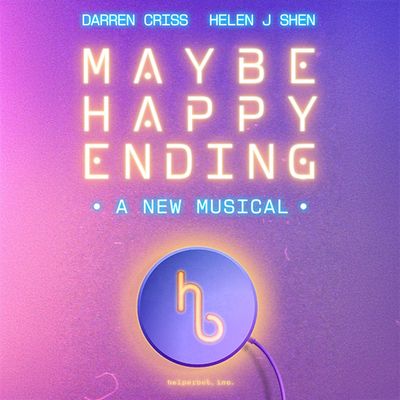
In this episode, we take you on a journey through the innovative new Broadway musical MAYBE HAPPY ENDING at the Belasco Theatre. This refreshing addition to the Great White Way features two robots exploring the depths of love and connection... Read More
From the show: Half Hour with Jeff & Richie (Post-Show Broadway Discussions and Interviews)
Guests


Featured Shows
About
In this episode, we take you on a journey through the innovative new Broadway musical MAYBE HAPPY ENDING at the Belasco Theatre. This refreshing addition to the Great White Way features two robots exploring the depths of love and connection. We dissect the unique premise, the captivating performances of Darren Criss and Helen J. Shen, and the beautiful blend of orchestral and jazz elements in the score. Our conversation delves into the show's exploration of loneliness and connection, and how Michael Arden's direction enhances the storytelling. Is this robotic romance the emotional powerhouse Broadway needs? Tune in for our thoughts on this original musical and its potential for Tony nominations.
Follow and connect with all things @HalfHourPodcast on Instagram, and YouTube. Share your thoughts with us on MAYBE HAPPY ENDING on our podcast cover post on Instagram.
Transcript
This transcript was automatically generated and might contain errors.
[0:00] Jeff Malone: Welcome to Half Hour with Jeff & Richie, the podcast where we explore the latest shows we see, sharing our insights and opinions on the performances, storylines, and everything in between. In today's episode, we're discussing the new Broadway musical MAYBE HAPPY ENDING, currently playing at the Belasco Theatre in New York City. Whether you cannot catch the show in person or you want to expand your thoughts after seeing it, this episode is free. And as always, we want to inform you that this episode will contain spoilers, so if you're ready to dive into this production, stick around with us. I'm Jeff.
[0:29] Richie Grasso: And I'm Richie, and we're thrilled to be your hosts for this episode. But before we start the conversation about MAYBE HAPPY ENDING, here are a few words from our advertisers.
[0:40] Jeff Malone: Welcome, everyone, to a new episode of Half Hour with Jeff & Richie. Today, we're discussing the Broadway production of MAYBE HAPPY ENDING. MAYBE HAPPY ENDING is the offbeat and captivating story of two outcasts near the end of their warranty who discover that even robots can be swept off their feet. Held by visionary director and Tony Award winner Michael Arden, with a dazzling scenic design by Dane Laffrey and book music and lyrics by the internationally acclaimed duo Will Aronson and Hugh Park, MAYBE HAPPY ENDING is a fresh, original musical about the small things that make any life worth living. The musical stars Emmy and Golden Globe winner Darren Criss alongside Helen J. Shen. Both you mish grads go blue. Yeah, I had to say that. Yay, go blue.
[1:25] Richie Grasso: Alrighty, so in today's episode, we're discussing the Broadway musical MAYBE HAPPY ENDING, and we're going to start it off with our hot take. My hot take on MAYBE HAPPY ENDING is this musical hit many marks for me. I found the story refreshing yet simple, and the design is beautiful, and the music in this score is something that we desperately needed on Broadway right now. So, big hot take here is we need to make this a Broadway hit musical. This was one of the best things I've seen this year. It's fresh, it's invigorating, it's exciting, it's well-crafted to a T. It's polished, it's wonderfully full of emotion. It makes you feel all the emotions, and you're living throughout this piece, and, oh my gosh, little to no flaws. I mean, truly an epic work of art that we've been craving on Broadway for so long. I'm thankful for this whole creative team for bringing this to the stage.
[2:25] Jeff Malone: Alright, let's get into this deep dive. So, we're going to get into plot and concept, right? Let's first kind of start off by discussing this unique premise of really two robots at the end of their lives finding each other, and how this kind of relates to real life versus how it just works in this piece. Well, I'm going to start by saying right away the message is not beaten over our heads like these directors like to do with narrator. We have to figure out they're robots. We have to figure out that they live across the hall, but where are their owners? Oh, one of them had a different experience with their owners than the other. What year could we be in? Well, they're talking about jazz music, but it seems like we're in a postmodern world, but I don't sit there confused at all.
I sit there learning, exploring this text as I go. When you get to the end, of course, there's spoilers here. When you get to the end, who erased it? Whose memory? It's not quite extremely beat me over the head with the message. Did they actually both erase each other's memory? Where is the owner? Where did they go? All these things are rising. You're on this roller coaster journey with them, and you're feeling it, and you're loving it. So this concept of take me through with extremely high tech scenery and lighting, and sound, and projections, and costumes, which are working so well effortlessly together. You wonder if this creative team is just so exhausted because they must have just put so much blood, sweat, and tears into this.
[3:50] Richie Grasso: Yeah. I really loved how we had to figure out the concept slightly. I loved how they are bringing in different themes of loneliness and connection. It's really the outside perspective of what humans go through with emotions. It's that inside out effect from Disney Pixar. Okay, inside out is to show us what our internal thoughts are doing. This one is showing us more about how we adapt to others and create that human experience. Robots are a blank slate when you get them, like any computer. Your phone starts learning how you use your phone. The computer starts learning how you use it. Even SEO and everything the internet figures you out as a person, and they start altering what you do. What's interesting that I found here with the robot concept here is the robots are blank, and the robots start to learn and become their humans.
We see two very different characters here because Claire is this hipster-y kind of girl which wants to learn more about love or wants to figure out how to love. Darren Criss's character, which I'm forgetting the name.
[5:23] Jeff Malone: Oliver.
[5:24] Richie Grasso: Oliver is completely different. Oliver's an old soul. Oliver loves jazz. Oliver wants to take care of his plants. Oliver doesn't want to go outside. I find that there's so much relation to what he was with his owner because maybe Oliver's owner couldn't go outside. Maybe because we find out later that he's sick, he does everything inside. It was really great to kind of see like, oh, okay, this is that, and how they then want to live after they're no longer with their owners. There's this fascinating use of orchestral and jazz music infused here in an original show, not jukebox, not the music of. I'm sorry, but I have been a proponent of all styles of music in new musicals on Broadway. Lately, it's been very rock, very folk, very country, very Americana in a lot of late shows, which is totally working for outsiders, totally working for swept away, but I don't think that needs to be every new musical.
I think Jason Robert Brown is an example of someone who puts orchestral classic sound into his pieces, but to see a new writing team on stage not writing pop rock, pop rock folk, pop rock, and give us jazz, give us orchestral, give us something different for our ears. It was beautiful. It was stunning. The score is stunning. It has to get a Tony nomination, has to. It's just stunning. I'm blown away by the beauty of it.
[6:54] Jeff Malone: And yes, Richie, to kind of go back to what you were saying earlier about concept, there is this fascinating commentary on what is technology doing to humans, what is human doing to technology, and how do different humans interact with technology? It was clear that Darren's owner used technology and ended the use of technology differently than Helen's character did, which then made them different robots and learning how to love and live and how much in the AI world that we're in can technology do and how much technology not do. There was this constant reminder throughout the whole piece that my charging is almost done. I'm almost out of life. And there's that constant reminder that our phone and our laptops and our technology will only work until the battery runs out.
You can compare that to human life. You could also totally not compare that to human life and say, well, humans are nothing like that. But in a way, we have an ending as a human on this earth, too. And what is the happy ending or the maybe happy ending? There's so much to talk about with this, the plot and the concept in general. And I feel like with the structure of this, this writing team really knew how to take this original idea, turn it into a love story, but at the same time also turn this into a musical. And I feel like we're kind of afraid to do that on stage for some reason now. So, you know, creating the narrative, creating the music that's woven throughout the piece, you know, there's a lot of repeating themes that we're hearing within the music, which I think kind of makes it cohesive.
It's very like Stephen Sondheim-esque to kind of bring that Andrew Lloyd Webber, you know, some of the greats whose musicals that we still love. This almost feels something that Stephen Sondheim would have written and put out.
[8:43] Richie Grasso: And yes, and I will say that it's also got this brilliant concept of direction as well, which we're going to talk about in a second. But I did want to kind of bring why I'm praising this actual writing because, you know, they learned how to bring you into a common space and then take you on the journey outside that many musicals do, and then bring you back to that space with many like filmic moments. And I just think that the actual message in the writing was there. And we haven't had something like this for a while. Similar to what Disney Pixar does with something like WALL-E, where you have this modern, modern world, but then there's that emphasis on those Hello, Dolly! numbers, that old soul sound. That was the same thing here, this modern, modern world with this emphasis on that old jazz sound that's warm and comforting, but didn't feel old and clunky, felt fresh.
[9:47] Jeff Malone: Yeah, you know, it definitely felt old. It definitely did not feel old. It felt fresh. And they were able to kind of take the risk, I think, here, which is why I'm praising this, and say, let's bring this to Broadway and put on a great production. I do want to dive right into some of this direction, as well as the actual performances and the design. So let's get right into that. Before we do, though, here's a few messages from those that make the show possible, and we're back. So when I was talking about the direction earlier, I think what Michael Arden does so well is he takes a script, he studies it well enough to understand what the point of that script is. He must be asking a ton of questions to make sure he understands it, and then he executes it with the design team that is on the exact same page as him.
And, you know, here's one small critique I will say about the direction. He's got a lot of small frame things going on where he's pulling focus like a filmmaker into small, which totally works. I think from a lateral perspective, it works. I'm not quite sure from a left-to-right perspective, we got to see every single detail. We were on the aisle, and we were center aisle. We weren't even way to the side, and we were pretty close to center, and I even saw some things cut off left and right. And so I will say, to realize that you do have people sitting far left and far right, we just might want to be a little bit more aware of some of the things that we're not seeing left and right.
[11:22] Richie Grasso: Well, I always find that sometimes with the direction, especially with newer directors, too. We are trying to pull focus sometimes. We are trying to shrink the stage sometimes if it feels too big. I get that. But at the same time, you have to play to a full house, and I don't always find that every time we see something, like the whole house is thought about, and you don't want so much an obstructed view when you're in a theater like the Belasco. I mean, you go up, and like anyone that I'm going to kind of go say to see this show, I think you should sit center. You can sit center maybe anywhere going up, but I would not sit on the sides. And I also think it's something to talk, like a minor critique of his directing is he sometimes does have bad moments of sightline issues.
I don't really want to see anyone prepping something behind a piece because if I can see that, we're not thinking fully about it. That means that I would say to him, like, did you only sit in the middle of the theater and not direct from the sides at all? As a director, do you only sit in the center, or do you move over? No, you float around the whole space. You've got to go upstairs, you've got to stay downstairs, you've got to go left, you've got to go right, you've got to go back, forward, you've got to go all over throughout the process. And I know maybe they'll clean some of this up because it just started, so maybe the crew backstage and everything will tighten up a little bit. But I would say, like, did he sit in our seats? And if he sat in our seats, did he say, oh yeah, I would totally want to watch it from this seat every night?
[12:35] Jeff Malone: Another thing that's part direction and kind of leads into some of the acting here is, you know, we have Darren Criss, who's brilliant in this and is just robotic so well, but also so human. It wasn't like Tin Man robotic, although it was at times. It was like Tin Man with a heart, no pun intended. He had this soul to him. That was a little interesting. And Helen was wonderful, too. What a wonderful, fresh perspective here to have someone of Helen's wonderful craftsmanship on stage performing like this. Helen wasn't as robotic as Darren, and I wonder if that was because she was a newer model robot and she didn't need to be as stiff. Maybe the stiffness of Darren was reflective of his personality and Helen's robot wasn't as stiff.
But I think it would have been nice to see a reminder once in a while that Helen does still need to be a robot. The only time I think she really felt like a robot to me was in the very beginning when she knocked at the door and froze there and he had to carry her inside to charge. Other than that, we never really saw her robotic. It almost at times felt like Darren's a robot the whole show and Helen's not. And I kind of at times have to remind myself, oh, Helen's a robot, too. And it was only a couple of times, and this is a very minor thing, because I would have liked to see a little bit, although if she was a newer model robot, maybe that was the point, was that he was an older model. That's all I could think of.
[14:01] Richie Grasso: Well, they always are talking about how as their robots, they can do more. A five can do more, but he has the whole joke that his battery's better. So yeah, the five could do more, but it drains more of the battery. Which is what we talk about with technology, I feel like in the world today, too. But I think Darren and Helen have such chemistry together. They're working so well together. Yeah, their chemistry is great. This is something that's big that we haven't seen for a while, because you totally believe that they fall in love with each other as robots, even though they kind of say robots can't fall.
[14:37] Jeff Malone: And I also want to talk a little bit about Marcus Troy was great in this. I love the song that he has with Darren when we learn about their backstory of the jazz going through the rooms of the house. Another set piece that came out of nowhere. I don't know where they're storing all this scenery backstage. Set was just in and out. It was flowing and effortless. Also, Des Doran as the jazz singer was great. And I love that reminder of that Americana jazz coming in and out. It gave us a perspective of having some sort of a jazz narration. He was a crooner up there in a very great way. And bringing that jazz sound in, bringing it in at the right times. Michael Arden really brought in some filmic moments to this piece.
I actually think that this would be a beautiful film if it was ever done. I would love to kind of talk about how he used some of the scenic design here and some directorial moments that he had. When they finally get to the Firefly Forest and they bring up that whole screen and we start seeing the fireflies. It was probably one of the most beautiful moments that I've seen on a stage in a while. We're seeing the orchestra. We're hearing the strings. We rarely hear strings written in modern shows these days. And just to hear them, you're like, oh, thank you. Thank you. Thank you. Thank you. And then to see them, you know, there was that moment because that was really their moment of like, OK, it's us. We're in love over robots. And we can't forget Wabun.
[16:15] Richie Grasso: Oh, yeah. Stealing the show, Wabun. I think that's the reminder of what Disney does when they have like an animal sidekick that doesn't talk. Or, you know, there's the reminder that we can have like plants, animals, life in our life. You know, it was a central focus. That plant went with them everywhere. You know, it was a central focus. I really enjoyed that. You know, a little thing in here kind of brings in like the whole Flubber storyline of, you know, he creates Weebo and that's like his little robot that's with him all the time. I kind of got moments of this like this is the story of the Weebo. Am I saying it right? Do you remember from Flubber? I don't remember from Flubber the exact name.
I think it was Weebo. Whatever. Someone can correct me. But we've never really had the perspective of the robot. We've always had the human perspective of what we do to robots, but we've never really had the robot perspective. So that's kind of what I found most intriguing of something like this piece, you know. And, you know, the costumes are great. The lighting design and the sound design in this piece are definitely going to be like, yeah, it's great. The special effect of the firefly flying into the house and then flying up was so cool. I'm wondering if that was like some sort of technology. You know, I don't know what that was, but that was very, very cool. Just floating through the audience.
And then they also, you know, they bring in comedy to this piece. Yes, they do very well. There was great comedic timing, especially from Helen. She for this being her first thing on Broadway, you know, I think we're really going to see her kind of move into this space, even if it's acting roles, because the comedy part of this, it was great with her. You know, she really was able to kind of get the eye rolling down, kind of like mimicking what it was like to be her owner, as we see later in the piece when they do flashbacks to when they were with their owners, she would like roll her eyes. She would be like, kind of against it. And it just like worked.
[18:28] Jeff Malone: Totally. I will say, as much as there was so much comedy, there was also a little bit of heartbreak and sadness at times too, when you find out that his owner has passed. I will also say there was one line that made me tear up and it was, I could tear up just saying it now, when Darren Criss, this character says, this is hard. I'm paraphrasing, but there was somewhere where he was sitting on the floor of his apartment. He said, are we done? Like, is our relationship done? And I'm sad or something like that. And he says, how do humans do this? Well, how do humans go through this? And I thought, oh, my gosh, that just hit me, that line, like humans go through this loss. Well, the robots are funny.
The robots are funny because they're trying to do everything that they're humans did. So the fact is they really loved each other and they wanted to be together and to go through the notion of like they're like, oh, well, should we break up now? Because that's what humans do. Not really realizing like you don't have to break up, but they thought that they needed to because that's what people do. And the impact of loss being maybe forever for them was heartfelt, which is where I would think Darren was coming with like, how do humans handle this? This is hard, you know, and it was sad. It was poignant. It was very touching. So, I mean, listen, I have very little else to say other than I think this is just an incredible work of art.
I hope this sells. We're going to talk a little bit about our experiences and some talk here in a second. So actually, let's kind of go over there and some fun facts about the show now. But first, here are a few messages from our sponsors.
[19:57] Jeff Malone: Okay, and we're back. So I'm going to say two things. Please push this show through the dead of winter to get us to Tony Awards because it needs it. It needs the Tony nominations. These got great reviews. We need to put butts in seats. We need to get people to this show. We need to get school kids to this show. We need to get elderly senior citizens. We need to get everybody to this show. It's wonderful and it needs to get to Tony Awards and then it needs to get a lot of Tony nominations and hopefully some wins because I think this just needs it, right? We need this. We want this. It's wanted.
[20:35] Richie Grasso: Totally. I mean, we could go down the list of everything that we think it would be nominated for. I mean, obviously, in the major categories, Best New Musical, Duh, Darren Criss, Best Score, Darren Criss, Scenic Design. With Helen, I think it is a tough year for leading actress. It also is a tough year for leading actor. So both of them could have a very hard time getting into the category. But what both of them are doing is totally, totally nomination worthy. But Score, the major categories, I definitely think that this could get in there. And let's hope that it gets there. Like I said, a lot of times, unfortunately, the track record tends to be shows that open in the summer and fall and then close by January don't always have the best track record of the Tonys a few months later. So you hope that this show will get through because January, February is a tough two months to sell tickets.
[21:31] Jeff Malone: Yeah. I mean, like I think anyone like if you've watched the Spring Awakening documentary, you know, it really goes to show you like how some new works are scared. You know, I want to raise a question here, and I feel like this can spark many conversations with many, but with a show so original like this, not that there's no demand for it, but how do we create a demand for this piece is where we're really going to have to start figuring this out. Because when you're in the lands of the Disney and the movies and the Jukebox musicals, and people know what they want to see because they don't need to really take a risk. This is a risk show for someone now to actually open up their wallet and say, I'm going to go see this musical. So, yes, it needs the word of mouth. It needs the buzz. One thousand percent. But does a show like this work for the not average theater goer?
[22:35] Richie Grasso: Well, it does. You have so many people heavily relying on reviews, right? There's so many people that will say, I'm going to wait till it opens. I want to see what the reviews are. I want to see how the ticket. OK, so it opened. It has great reviews. It's a new musical and it's enjoyable. So like what? So, yes, now we are up as a society. We need to be taking the risks to go see this not Wicked for the 10th time. I love Wicked for the 10th time, but go take a break from Wicked or Book of Mormon or Aladdin or something like that for a Lion King for a minute and go see this.
[23:08] Jeff Malone: Right. But I think you need to understand how when someone like we're about to enter the biggest tour season of the year. Right. OK, it's the holidays. What are people going to see? And if you're not saying maybe happy ending, then we have an issue. Right. Because if it's well, I'll go see Elf because it's the only holiday show on Broadway and I have three kids versus, oh, I'll go see Left on 10th because I like Juliana Margulies. Like this is not we can't always think like that. We need to say, oh, a new musical. I know of Darren Criss. Oh, yeah, I got. Oh, my gosh. The New York Times loved it. Great. Also, I'm going to get I'm going to go. Yeah, because if you're waiting for the reviews, it all got reviews across the board.
But I think it doesn't always matter. I think I think reviews at this point really are obsolete when it comes to this. It's like you got to get the people talking about it. You got to get the word of mouth, you know, because, you know, a big comment I saw is that reviewers have the best seats in the house. Everyone else doesn't. And one critique from some people that I've seen is that, you know, you can't sit anywhere at this show. But like the reviewers all praised it because they had the perfect sightline to watch it from. But I'm also going to say.
[24:21] Richie Grasso: There needs to be some sort of a demand now for maybe happy ending from everyone. It needs to either have a viral moment on social media. It needs to be that thing that like if you don't see this, you missed the greatest thing this season. And I don't think it has that yet. And when you did have something like, oh, Mary, come on to the scene that got the huge buzz. But that's the demand.
[24:43] Jeff Malone: It's got the demand now. So there is time for maybe happy ending.
[24:47] Richie Grasso: There is. I know. But oh, Mary had an amazing run downtown off Broadway with such a demand that was created.
[24:54] Jeff Malone: Right. That it then moved to this house in Broadway. And now it's the thing like everyone needs to see. Oh, Mary. And everyone keeps saying that. Do you know how many people still to this day say to me, I haven't seen Omer yet and I really want to see it, but I can't get a ticket because it's so expensive. Maybe happy ending needs that same.
[25:14] Richie Grasso: Yeah. Yeah. It really does. I have faith that it will. I do. We have a lot of shows closing in the next year. Water for Elephants is closing. Notebook is closing. Elf will be closing. There's a lot of things in January that will be closing back to the future will be closing. Right. So a lot of those big shows will be closing. And what will this show? These producers should sit and say, you know what, we're going to be sitting in January and February. There are shows that we can hold our own. You know, I'm pretty sure maybe happy ending did a music video, if I recall. They might have one of the songs. It definitely needs something like that, though, is what I'm saying. The Notebook did that with Joy Woods.
They put her on top of a roof. She sang the song and it had its moment. You know, people use that song now and there is a cult fan base now for the Notebook. Not that it's making any money and it's still closing, but still they had its moment. And I think that's what maybe happy ending needs as well.
[26:04] Jeff Malone: Well, we have a few fun facts about maybe happy ending. One is that the idea for maybe happy ending was sparked by a song. And creator Hugh Park was inspired after hearing Damon Albarn's Everyday Robots in a Brooklyn cafe in 2014. So love that. I love when we can find inspiration everywhere in our world. The main characters, Oliver and Claire, are designed to look like 2010s hipsters, despite being set in the future. Also loved that and got that vibe and thought that was great. And the musical style differs between the Korean and the English versions. The Korean lyrics are more poetic, while the English version aims for a more conversational tone. I could see that maybe because sometimes I hate to say it, American audiences need things spelled out for them a little more and can't be as Shakespearean maybe as they would want.
So I understand maybe. But it would be cool to see the same show with Korean lyrics. Now that you know the plot, to see how poetic that could be. It's nice to see it. I would need to know Korean probably for me to even actually get the poetic.
[27:03] Richie Grasso: I think they're actually talking in the lyrical writing. I feel like, would you say Sondheim writes poetic or conversational?
[27:11] Jeff Malone: It depends on the piece, but I think certainly poetic in a large piece of his works. Then I think with some songs, like his patter songs might be a little more conversational, like Not Getting Married Today and Company is very conversational in a way. But then there's ballads that are very poetic, of course.
[27:25] Richie Grasso: Yeah. I mean, I didn't mind the conversational tone. I think they're going to maybe better balance. I love hearing poetic lyrics in a piece. You know, but I actually find what is most interesting is like, look how long it's taken a show like this to get to Broadway from, you know, inception to now. And that's inspiring.
[27:51] Jeff Malone: It is inspiring. And I hope that this goes a long way for sure. Oh my gosh, we're just about out of time. What are your final thoughts on maybe Happy Ending on Broadway, Jeff?
[28:01] Jeff Malone: Everyone knows it already. Final thoughts are this is the moment that we need it on Broadway. And I highly recommend people going to see this. Tell your friends, go check it out. Have a good time. And I will say, while there's nothing wrong with scripts and scores being based on books, on movies, on TV shows, we can still have original concept musicals with original scores and original ideas, completely original. And sometimes I hear people say, well, it's going to be something original to Broadway. Well, it's here. It's here right now. It got amazing reviews. It's very, very, very well done. And everyone needs to go see it. So you heard it here. You heard it here. Please go see this. Please go see this.
It's beautiful. So that does wrap up our discussion for this episode. We hope you enjoyed our deep dive into maybe Happy Ending. We will share the link with the information in our description. And remember, we want to hear from you. Continue the conversation with us at half hour podcast on Instagram and let us know your thoughts on maybe Happy Ending. And if you enjoyed our show, please leave us a review. Your feedback helps us bring more theater to you. And remember, you can listen to past episodes and stay tuned for upcoming ones as well. Until next time, I'm Jeff.
[29:04] Richie Grasso: And I'm Richie saying tata for now. Bye.
© Broadway Podcast Network, All Rights Reserved