

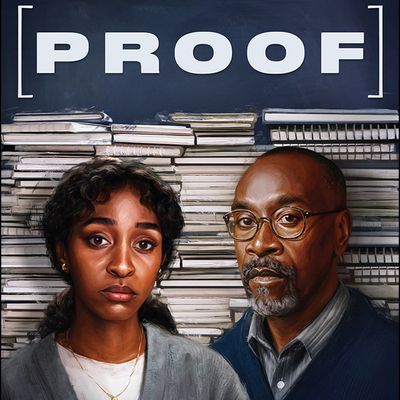
In this episode of “Half Hour”, we take a closer look at the 2026 Broadway revival of David Auburn’s Proof at the Booth Theatre, starring Ayo Edebiri and Don Cheadle in their Broadway debuts... Read More
From the show: Half Hour with Jeff & Richie (Post-Show Broadway Discussions and Interviews)
Guests


Featured Shows
About
In this episode of “Half Hour”, we take a closer look at the 2026 Broadway revival of David Auburn’s Proof at the Booth Theatre, starring Ayo Edebiri and Don Cheadle in their Broadway debuts. We walk through the play’s structure and plot, considering how this production navigates questions of genius, trust, and mental health within a family still reckoning with loss. We break down Thomas Kail’s direction, pacing, and emotional temperature of the evening, while reflecting on how the performances by Ayo Edebiri, Don Cheadle, Kara Young, and Jin Ha shape the onstage dynamics. We also discuss the set and lighting design, how the visual world supports the mathematics and memory at the heart of the play, and how revisiting the script compares to encountering this revival in performance. The conversation turns to awards prospects, with predictions for potential Tony nominations and thoughts on where this Proof fits into recent Broadway revivals. We close with creative notes we would offer the production team and cast, and what this staging suggests about the play’s future life on Broadway and beyond.
Follow and connect with all things @HalfHourPodcast on Instagram, TikTok, and YouTube. Share your thoughts on this production in the comments on Spotify, and let us know what you would like us to cover next. If you enjoy these post-show discussions, follow Half Hour and leave a rating and review so more theater lovers can find the podcast.
Transcript
This transcript was automatically generated and might contain errors.
[0:01] Jeff Malone: Welcome to Half Hour with Jeff and Richie, the podcast where we explore the latest shows we see, sharing our insights and opinions on the performance of storylines and everything in between.
[0:08] Richie Grasso: In today's episode, we're discussing the 2026 Broadway revival of Proof, playing at the Booth Theatre.
[0:13] Jeff Malone: Whether you cannot catch the show in person or you want to expand your thoughts after seeing it, this episode is for you.
[0:18] Richie Grasso: And as always, we want to inform you that this episode will contain spoilers, so if you're ready to dive into this production, stick around with us.
[0:24] Jeff Malone: I'm Jeff.
[0:27] Richie Grasso: And I'm Richie, and we're thrilled to be your hosts for today's episode.
[0:32] Jeff Malone: Welcome, everyone, to a new episode of Half Hour with Jeff and Richie. Today, we're discussing Proof.
[0:37] Richie Grasso: Emmy winner Ayo Edebiri and Golden Globe winner Don Cheadle make their long-awaited Broadway debuts in David Auburn's Pulitzer and Tony Award-winning Proof.
[0:46] Jeff Malone: Directed by Tony winner Thomas Kail of Hamilton, this landmark revival returns to Broadway for the first time, reawakening a haunting story of brilliance and erudition and belief.
[0:55] Richie Grasso: Catherine, played by Edebiri, the brilliant but restless daughter of renowned mathematics professor Robert, played by Cheadle, is thrust into turmoil when a notebook containing a revelatory proof is discovered after his death.
[1:08] Jeff Malone: As debate erupts over its true authorship, Catherine must confront the power of legacy and the cost of proving herself.
[1:15] Richie Grasso: Okay, so let's get into our overall thoughts on the plot and concept of this play, because this is both of our first time seeing this play.
[1:22] Jeff Malone: Yeah, and we've actually both read it before going into this.
[1:25] Richie Grasso: I read it this year.
[1:26] Jeff Malone: You read it this year.
[1:27] Richie Grasso: The question I was going to ask you is, when you read it, before knowing, like, a plot, or knowing the plot but not seeing a production, what were your thoughts on just not knowing the casting, per se, but just, like, reading it from the text perspective?
[1:39] Jeff Malone: I was very addicted to reading this as a play. I liked the kind of aha, wow moments as you're reading it, because you kind of don't know where it's going. I kind of also gave my own visual of what I would have imagined seeing in this play. So when we get to the production of this, I'll kind of, like, compare that. But overall, like, I really enjoyed reading it. So getting to see this on the stage was what I was very excited for.
[2:07] Richie Grasso: Yeah, and I remember in my undergraduate in theater school, we would do a lot of scenes from this play. The scene work is great. The dialogue back and forth, it's written well for that. It's a small four-person cast. So it allows for some of those scenes to kind of be developed. I think the play is well written. I think there's some cool things happening here. It kind of has this undertone of family and trust and figuring yourself out and coming of age and generations. And there's also, like, this mathematical side of it, of just, like, how that world operates. And scientists and mathematicians spending their lives working for these characters to be so book-oriented with the numbers. And yet then having difficulty with relations and the comparison and contrast of those two things is interesting to read and see here.
And I think that proof, they're constantly trying to prove themselves in the math and proving theories and proving things. But then you look at these characters and you say, were the sisters trying to prove something to each other? Were they trying to prove something to their father? Was their father trying to prove something to them? There's all this, like, proving each other theme throughout. And I think that's kind of cool with a piece like this.
[3:20] Jeff Malone: Yeah, because I feel like on a surface level, that's what we're probably supposed to do, right? Like proof, show me the proof, et cetera, that whole saying in itself. I look at this and I say, at first, I wonder where you kind of sit in a line of, do you need to know math or the idea around this whole, like, being a mathematician to kind of understand and enjoy this play?
[3:46] Richie Grasso: I don't really think so.
[3:47] Jeff Malone: No, I don't think so. But how do you kind of equal that equation now to what is happening between each one's dialogue? So there is a lot of proving that they're all trying to do.
[4:00] Richie Grasso: Yeah. And what I found, though, in this production, we'll talk about the specifics of the casting and the direction in the next segment, but I find that in this production in general, there was something off for me about the overall pacing of it. It felt like we were watching almost a staging concert one night only in terms of like, there's this set, which could have been a backdrop. It was barely used and they were just playing down in front of it the whole time. And the scenes didn't feel like there was urgency and then light and then urgency. And then it just felt like everything was just kind of moving like a slow moving train. And to me, I had some issues with like telling the story that way.
[4:41] Jeff Malone: I get it. So much of it takes place on the porch and I get it. There's not. But I wonder if for the first revival of this on Broadway, if we could have done something that had a little bit more depth of just maybe moving these characters around a little bit differently or telling this a little different. I didn't hate it. I just think that there was stuff going on here that felt like it was like the play was being pulled down by like weight instead of having this life to it. And this sense of urgency and urgency is the wrong word, because I think when I say urgency, people think, well, it doesn't need to be moving fast. I'm not saying fast. I'm saying this light sense of movement in general. It felt like at times we just sat with it.
[5:20] Richie Grasso: Yeah. And I don't know if you felt the same way with the pacing of it.
[5:23] Jeff Malone: Yeah. But I think like that would lead to a bigger question first about structure of this play. Right. So do you think this structure holds up 25 years later from its original run?
[5:37] Richie Grasso: Yes and no, because I think that it seems like the play is written in a way to mirror mathematical equation solving. Here's the problem. Here's the solution. Transactional cut, click, paste, done next. Mathematical equation. Like when you think of taking a math test, right? Like, here's the problem. Answer it. Good. It's very emotionless. It's very statistical. It's very transactional. And in this play, I think there was times where we're trying to see some of the emotional depth. And I don't think we really got there. And I think that's a mix of the play and the production.
[6:11] Jeff Malone: Yeah. I don't think the play is perfect. I think it's great in some ways, but I'm missing rooted sense of emotion. And you're going to tell a drama, especially a family drama. I think I need a little bit more of just sense of, you know, there's that mystery. Like she's not really talking to the dad in the beginning. And the audience, when they realize that he's actually passed on and that she's kind of figuring out how she's talking to him and when and where and why. But that was cool. And then that kind of didn't, you know, we don't see the father a lot in the play.
[6:40] Richie Grasso: Well, I don't think like, okay, so what I really enjoyed with reading it versus like now actually seeing it staged, I kind of like looked at the concept a little bit more about like, what are we going for here? Because when you, you know, we just saw Death of a Salesman as well. And we were talking a lot about how what is the actual like plot point here. And it's about selling. Anyone could be that person. You could talk about that like a female could be playing the role of Willie. And it still has its kind of like idea around like being a salesperson, you know. And when I look at something like this, I think this is a little bit more rooted in structurally around this being a female mathematician and them not believing her that she wrote it.
So now, you know, when that first came out 25 years ago, I'm sure a lot more people could believe like that. We would not believe a female writing this, whereas today I find it a little bit harder to connect with something like that because I don't believe that.
[7:44] Jeff Malone: Yeah, exactly. And so I think that's what's hard all these years later is like I believe her. I trust her and believe her because I think as audiences, we're kind of always starting plays with a clean slate. And like until someone proves me wrong, I think that I totally believe. Like I never thought he was stealing the journal. And then when he was stealing it, I was like, oh, or she found it. I was like, oh, but then I did still kind of trust him. But then I was like, oh, wait, maybe I don't.
[8:13] Richie Grasso: So if anything, I almost lost some trust in him a little bit more than her.
[8:18] Jeff Malone: Yeah, I think that's meant to be shown that way, that he's the one that doesn't believe her. And then the sister doesn't believe her. And like that's where you're kind of like, I don't. Why does no one believe this girl? What did she do? Because I think what I'm talking about is like they could not at that time. They could not believe that a woman would be writing a math problem. We don't believe that. You know, that's not us. That's not in our human nature here to say like, oh, no, everyone, anyone could write a proof. And there's mystery throughout all of this, similar to how there's like, I guess, mystery in math. Like there's still things that we haven't solved in science and math. And they're looming like how.
But we've also discovered so many things in that world. So there's that like feeling of like the dad's perspective on this. But I think there's this mystery around the sister coming. What's her true intentions? You realize that she wants to move out of the house. She wants to sell the house. And all Catherine's kind of feeling is that she's just losing trust in everyone since the father's past.
[9:16] Richie Grasso: Yes. And I think there's another big talking point that happens in this play that I think 25 years ago, a lot of people were not talking about mental health. And today, you know, we all are talking about mental health. And like, do you are you diagnosed with something? Do you feel something? How do you feel? Should we talk about this? And I think, you know, yeah, 25 years ago, a lot of that was not getting talked about. So I think that's like another major plot point in here that I think for us, it seems a little bit like, oh, you know, then made sense. Now, it's not as more of like a unique thing to be talking about anymore because we do talk about it constantly. But I think this is a great time to transition now into the overall production here, the direction, actor performances. And we'll do that when we get right back.
[10:07] Jeff Malone: OK, and we're back. So let's kick things off with the direction here because we have Tommy Kail directing. And what do you think?
[10:13] Richie Grasso: I mean, you know, it was Hamilton director here. Now, I mean, it's very difficult for me to believe that Tommy Kail directed Hamilton and directed the Sweeney Todd revival in those brilliant ways. And then to have directed this, I don't think this was the strongest thing. I don't need bells and whistles, per se. But it's hard for me to just see. Like I said, I feel like I'm in like a workshop setting of just we're just like doing a one night only version of this. And we're going to kind of keep it really simple and set. Like there's all this grass down in the front they barely use. There's a whole house that's barely used. Why couldn't we use more space and some more telling it? And I'm sorry for I understand there was a few costume and wig changes that probably had to happen throughout a couple of times.
But to sit in the dark and wait for a scene change to happen and just give us like a light moving on the set, which I actually thought was kind of cool. But to see the light on the set just go up and down and we're sitting there like following. You know, what's that game where the ping pong ball goes back and forth? And I feel like I'm just as an audience. We're a few hundred people sitting there just watching a light move around a set. That's what we're doing during a scene change in the dark blackout. Why did we have so many blackouts? Why couldn't we have some sort of transitional? Could have there been video footage added of like the youth or maybe we maybe we had a character come out and doing something else. I just think we could have had so much more creative flow with this than like blackout. Wait, wait, wait, wait, lights up. OK, blackout. Wait, wait. I was like, oh, this pacing is way off for me.
[11:39] Jeff Malone: I wasn't I don't think it was as strong as work.
[11:41] Richie Grasso: I would agree with that. I think that we have seen a lot of great direction this season in the play space. So to see something like this, and I agree with you, it not a park and bark kind of way because there was not singing happening on the stage. But the scene work did feel kind of like very centralized, not a lot of interaction with the set. No other like kind of movement happening without. But I would say, you know, there's not a ton of actors on the stage. It's a four person play. So I do think it makes it a little bit difficult. But, you know, we also saw a play like Becky Shaw and there was five actors in this play. They were able to do their constantly doing things. And in the scene changes as well.
I it really. Hit me in a weird way that like nothing really happened in the house. Talking about like we had this really cool scenic design of this house with the back porch, which I maybe I read this very wrong in the play. But I always thought this happened on the front porch. But we're on the back porch and and we have this house on the stage here. And we in a really cool scenic design here, like you can see through the house, which I thought was I thought it was cool. And I said, wow, something's going to happen in that house. I thought that the whole time, especially the stairs leading up to the room in the attic where the notebook was. I think we're going to see him go up there. There's going to be this light up there. We're going to see the dad working up there in a flash. Nothing theatrical with it.
[13:14] Jeff Malone: No. And for me, it's like, OK, that would have been the moment, the one moment that I could have saw them going into that house and walking up the stairs. And maybe they weren't actual stairs and that's why they couldn't walk up them. But, you know, you have Catherine and Claire on the stage and they're talking about this the morning after their father's funeral reception. And Catherine had just gave the key to how to go get this notebook out of the top drawer of the desk. That would have been the moment for me that we would have saw him walking slowly up those stairs, getting to that desk, taking it out and then coming down. I just felt very, like, empty. And that's why I feel like a lighting designer was lighting this as best as possible around.
Like, could the set have just been a backdrop? Sure. I guess it could have been. We could have just had a backdrop of a house at that point because there was no depth. It was such a lateral, two dimensional kind of left to right.
[17:08] Richie Grasso: Mindful moments of her, Catherine, speaking with her father. I didn't believe the performance that when he was dead versus when he was alive in the flashback moment that he was two different people. I think he's supposed to be a little bit more of the voice of reason for her while he is dead and speaking to her versus like when he is in reality and actually showing more of his little crazy side. And I didn't see differences between the flashback or the fantasy sequence. Right. And there needed to be a difference in that. There was moments of like he didn't let this role breathe for him. He needed to kind of like give us a little bit more. And like for both Don Cheadle and Ayo Edebiri here, I found both of them to come in too big with their punch.
Yes. And then we had nowhere to go. Nowhere to go. And Ayo, you know, I know she's done a ton of TV, but it almost felt like with Don. So when you read that Don and Ayo are making their Broadway debuts, part of me is like, okay, I don't mean to be disrespectful, but it's clear that they don't have stage experience because when you're acting for a camera and you're doing a lot of shoulder up shots or just smaller, softer speaking and things, I feel like more presenting on a stage for hundreds of people eight times a week. I lost some of her words. I found like her lines dipped at the end. I found like she was using her hands a lot. It was just this, she had this paranoid energy to her the whole time.
It couldn't, I wanted her to breathe a couple of times and just take a second. But then there was this also this like sad energy to her. And I get that, but I don't think Catherine needs to be sad the whole play. No. I didn't think that in the flashback scenes that there was as much joyous youthfulness. I just, it just wasn't going where I thought it could have gone. I wasn't quite there with her performance. My issue with her portrayal is that while I read it versus what I saw is that I got the vibe that I'm not really supposed to think that she could write the proof. And the way that Ayo kind of made me believe is that right away I'm supposed to believe that she wrote the proof. And I think that's the difference here.
Why I think the play was so strong at its time is like, I don't think we're supposed to think right away that she wrote it. I think we're supposed to, like the buildup here is that like we're always hearing about the dad. We're hearing about the dad that he's a mathematician and that, you know, his student is looking for his work and that he wrote the proof. To have this moment then be like, aha, no, his daughter wrote it. That this kind of went and was passed on to her. And that I didn't get from this performance because I found way too early on that. I'm like, oh no, she's already telling me that she's smarter than we think. And that she wrote this. And that's why I feel like we didn't go anywhere with the plot.
Yes. The audience had a few like moments that you're in there if they didn't really know the plot, but I just felt like we were at times. I felt like the four of them were, oh, not the whole time, but at times we're in four different plays. Yeah. And one is doing this dramatic performance and one is kind of not dramatic enough. And then one is, it just didn't feel connected. Like I almost wanted them to have another week in the rehearsal room. Maybe like it maybe felt rushed. Um, it just, and I didn't hate it. I thought there was some nice things going on. It's strong writing. It's strong performance of some of those lines at times. It just, and it didn't seem cohesive. It seemed like everyone working on the play in different ways, including the designers.
Yeah. All right. Well, let's take another quick break. And when we get back, we're going to move into our own questions about the show. What we think is going to happen at this year's Tony's and our closing half minute segment.
[20:54] Richie Grasso: Okay. And we're back. So let's kick things off with our Tony predictions for this show. How do you think this is going to do on your end? I think I could maybe see Ayo getting nominated. She is carrying the show a lot. Um, I don't know if I see a win for her, but I think they could maybe give her a nomination. I think Kara Young could get a supporting role nomination, no doubt, and maybe even win it. Um, yep. I, I don't see this getting design much, maybe lighting nomination. I don't see this getting a director nomination. If, if I remember being really upset and shocked when Tommy Kail didn't even get nominated for Sweeney Todd and I was like, whoa, what? So I don't even know if I see it. We always talk about this around direction.
I think it's a harder category to get in because I mean this compared to last year with the musical stack season, this is the play season of Broadway that like it is full of new plays and revival. So yeah, I agree. I don't know if he's necessarily going to be nominated for this. Could this be up for revival? Sure. And I can see that there's a lot of things up for revival right now. You know, when you kind of look at the reviews of this, it did get mixed reviews and I don't think our kind of like critiques and thoughts are far off from what the reviewers are saying as well. It, it was a, for me, a little bit more of a hyped up play coming back saying like, Oh, proof is coming. Everyone loved proof when it come out.
Ayo is going to be in it. Don Cheadle is going to be in it. And, uh, Tommy Kail is going to direct. Tommy Kail is going to direct. So like already we were surrounding the names. This is also like the bear season on Broadway. Like last year was succession. Now we get the bear. So, and I think, you know, that's getting people to come out in the droves. We also saw Dog Day Afternoon and people were there, you know, her cast members are on that stage as well. So when I look at that, I'm saying it is working in the sense that, you know, this is a commercial grab in a way that people are going to go and see it, but I don't know if it necessarily had the right intent right away. Like, I think it's still missing something on like, why did we bring Proof back to the stage in 2026?
Right. No, it's a good point. And then it makes you wonder, is it a, is it another play with star studded cash grabs sort of things for producers? Cause it was a play that was successful so long ago. You look at something like Othello last year, that was going to be, it was a big cash grab for them and then didn't even get really honored much in the Tony. So that this, we get really full of plays at this time of year. And I know we're trying to fill theaters and slots and put revivals. But you know, it's another topic of around like maybe producers and people don't even care about the Tonys for this. It's another limited run production that is just, you know, putting something out on the stage and it's selling.
So at the end of the day, I don't think anyone's complaining about that because it's, it's working in that way. So, you know, and like for a final question before we kind of wrap up here and we do our half minute segment, do you kind of see this revival as it making you want to revisit Proof as a script or the film or anything? Or are you kind of just like, fine?
[24:07] Richie Grasso: I think I'm just fine. There's been a film adaptation. It won a lot on the original. I think the scenes work for scene studies and just like seeing well-written two-person dialogue. A lot of plays are written like that too. This just seems fine. And of course there's room for everything on Broadway. I always say that it's not like this couldn't have come back. I just thought I just had higher expectations and higher hopes for it. So to kind of answer that, I'm like, yep, I'm good. Like this was not the worst thing I ever saw. It was nice in ways, but I also, I'm not sitting and raving about it either. Yeah. You know? What about you?
[24:41] Jeff Malone: I, I actually probably would revisit it in the, I probably want to watch the film now and just kind of see and get another perspective on like, maybe this is just not aged well as a play as we all were kind of hyping it up to be around, you know? But I did enjoy reading the play. So that's why I would go back and watch the film probably just to see kind of like what's going on there. Totally. Oh my gosh. We're out of time. Ready for our half minute segment. This is when we spend 30 seconds each talking about what we would say to the cast and creative team of the show if we had 30 seconds to talk to them. So should I go first?
[25:12] Jeff Malone: Sure. Okay. Ready? All right. So if you had 30 seconds alone with the creative team, what note or compliment would you give them? Go. I would say to the creative team, proud of you all for doing the work. It's obviously difficult to put these big pieces on and work really hard as you all do. I would have preferred, you know, one critic critique I would give is I would prefer it a little more cohesive work together. I would have preferred the designers, the director and the cast working a little bit more collaboratively together instead of feeling like the lighting designer came in and lit the set. The set's there. It's not being used. We're staging it down center most of the time. The actors are kind of in different worlds. It didn't feel as cohesive as I would have liked, but I applaud you all for working as hard as you do.
[26:01] Richie Grasso: All right. There we go. So same question to you. For 30 seconds, if you could say anything to the cast and creative team of Proof and go. For 30 seconds, if I was to give you a critique or comment on here, I would harp mainly on transitions. I think that there are so much that you can be doing when it comes to transitions that is also kind of giving us more of a moment to breathe throughout the piece or something to think about that's happening within the show. And as transitions are happening, I also would say to the cast, like, take a moment to breathe and let what's getting and let what's being said be the moment.
[26:48] Jeff Malone: Awesome. Yeah. Really cool stuff. Really, really cool stuff. Final thoughts on Proof on Broadway. Listen, I think this might be the love or hate play revival of the season. Maybe I think many people are going to go see it and say, well, that was really great. And others are going to say, oh, you know why? And the why could just be that we wanted to have a revival of Proof on Broadway. And I would say definitely go check it out. I think there's great work that is still happening on the stage. I highly applaud Kara Young because I love her so much and she is one of our greatest talents of this generation. So, yeah, that would be my big reason to go check. My big reason definitely is to go see Kara Young, even though she's a supporting role in this, and I'm also waiting for the day that we're saying that Kara Young is the leading role in this because I feel like she's doing so many supporting roles in so many shows, which is great.
I want to see her lead a play one day. She's coming back to Broadway next year. She's already announced another show. So, but that would be the reason for me to go see it. And a pretty well written play overall with some cool moments. Also, can Kara Young sing? Because if she can, I want to see her in a musical.
[27:50] Richie Grasso: Yeah, right, right. Exactly. Or like put her in a movie or something. I love her. Definitely. All right. Well, that does wrap up our discussion for this episode. We hope you enjoyed our deep dive into Proof. Remember, we want to hear from you. Continue the conversation with us on Instagram and TikTok at Half Hour Podcast, and drop us a comment on Spotify and let us know your thoughts on Proof. Please also leave us a review. Your reviews mean so much to us. And remember to subscribe to our channel for all past and future episodes. Until next time, I'm Jeff.
[28:13] Richie Grasso: And I'm Richie saying ta-ta for now. Bye.
© Broadway Podcast Network, All Rights Reserved