

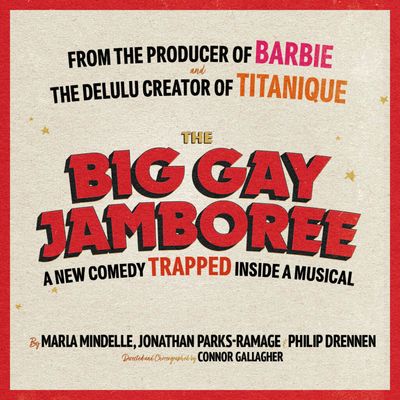
Step into the glittery world of off-Broadway with Jeff and Richie as they unpack "The Big Gay Jamboree" at the Orpheum Theater! This week, we're trapped in a 1940s musical extravaganza, and we're loving every minute of it... Read More
From the show: Half Hour with Jeff & Richie (Post-Show Broadway Discussions and Interviews)
Featured Shows
About
Step into the glittery world of off-Broadway with Jeff and Richie as they unpack "The Big Gay Jamboree" at the Orpheum Theater! This week, we're trapped in a 1940s musical extravaganza, and we're loving every minute of it. We'll dive deep into the show's clever premise, dissect the original music that had us tapping our toes, and spotlight the performances that left us gagging – especially the showstopping Natalie Walker. But it's not all sequins and show tunes; we'll also dish on the venue challenges and marketing missteps that might be holding this fabulous production back. Is "The Big Gay Jamboree" the next big hit or a hidden gem waiting to be discovered? Tune in for our hot takes, insider insights, and a whole lot of theatrical tea!
Follow and connect with all things @HalfHourPodcast on Instagram, and YouTube. Share your thoughts with us on The Big Gay Jamboree on our podcast cover post on Instagram.
Transcript
This transcript was automatically generated and might contain errors.
[0:00] Jeff Malone: Welcome to Half Hour with Jeff and Richie, the podcast where we explore the latest shows we see, sharing our insights and opinions on the performances, storylines, and everything in between.
[0:09] Richie Grasso: In today's episode, we're discussing the off-Broadway musical, The Big Gay Jamboree, currently playing at the Orpheum Theater in New York City.
[0:17] Jeff Malone: Whether you cannot catch the show in person or you want to expand your thoughts after seeing it, this episode is free.
[0:22] Richie Grasso: And as always, we want to inform you that this episode will contain spoilers.
[0:25] Jeff Malone: So if you're ready to dive into this production, stick around with us.
[0:28] Jeff Malone: I'm Jeff.
[0:29] Richie Grasso: And I'm Richie, and we're thrilled to be your host for today's episode.
[0:32] Jeff Malone: But before we start the conversation about The Big Gay Jamboree, here are a few words from our advertisers.
[0:54] Unknown speaker: Help.
[0:55] Unknown speaker: Stacey's fallen into a musical and she can't get out.
[0:58] Unknown speaker: Last night she got a little bit blackout drunk, and this morning she woke up in a music man world where everybody keeps bursting into song and dance, where gay still just means happy.
[1:07] Unknown speaker: Maybe it's a dream, maybe it's an allergic reaction to her birth control, or maybe it's Maybelline.
[1:13] Unknown speaker: But if Stacy's truly trapped inside a golden age musical, there's only one way to find out.
[1:18] Unknown speaker: Sing out to get out is to sing out, or find the stage door, whatever gets the most applause.
[1:24] Unknown speaker: From the Oscar nominated producers of Barbie and the Dululu creator of the off-broadway hit Titanic comes The Big Gay Jamboree, a big new musical comedy that's pushing the envelope and the gay jam.
[1:35] Jeff Malone: Well, in today's episode, we are discussing the off-Broadway musical, The Big Gay Jamboree.
[1:41] Richie Grasso: And as always, we're gonna hit you with our hot take.
[1:43] Jeff Malone: Do you want to go first?
[1:44] Richie Grasso: Yeah, let's start with this.
[1:46] Richie Grasso: The Big Gay JAMBOREE is fun. It's a downtown, fun comic romp of a chef. I think it's mostly working. I'm not sure it found its audience, and I actually think some of the issues here may have to do with the actual location of where this show is playing more than anything. But I do really enjoy the premise. I think the comedy's fun. There's some really great original music here. And I was laughing the whole time. I had a really great time. I truly did.
[2:12] Jeff Malone: Yeah, I'm gonna agree with that hot take. I found the show to be wild. It's unapologetically queer. It had me laughing from the start and then tapping my feet throughout. And I'll agree with you too. It's not perfect, but it definitely is a really great time.
[2:27] Richie Grasso: Totally. So let's get into this, right?
[2:29] Jeff Malone: Yes.
[2:30] Jeff Malone: So if we look at just this overall idea, I mean, I know Marlon Mandel was very successful with Titanic. It's still running downtown, and Titanic has found its audience. And so Marla then, you know, does this show, and I know she has a Margot Robbie kind of attached to it. The show was Margot Robbie's production company, Lucky Chap Entertainment, is one of the producers, fresh off the success of Barbie, is now putting their backing into this. And I think that there's this awesome idea here. The whole like trapped in a 1940s musical was done a couple years ago with Shmigadoon. Now it's getting done here again. It's funny because we all grew up with our parents, our grandparents in that golden age, you know, musical theater comedy world, which we all adore and love and still see on Broadway today.
But I think with this, the overall idea is a very niche idea for a very specific person. And so it's only whereas I think Titanic is a niche idea, but it's for the masses. You know, I always think elevator pitch, Jeff. If someone said, What's Titanic? And I said, Oh, it's this hilarious comedy about the Titanic movie, and they send Celine Dion's the narrator and they spoof what's going on in the Titanic. Period. Yeah. People would say, Oh, oh my god, let's go. If I had to explain The Big Gay Jamboree in a one to two sentence elevator pitch like that, well, she's trapped in the 1940s musical and she has to get out, but then there's this AI thing at the end, and it was all a bit the Oh, that's cool.
It's a little more niche. It's not maybe as much to the masses, which may be why it's how difficult finding its footing, which we'll talk about later, but I like the idea of someone being trapped. I think Shmigadoon worked so well, and I'm not trying to compare this to Shmigadoon always, but I think this narrative, and it's very Dorothy-esque in The Wizard of Oz. You're plopped into a land, you don't know anybody, you're very lost, and you have to follow a journey to get out. We've seen a narrative like this in children's stories and in media for hundreds of years, right? It goes back to Mother Goose fairy tales. How does the child or the person get out? You put someone from one generation with people from another generation, and chaos is so the idea works, you know what I'm trying to say?
[4:47] Richie Grasso: Yeah, I think the idea is clever. I mean, getting trapped inside the musical is kind of everyone's maybe worst nightmare. I mean, for me, it's like a dream. I would probably love it. Yeah. But that's just me. But I do think the play on that is kind of where I would say that it comes in as being clever. And yes, I think we've kind of started seeing a few things that have this similar concept. So how original does this feel now for some people? You know, I think that's where the comparing of like Shmigadoon would be something like this. I it's like how did she get there is kind of the thing which you find out later in this show. You know, and I also kind of think the interesting part of this is like watching her have to navigate the musical world and like go to her roots on what she knows about the musical world and try to fix it.
[5:41] Jeff Malone: Yeah, exactly. And I think it well, listen, in terms of the plot, I think what helped this is when she's flashing back to the modern day and she's talking about her struggles as an actress. She meets this wealthy boyfriend, she moves. We're seeing her struggles. Shmigadoon did that a little bit too, with the flashing back to what their life was like. But then you get to the end, and through it, she meets characters that help her, and she helps them, just like Dorothy. I mean, listen, I don't want to keep married to Wizard of Oz, but there is that we go here and then we go here, and we meet this person and then we go there. So it's linear plot that works well. I think the 90 to 100 minutes no intermission works very well.
And I think to me, you get 80% through the piece and you're with it. And then there's something about the end that's a little jarring to me, only because it's AI, it wasn't really real. The boyfriend kind of created this. It just seemed to unravel a little bit at the end. And I was like, okay, I'm not saying I was confused, but it didn't really have the like splashy, it's a wedding, like golden age musical that I thought it was gonna have. Like this very, you know, and Shmigadoon actually remember bringing a tear to my eye when they leave the town and they all say goodbye, you know, and they say we're gonna we're not coming back, and they're like, Thank you for being here. Like they were or when Dorothy leaves, that's what's happening, you know. You know, so that wasn't quite what happens here. And so I'm not sure if the AI thing really worked 100% for me in terms of the end.
[7:10] Richie Grasso: To add a question to that, I feel like what do you think they were trying to have come across with that?
[7:18] Jeff Malone: That I think the message was the golden age musicals were created by people and that that wasn't real life. And so, like to think that, oh, the 1940s was this real, you know. I think the point is like that was made up a hundred years ago, and we can still be in made up lands and made up places today like that too. And also the farcical element of the elephant in the room being the gay themes, right? There's so many gay themes throughout this whole thing. So it's like, what if we took the 1940s musical setting with like a gay lingo and terminology and tell AI to go? That's what happened here, right?
[7:55] Richie Grasso: Yeah, I know. I feel like if we're trying to like overanalyze the actual plot of this, I'm trying to get more behind like why did we add this AI element into the piece? I mean, you know, that's another thing that we've seen before in like pop culture, especially like in a great example would be like the film Cabin in the Woods, that horror film, and they are in the game and they're putting all of the like scary things out because they have to like kill them to save the world. You know, there was like a point on why they were doing it. So when you come back to a musical like this, I'm trying to figure out like what was the point though of the AI that he was creating this. I'm like, I'm also trying to remember like back to the actual storyline here because he's created this like app where it can be a musical and he can put her in the musical so she can actually be in a musical. And it just seems a little like okay. I just wanted to maybe just have more of a comedy part of this. I don't know if it really like needed that.
[8:58] Jeff Malone: Right. Especially if like maybe she had the moment where she gets out, but they all were saved. And maybe that was a little cliché. But I think what is working here also, though, is the placement of music, the characters, who's a gay character, who's not, who's a female character who's trying to find herself, who's the sister that's this, who's the townspeople in this, and all this gay terminology scattered throughout. If you're a gay man in New York, you're probably the number one audience for this, because you'll understand all just about every joke. And if you're not, not saying you can't understand every joke, but some things could go over people's heads here for sure.
[9:34] Richie Grasso: Yeah, you know what I mean? Literally, when they have a set piece come down and it's the faces of the real housewives, you know, and then they sing a song about being a real housewife and but not being on the Dubai series. Like that's so niche. So it's like, you know, I get that that's why this is off-Broadway. And if they ever had like any inkling of maybe transferring to Broadway, this definitely I don't think would have worked in that space. Because it's what when you look at something like Oh, Mary that transferred, we're talking about the president of the United States and the first lady, which most of us learned and know. When you're talking about Titanic or Titanic, that didn't transfer to Broadway, but it's still running downtown successfully because everyone knows that movie.
Not everyone really maybe knows the real housewives, or like Jennifer Lopez's plan B career, or like, right? Or like you know what I'm saying? Or like the references to those gay terms that she does the Sound of Music style song where she's, you know, dough a deer, but it's like all the terms, or that they keep referencing that the name of this town is Bearback, like, right. Like there's all these like different like terms and things, and it's just so raunchy in that way and experimental in that way.
[10:41] Jeff Malone: But you know, I do want to get into some specifics here because I want to get into some performances and I want to get into some overall RDS. So let's go over to some directions, some actor performances and design now. But before we do, here's a few messages from those that make the show possible.
[10:55] Jeff Malone: And we're back.
[10:57] Jeff Malone: So we know the show is conceived by Marla Mandel. I think Marla wrote something really hilarious here. She was I did see her as Celine in the original Titanic run at that venue. She was great. I feel like she's doing really good comedy here. She's almost borderline overusing her voice at times. She's doing a lot of belting. I don't catch every word she says with diction because it's very fast patter singing at times. I'm not saying she couldn't be in it, but I'm saying I wonder if like the Lynn Manuel effect, like maybe just write it and not be in it also. I don't know.
[11:36] Richie Grasso: Well, it does seem like she's creating something that she does want to be in. And it's the same thing with Constantine being part of this production. I know I'm not sure that he actually did anything with this, but like he did with Titanic, and he was in Titanic. You know, I feel like Constantine, Marla, Ty, they've all kind of worked on these projects together, and then they're putting out their work and they want to be part of it. So I don't really see anything wrong with that in that sense, but I do kind of agree with you though. It's like, okay, now she's starring in this again, and is she the right person to star in this role?
[12:14] Jeff Malone: Right. You know, is she the big enough sell for this? Because previously, when it was Titanic and she was in that, you know, once again, the parody of Titanic and parodying Celine Dion and those things, I think that's the actual sell of that show, not who's actually performing in it. And that show is living on because everyone wants to see it now. So, you know, looking at this as an overall show though, like hello, budget, because I'm we're in this off-Broadway space. There's a turntable on the stage. The set is beautiful, it's so cartoonistic. And the cast is really great. So I'm like looking at this and the costumes, I mean, they're fun, and I'm looking at this, I'm like, this is big budget, but why are we in this theater?
[13:00] Richie Grasso: Well, we're gonna get to that in a second, too, because I yes, we have to have that conversation.
[13:04] Jeff Malone: Okay. I do feel like going to the scenery though, Dots did the scenery. Dots has been a company that has now been not just one sole individual designer, but like a company of I wonder how many designers actually are working for Dots. We've seen a few of their things now on Broadway and now off-Broadway. They are really, really smart set designers.
[13:22] Richie Grasso: Yeah, I think they do this wonderful fusion of projection, literal physical scenery, turntables, working well with the lighting designer. This was directed and scenically moved so beautifully. We moved in this small space through many different locales seamlessly with a great lighting design, scenic design, and direction. I thought it was very, very well done from an aesthetic point.
[13:47] Jeff Malone: Mm-hmm. I thought that was all great.
[13:49] Richie Grasso: I totally agree with that. We've seen Dots do a few things now. We just saw them do Romeo and Juliet. Every time we see Dots kind of attached to a project now, I'm like, it used to be Bywol for me, and now anytime I see Dots, I'm like, oh, we're gonna get a set, you know, we're gonna get something really unique and innovative. And I wanted to touch on that the how they incorporate projections into their subpieces because, like you're saying, that projection really feels like it is part of this the set. It's not just a screen up on the stage. And I sometimes feel like with the designers, we're just getting a screen up on the stage. You know, and I feel like with these younger designers, we're getting them really magically weaving it in. You know, we just saw that with In a Wonderful World when Adam Coach incorporated the projections into his set as well, and it just worked better that way.
[14:44] Jeff Malone: We don't just need a set, we don't just need projections, right? But also, like I think what worked well with BIG GAY JAMBOREE is like when the horse would gallop across the screen, or when the clouds would move and the birds would fly. That in a normal musical, I may be like, oh my gosh, this seems cartoony, but it works so well for here because this is that campy, kitschy kind of cartoony feel. So it totally worked. You know, the statue revolving on the salon, the woods, all the different locales that we were in. Um totally um, and we'll get to the actual Orpheum Theater venue in our next ring. We'll get that. But um, the show did feature original songs by Marla Mandel and Philip Drennan, and some critics did note that the first half of the show was a little bit weaker than the second, but the performances carried through.
[15:27] Richie Grasso: I actually thought maybe more of the opposite, where the first half was really strong, and then that AI thing, as we talked about, but was a little bit more. Yeah, I think at the end. I kind of well, I I do think some of the characters uh developed more into the second half of this show. You know, we were getting some really interesting production numbers around some of the characters and kind of weaving them into how they relate to each other. I mean, yeah, I don't know. I I it just like I can see why it got mixed reviews there. I will say two, you know, Marla and we talked about earlier, but two standouts for me. Constantine Roscioli was is very good in his role. He looks great, he performs it really well. But to me, I have to just say there is a standout star in this show for me. My jaw was on the floor watching this girl. This girl, I should say woman. Her name is Natalie Walker. She plays Flora.
[16:25] Jeff Malone: The what we think in the beginning is this like girl who goes into the woods and meets with men, which was such a thing in golden age musical comedy. Like there was always the character that rolled in the hay, as they said, right? And you never she never got married, right? She was the eldest sister, right? And this, she never got married, and she went off and she was with the guys in the woods, but then it took this sexual turn and she found such sexual confidence and she wanted to be like what, like a sex worker, right? And Marla's character was like, you can do that in the future. And she was like, okay. And but the vocal, the wig, the look, everything. Accent that like SNL Kristen Wiig style, like super, it was super funny.
[17:04] Richie Grasso: Yeah. The accent that she puts on, and then like Lars Oh, the 1940s, like that. I just think that woman is extremely talented. And I really hope I see Natalie Walker again really soon on a stage.
[17:15] Jeff Malone: I totally agree. Um, and I will also touch on Constantine as well. I mean, he really brought a lot of energy to his character. And it was fun to watch. You know, his music in the mirror parody, I mean, come on. That that's also like it's for the theater lovers. Totally. Right. I mean, we're like watching and we're like, oh, it's hello, here we go. We're about to have um a chorus line here. Um and um, yeah, it was great. Really, really great standouts overall. And um, yeah, I just thought, like I said, designers, direction, choreography, everything was working up on stage to tell this story. I don't think any specific element was weak because I think the whole piece worked.
[18:02] Richie Grasso: Now we're gonna go on to our next segment of discussion here onto our own experiences of the show. And I want to talk about the Orpheum Theater and the venue and maybe some history of where this show has gone and where it could go and what's happening with the next. So we'll go there in a second. But first, here are a few messages from our sponsors.
[18:19] Jeff Malone: Okay, we're back. So we go downtown to the Orpheum Theater. For those of you who may not know uh New York City off-Broadway theater landscape, this is downtown in the East Village. Uh, the most famous works that have played there a really long time would be the original Little Shop of Horrors run in the 80s. Ran there for a very long time. And then Stomp. Yeah. Ran there for a very long time, right? It's a small space. It's got a pretty cool marquee and a pretty like awesome, swanky downtown East Village location. Yeah. Um, love that niche feel, but something's not working with the location for this style show. I don't know if this is trying to get tourists and tourists don't want to go down there.
I don't even know if native New Yorkers want to go all the way down there. And they're they were struggling with ticket sales. This opened some mixed reviews, but some pretty good reviews in like late September, October-ish. And now we just get word that this is closing in about two weeks in mid-December.
[19:18] Richie Grasso: There's no there, which is interesting because they didn't originally extend to March, and then they backpedaled way back to mid-December. So my question to you, Jeff, is should this have gone to New World Stages like Teeth did, like track the musical? Because I always think that's like the midtown, you know, or even the Westside Theater where Little Shop currently is. Like, where is the midtown off-Broadway space that this should have gone? And should it have gone to a midtown office space?
[19:43] Jeff Malone: I think it's hard to really say that right now because I I would look at the producers on this and I would say, okay, they had Titanic. It was at the Darrell Roth, or is that where it's at now? It's currently there. Where was it before? It was down um I I uh I believe it was a UCB over in Chelsea in an underground, small, small black box theater that I think it's underneath a grocery store uh in Chelsea. So it went there, then it went to Darrell Roth, and it's had its success in both spots. So I look at that and I would say, as a producer, I would say, oh, okay, no, people will come to um the Orpheum because Stomp ran there for all those years, too. And you know, I think what we're having a little bit of a hard time is we're blaming everything other than the actual show, and instead, we need to be talking a little bit more about the actual show.
[20:37] Richie Grasso: If anything, I would start with the name. And does this name appeal to many people? And guess what? The creator might be saying, like, oh, it doesn't need to appeal to a lot of people. We know who we want this to appeal to, but then I would say, well, you don't know where your audience actually is, though, because they're not in the East Village, you know, they're in the West Village, or they're in Chelsea, or they're in Hell's Kitchen, and you can't just say, Well, it's still New York City because now people don't travel. You know, the whole thing is like if most of your fan base is in the theater district and Hell's Kitchen, well, you need to put your show closer. And there are plenty of off-Broadway theaters up there that this could have, you know, really appealed to.
I mean, even Theater Row, you know, there's a lot of spaces where I'm I'm thinking of the um, oh my gosh, I'm I'm blanking that that space over on like 42nd Street and like 11th or 10th Avenue over there where we saw um oh my gosh, uh the Cynthia Nixon play.
[21:40] Jeff Malone: No, it's like the Cynthia Nixon play, the off-Broadway play in the series. Oh, yeah. Um, Tennessee Williams play there. Uh, there's that's the the center for I'll think of it. Yeah, but there's a few years. So I think of it and I say, yes, but also, yeah, the piece is working, but we're trying to find its audience, but maybe the title's not working. But what's the marketing like? They got a couple of did they have real housewives working on this? Like they I know they tried to get a few famous people to do some promo on it. It just didn't seem to find the audience that it's also it also feels like they're doing their marketing too late. Like they're starting to do it now, they're getting influencers in now, but they're not really they didn't do it in the beginning.
And I really think they were relying heavily on it being like, oh, it's Marla and the creators of Titanic and the creators of Barbie to sell the piece, and they just said, okay, we'll go like any of the marketing or press teams or advertising teams just said, okay, we're gonna just go do our other work then instead, because this is just gonna sell itself. And maybe in the beginning that was the case, but they didn't continue the momentum for the show.
[22:44] Richie Grasso: But I and I also feel like maybe the show is just a little too big for that theater. I mean, you know, the the thing with that theater is you walk in the lobby, it's very small. There's a bathroom upstairs, we gotta squeeze by the bar to get to your seat. It's it's not like when you're at New World Stages and there's this huge lobby and there's a big bathroom and you can take an escalator down. And it just the fruit the open feel of New World is really nice. And I think for a modern show like this, it could have used something maybe not in this venue. I'm not blaming everything on the venue. I'm not blaming everything on the show. It's a kind of a mix of mixed back.
[23:15] Jeff Malone: Well, there are just there are pieces that add to this whole puzzle because the line items should make this a success. And I feel like it's doing the opposite. And also, you could go as far as saying time of year. Off-Broadway shows that are opening up in the prime of the Broadway season doesn't make sense to me because you are now competing with the big wigs in trying to get butts in the seats in the theater. And how how are you gonna do that when you also have some of these other successful shows running? I mean, the audience for BIG GAY JAMBOREE is going to Oh Mary. They're going to Death Becomes Her. They're going to Drag the Musical, they're going to Tea, you know. And right now, I'm like saying, okay, well, uh, and they're still going back to Titanic.
[24:07] Richie Grasso: So that's why I think that I wonder if there's like an I dare I say, an over saturation of extremist comedy right now, at least right now. Give it a like the next I'm always I'm not just talking about your average comedy. I'm talking about like the extreme comedy of the absurdity of of the comedies that we're seeing right now in the best way. I'm just saying also like this could be a summer thing where everyone's like running around the village getting dinner and having drinks with their friends. I'm thinking of like that versus, oh, it's freezing cold out. I don't want to leave my apartment. I'm gonna hang out with my friends in order to take out, and I don't want to go downtown. I'm not saying that's the whole reason here.
I'm millions of millions of people live in New York City. I'm just saying it's a lot of factors. And then my other question for you would be you know, this closes now, right before the holidays. If nothing comes of this, what is next for this? Do they license it? Do regionals do it, do schools, uh maybe not schools, do uh colleges, you know, fun college theater troops do this, regionals. What where do you think this could go?
[25:06] Jeff Malone: I don't really know. It feels very uh like we've been saying throughout this whole podcast, a niche. So for that, you know, you might see a couple of schools that put it on as maybe like their senior thesis or something like that. But other than that, I don't know, because I also don't really feel like the meet had a big enough message for the for the piece. Does it make sense? I mean, does it lean like femin? Like is she a feminist in this situation? I I would say so, but like it doesn't feel that way after leaving that. And I think we should have a clearer answer when you leave a piece like that. Or is it just supposed to be comedy? You know, and there's nothing wrong with that. It's just supposed to be like entertainment.
That's fine. Well, I look at this and I say, good for them for getting it up on its feet. It was very entertaining. I've seen many worse things. Um it we we kind of got in pretty late here. Um, I know it was to uh we kind of got in pretty late, so we're putting this episode out only with a few weeks to go. So my suggestion would be if you're looking for something silly and fun in the last couple weeks, I mean these first couple weeks of the holiday season, I should say go downtown and see it, support them before it closes.
[26:16] Richie Grasso: Part of me thinks they should have tried to get to January 1st, because a lot of people do travel around New Year's to New York, and I think that could have been a great last week push for them, but maybe they just weren't. You know, and one last thing I'm thinking about here, like the show almost felt like for my own experience that it wanted more improv. You know, I think what worked really well in Titanic was the improv and you know, having them do funny things that you could tell the cast members were like it was unexpected. So we're, you know, they're pulling someone out of the audience for BIG GAY JAMBOREE. It's funny, it's improv, it's good, but it was like it felt too quick. It felt like it needed more.
They were so engaging with the audience throughout that. Why did we not have more of that? But also, like, why didn't you throw the cast off more? Because I think that would have added to the comedy in it. Uh here is an idea. The Renee Rap concert ticket things. Number one, that's very niche because most people don't know who Renee Rap concert.
[27:13] Jeff Malone: Right, right, right. And it it's so Broadway, but like what if they change the artist every night and it it would totally catch Marla off guard, like what the tickets were, you know, and then she would have to come up with some sort of reaction to what they say around the ticket.
[27:30] Richie Grasso: Yeah, that's just what I'm thinking in like. I also think that the Jennifer Lopez references at the end are very specific too. Yeah, like most people don't know that she like has, you know, of course, a lot of people know who she is, but it just isn't a very niche specific thing. Um, and like I said, where I guess some of the jokes may feel a little tired, you know, and jokes like that shouldn't feel tired already in a new show. Like they should be current.
[27:57] Jeff Malone: Yeah, yeah, yeah. So well, I will say I did enjoy it. I did have some fun with it, and I thought it was a nicely polished piece in terms of the execution of it too on stage.
[28:05] Richie Grasso: Totally, yeah. So oh my gosh, just about out of time. What is our wrap-up thoughts on our final thoughts on the BIG GAY JAMBOREE off-Broadway? Again, we're overanalyzing the show totally, which is fine because that's what we do on the podcast. But at the end of the day, the show is funny and a good time. You know, we went with some friends, and you know, why not? Go with your friends, have a good time, have a few drinks, definitely, and you know, you'll enjoy it.
[28:33] Jeff Malone: Right. I would say, yeah, if you can get there in the next couple weeks, if you're looking for something original and just silly and campy and fun, yeah, we went with some friends, we had a really good time. Go check it out. Um, it's only got a couple weeks to go, but um it did these are the the issues with it, are hopefully things they'll work out um in future productions what they create. Maybe this team will want to do another show at some point. Totally. Um we live and learn as we go through theater, right? That does wrap up our discussion of this episode. We hope you enjoyed our deep dive into the BIG GAY JAMBOREE. We will share the link with ticket information here in our description. And remember, we want to hear from you.
Continue the conversation with us on Instagram at Half Hour Podcast, and let us know your thoughts on the BIG GAY JAMBOREE. If you enjoyed our show, please leave us a review. Your feedback helps us bring more theater to you. Remember, you can listen to our past episodes and stay tuned for upcoming ones as well. Until next time, I'm Jeff.
[29:23] Richie Grasso: And I'm Richie staying taught for now. Bye.
© Broadway Podcast Network, All Rights Reserved