

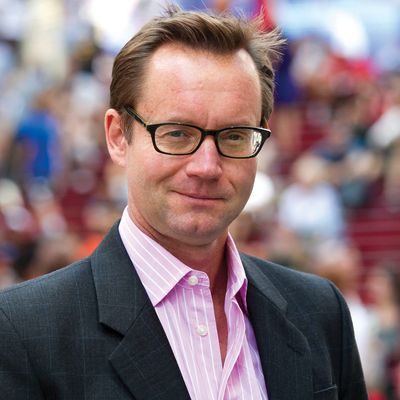
Historian, gossip columnist and brutally honest theater lover Michael Riedel dishes about, well, almost everything on the season one finale of “My First Show.” Michael talks about his two books, including his most recent, SINGULAR SENSATION: THE TRIUMPH OF BROADWAY... Read More
From the show: My First Show
Guests
Featured Shows
About
Historian, gossip columnist and brutally honest theater lover Michael Riedel dishes about, well, almost everything on the season one finale of “My First Show.” Michael talks about his two books, including his most recent, SINGULAR SENSATION: THE TRIUMPH OF BROADWAY. Get ready to be regaled: from seeing shows with Stephen Sondheim, to fixing an air conditioner for Alan Rickman, to wine-infused lunches with Dorothy Loudon (of ANNIE fame), this is a journalist who’s seen it all.
Part of the Broadway Podcast Network.
Transcript
This transcript was automatically generated and might contain errors.
[0:15] Eva: Hello everyone and welcome to this episode of My First Show. I am here today with someone who probably thinks he is a singular sensation, and frankly I do too. And that is everyone's favorite Broadway gossip columnist and Broadway journalist and friend of the Great White Way, Michael Riedel. Hi, Michael.
[0:39] Michael Riedel: Think I know, darling. I know I'm a singular sensation. Never had any doubt in my mind since the crib.
[0:49] Eva: Well, I actually do believe that. And the fact that we're gonna delve into your past, into your humble beginnings, into what made you you is one of the things I'm most excited about with this interview. But the fact that you were an actor at one point, I certainly didn't know that. And I don't know if our listeners know that. So before we get into anything too, too juicy and gossipy, can you, you know, maybe give us a memory from your early stage days?
[1:17] Michael Riedel: Well, I mean, I certainly was not a professional actor, and I never had an equity card, and I never really aspired to be an actor, but I do have the distinction when I was in ninth grade of being in the all-Christian version of the Diary of Anne Frank. Now I grew up in a small town in upstate New York, Geneseo, and there was only one Jewish family, the Levins, and everyone said, you know the Levins, the Jewish family. Well, the two Levin kids auditioned for Anne Frank, and they didn't get cast, but a bunch of Presbyterians, Episcopalians, and Catholics did. So it was a bit like that David Laveau production of Fiddler on the Roof, where there were no Jews in that one, if I'm not mistaken either.
[1:51] Eva: Well, Harvey.
[1:51] Michael Riedel: You had Harvey for a minute, but you had Rosie too.
[1:54] Eva: That's right, that's right.
[1:55] Michael Riedel: And you had Alfred Molina who originated it, and he's a Spanish Catholic, so there you go. I think I did say David Laveau ethnically cleansed Fiddler on the Roof, and I think that's why he punched me that night at Angus Mackindo's. But there therein lies another tale. So yeah, so I did the Diary of Anne Frank. Who knew, right? And I can't say it was the best production in the world. But actually it was better than the one that was done on Broadway a few years ago, which was kinda lame, I thought. And that was the beginning of my wonderful acting career, and also it was the end of my wonderful acting career because aside from that one show, I think I did a play. I may have done a play in my senior year, but I was in the—oh God, can you believe me? I was in the ensemble.
[2:34] Eva: Oh, the ego cannot be contained in the ensemble.
[2:37] Michael Riedel: That director has never been heard from again since she made that mistake.
[2:42] Eva: She certainly did.
[2:43] Michael Riedel: And the leads, I killed them too. Because what I did was I reviewed, even though I was in the show, I also reviewed it for the school paper and I panned it. It's kinda fun.
[2:50] Eva: That is great. Well, we're gonna get into all that history, but first of all, Michael, though you are a positive, upbeat, and shall we say, genteel, optimistic slash pessimistic fella, it has been a tough, you know, eight months for our industry. It has been a tough fall, and I care about you. So how are you? How are you doing?
[3:14] Michael Riedel: You know, I'm fine actually. Believe it or not, I was kind of ignorant of the whole COVID thing. I finished SINGULAR SENSATION in February. The book took me about two years to report and a year and a half and change to write. And I turned in the manuscript in February. And as I often do when I finish a book, I treat myself to a nice holiday. And I'd never gone skiing in Europe before. So I thought, you know what I'm gonna do? I'm gonna, as a present to myself for all the hard work, I'm gonna take myself to Zermont, Switzerland, to ski at the base of the Matterhorn. So I went off the first week of March, was having a great time. And then one day it was an absolutely sensational, sensational day.
And you could go up to the very top of the mountain and ski down into northern Italy. So I spent the day skiing in Travinia. And I stopped at a restaurant on the slopes, had one of the best meals I've ever had in my life, and I had a glass of absolutely delicious northern Italian crisp white wine, and I took a picture of the glass of wine with the Matterhorn as the backdrop. Very dramatic. And I texted it to my girlfriend, and she said, Where are you? And I said, I'm in Italy. She said, Do you have any idea what's going on? I said, Well, not really. I mean, when I check on the news, I was more interested in Bernie Sanders versus Joe Biden then. She said, This virus is spiking all over Italy.
What are you doing there? Well, I mean, I'm here now, too late, right? So I finished the wine and didn't think much about it. Two days later, they shut down the resort I was in. I got back just in time. Had I waited another few days, I would still be in Switzerland probably, not being able to get back to New York. And I got back to New York, and you know, well, five, six days later, I remember getting a call from some of my friends, some people you know who said they're closing Broadway. And I said, Well, for how long? And I remember everyone was saying two weeks, two weeks, four weeks tops, that's it. But if you—I don't know if you remember that night, Eva, but a bunch of those Broadway producers who were in that meeting when they shut down Broadway, they went to Sarty's and somebody had a cough, and a whole bunch of our friends got sucked with COVID.
[5:20] Eva: Yeah.
[5:21] Michael Riedel: Yeah. I do remember that. I mean, I don't know what happened. I was on a plane, no masks, flying back from Europe. I was in Italy where the virus was spiking. I remember when they announced bars were closing, the first thing I did that night was I went to my local bar and everybody in the neighborhood was there, you know, getting tipsy and having a good time. But I never got sick. I had an antibody test, didn't have the antibodies. I've had a number of test snaps. I've tried to see my parents who are elderly. And I've, you know, I'm COVID-free. So I mean, you know, I was supposed to actually—my girlfriend was supposed to move in with me. And the good thing about COVID is that it postponed that drastic—there's a silver lining everywhere. Good thing she's a frequent listener. Things are gonna be great for you tonight.
[6:03] Eva: That's right. She's sitting right here giving me a terrible look.
[6:06] Michael Riedel: I'm kidding, darling. I'm kidding.
[6:09] Eva: No, no, no. I'm glad to hear you stayed healthy and that you found the positivity in all this. And I'm sure finishing a book which felt like its own sense of pandemic dread. I've never written a book, but that's my guess is the stress and anxiety and sort of lockdown. The interesting thing though also gave me a chance because when you're working on a book, it's hard to read other books. You can't really commit yourself to like a great 19th-century novel. So when I'm writing a book, I tend to read, you know, Agatha Christie books or Rex Stout Nero Wolf mysteries, or like, you know, PG Wodehouse like comic stuff. So when I finished the book and then I thought, okay, we're in lockdown now. I picked up a book that I've been intending to read my entire life.
It's a brilliant book, Robert Caro's book, The Power Broker, about Robert Moses, who basically turned New York into what it is today, building bridges and highways and clearing out slums and building public housing. And it's a 1200-page book, considered one of the great nonfiction books of all time. And so that's what I did throughout COVID. And the other thing that kept me going, because remember, while you were here, we were totally locked down. I mean, this city was deserted. You could do nothing. And I didn't see my girlfriend because I just gotten back from Italy and she was concerned and this, that, and the other thing. But what I would do is I would read this book about how Robert Moses totally transformed New York.
And I would read about a neighborhood that he completely destroyed because he decided he wanted to put a highway there. And he would just, you know, clear everybody out, raise the buildings to the ground and build this highway or his bridge. And what I did was because I wanted to exercise and the gyms were closed and it was kind of cold, I would read in the book about a neighborhood, and then I would get on my bike and I would ride my bike to the neighborhood, and I would look at all the things that Robert Moses wrought, or I would bring my architectural guide to New York with me, and I'd look at all these fabulous buildings that you would never look at before. Because, for example, I would go to Wall Street, not a soul on Wall Street, not a human being, not a car.
Amazing architecture. You would never look at it though, because Wall Street is teeming with people going from one place to the other, and no one's ever looking at buildings. It was just me, my bike, and my architectural guide looking at the Cunard building and the Standard Oil building. I found all these wonderful neighborhoods and gems of New York City. And that's what I would do every day. I would get on my bike and just find a neighborhood and just go explore it. And once I rode down Fifth Avenue in the middle of Fifth Avenue from 72nd Street to 59th Street, in the middle of the street, not a car in sight but for a police car. That was it.
[8:39] Eva: Wow.
[8:41] Michael Riedel: Wow, wow. And if not, I mean, this is one of those stories, if not for COVID, you probably wouldn't have read that book. You wouldn't have had those walks, you wouldn't have made that discovery.
[8:50] Michael Riedel: And I'd be living with my girlfriend now, and she probably would have killed me. So I killed my life from COVID. So there's a lot of positivity here today.
[8:56] Eva: I'm glad to hear that. SINGULAR SENSATION, The Triumph of Broadway, your new book. You know, slightly different, similar in tone and style than Razzle Dazzle, your previous book, which I also loved. What discovery? What sort of thesis statement? What was the big aha from the work you did in researching and then writing this book versus your previous book?
[9:25] Michael Riedel: Well, the first book had a very, very clear and simple, straightforward thesis, which was that Broadway helped save New York City in the 60s and 70s when the city was going bankrupt and Times Square was dangerous and sleazy and full of porn houses and prostitutes and drug dealers. You know, New York had one thing going for it that no other city has, and that's Broadway. And Broadway certainly, as I detail in the book Razzle Dazzle, had its troubles back then. But it was about a handful of people who stuck by Broadway, the Schuberts, the Niederlanders, Michael Bennett, Andrew Lloyd Webber, Cameron Mackintosh, and did shows like A Chorus Line and Annie and Cats and Phantom and Les Mis that really kind of saved the industry of the theater in New York and kind of helped it begin the transformation of Times Square.
And the point I was trying to make was that everyone often gives, you know, credit to saving cities to sports franchises or restaurants or things like that, and the arts don't get enough credit that they deserve. And I really think because Broadway stuck there and didn't fall apart and was elevated, it helped lift the fortunes of Times Square and ultimately New York City. And that book ended really around the early 90s when my protagonist Bernie Jacobs, who ran the Schubert organization back then, died. It's always good to end a book with when somebody dies. Very simple way to put the final—he died at 87, period. Boom. That's it. And I had no intention of writing another book because I really thought I was done with Broadway.
But my publisher, Simon and Schuster, Avid Reader Press, they wanted a sequel. So I was gonna write a book. I thought, well, I'll do a book. I guess I can do the story of Broadway up to Hamilton. But I realized, God, that book would be longer than The Power Broker, which was 1200 pages, and I don't have it in me to write a 1200-page book. So I thought, well, how do I—what's my scheme here? And that's when I realized, because I covered Broadway throughout the 90s. I began covering the theater in 1989. And a couple of things I realized thinking about the 90s was one, it is the end of the British invasion. The Andrew Lloyd Webber, Cameron Mackintosh era comes to a close with Sunset Boulevard. And the Americans are back in business with Rent.
Jonathan Larson's terrific musical, which of course was young, contemporary, had a rock score, dealt with the issues of the day, was not set in, you know, 19th-century opera house or, you know, I don't know, I have no idea where Cats is set, somewhere in the heavyside layer or something. But it was relevant. It was what was going on in the city at that point in the 90s, gentrification, pushing artists out of their apartments because they could no longer afford them. And right after Rent, you get Chicago, and then you have the arrival on Broadway really of Disney with The Lion King. You've got Tony Kushner's Angels in America, the return of Edward Albee, who'd been out in the wilderness for all those years and nobody would touch any of his plays because he had so many failures, and he came up with Three Tall Women.
And I realized also that musical comedy, American musical comedy, came back in the 90s, and I thought, you know, I can cap this book off with the story of The Producers. And then I actually found my ending one morning when I was standing in the middle of my apartment and looking out my window, and in the 90s, I had a straight shot right down to the World Trade Center. Could see it every morning of my life. And one morning I woke up and I saw this black gash in the North Tower, and I saw the second plane hit and I saw the towers fall, and I lived through that terrifying week where Broadway had no idea if it could survive that crisis. But Rudy Giuliani, then mayor, wanted to show the world that New York was open for business, and the best way to do that was to get the lights of Broadway lit Thursday night, two days after 3,000 people were murdered in this city.
Broadway was up and running, and I went with Mel Brooks and Ann Bancroft to The Producers that night, and Matthew and Nathan led about there were about 500 people in the theater because, you know, it was certainly not sold out. But 500 people showed up and Matthew and Nathan led them singing God Bless America in tears. I remember thinking that's how I end my book on the 90s. And that's why I called it SINGULAR SENSATION, The Triumph of Broadway, because Broadway came back so quickly after what we thought at the time was the real existential crisis.
[13:26] Michael Riedel: I never intended for the subtitle of the book, The Triumph of Broadway, to be ironic, but it's turned out to be so because the pandemic hit just as I finished the book.
[13:35] Eva: Yeah, yeah, yeah.
[13:35] Michael Riedel: And Broadway's about to hit or is hitting another existential crisis. Worse than 9/11, if anything's possible.
[13:42] Eva: So what's your prognosis? Come post-vaccine for our fair?
[13:47] Michael Riedel: Well, I mean, I think you probably know better than I do. You're in all these meetings that everybody, all these Zoom meetings producers seem to be doing, but I always thought it could not come back until there's a vaccine because, well, the actors and the musicians, they have to feel safe going to work. And what they do spreads the virus. If you sing and enunciate, you're spreading the virus. If you blow on instruments in a small pit, you're spreading the virus. So I always knew it really could not come back until there's a vaccine. I think the unanswered question is when does the audience come back? When does the audience feel safe to come back? You can open up the shows, but as you know, if the audience doesn't come back, you're not gonna run very long.
I don't care how rich you are, you're not gonna throw hundreds of thousands of dollars down the drain every week if the tickets aren't sold. I do think you guys have to figure out how to restructure the economics of your business because you cannot reopen Broadway and say, "Hey, Hamilton's open again. We're gonna charge you a thousand bucks a ticket." That's not gonna happen after we've gone through this, particularly now that we're in this recession too. So you guys, it's really up to you and the unions to figure out how can you restructure the finances of Broadway so that when you open up, you can entice people back. And the first people to come back are gonna be New Yorkers because tourism is not coming back here for a long time.
I can tell you that. This was the epicenter of the pandemic, and you can't just turn the switch on and everyone's jumping on a plane rushing to New York. That's not gonna happen. You gotta entice New Yorkers back to the theater, and you have to entice them back by saying, you know what, the tickets are now gonna be reasonably priced for the foreseeable future. It's not gonna cost you eight hundred and fifty bucks to see Hamilton. Maybe it'll cost you a hundred and fifty bucks, which once upon a time was a huge amount of money, but now it's a bargain. So you guys have to figure that out. And if you don't figure that out, you're gonna have a tough time bringing people back to the theater.
[15:25] Eva: Yeah.
[15:25] Michael Riedel: Yeah.
[15:26] Eva: No, I think everyone would agree with that. Everyone agrees that there's some sort of reset that has to happen for the industry as a whole and for audiences to feel safe and to need it. I mean, I think the one thing we do know, and we are hanging our hats on, is that the idea of gathering and being with people and feeling alive again and having a thousand beating hearts syncing up because of an emotional catharsis, that is needed. That is needed for New York, that is needed for America. So that's what we're hoping for.
[15:57] Michael Riedel: Yeah, I'm just gonna say, you know, the big difference between September 11th and I detail in the book how the industry really rallied and got those lights lit on Thursday. Well, let's dive into something a little nostalgic and joyous, and that's your beginnings, Michael. The first show you ever saw, what was it?
[16:20] Michael Riedel: The first show I ever saw, I came to New York City for the first time with my parents in 1977. So I would have been about ten years old maybe. Actually, I'm lying, I would have been eleven. But like every actor, I shave a couple of years off. And the first show I saw was Annie. We sat at the last row of the balcony at the Alvin Theater, now the Neil Simon Theater, and I fell madly in love with Andrea McArdle, who is just adorable and would have been about my age back then. And I remember she was much cuter in rags than she was when they put her in that ridiculous red little suit and had her hair curled. She lost her looks when they did that. Red isn't for everybody.
[16:59] Eva: No, no.
[17:00] Michael Riedel: But the one thing I did fall in love with Andrea McArdle, and one of my favorite songs of all time is the opening number to Annie, which is "Maybe Far Away" or "Maybe Real Nearby." Always loved that song. Interesting way to open a Broadway musical, by the way. Usually, you open a musical with a big, brassy kind of number, but Annie opens very quietly with that lovely Charles Strouse and Martin Charnin song. But the person that made the biggest impression on me was Miss Hannigan, played by the brilliant Dorothy Loudon. I mean, that was one—I remember that I was only 11, but I remember that performance. I remember her, you know, "Some night I'll step on their freckles." She had this great line where the orphans were laughing before they were going to bed or something, and she said, "Do I hear happiness in there?"
And it was my great fortune when I started covering Broadway. I got to know Dorothy very well, and we became good friends. I used to take her out with her press agent. They're both dead now, sadly. David Bowers was her press agent. And David and I would take Dorothy to lunch. And, well, let's just say Dorothy was a saloon singer. There's nothing like that anymore. She came from the saloons of Chicago, and man, could she drink. And boy, she would polish off about two bottles of Chardonnay at lunch and then pretty much fall into her soup. And then I would get her into a cab, take her home. She lived in an apartment on the Upper West Side, and I would call Fred Ebb, who lived on the floor below her, and Fred would meet us in the lobby, and Fred would take her up to make sure that, you know, he would get her into bed and look after her and take care of her.
But she was brilliant. She was one of the funniest, smartest people I've ever met. And if you go, and I encourage your listeners, go check out her performance in "Easy Street." You can find it on YouTube at the 1977 Tony Awards. And she does this bump and grind that I don't think there is a dancer living today who can move the belly and the hips the way Dorothy does because she is, I said, a saloon singer, and that whole world is gone. And Dorothy was kind of the last of that kind of bump and grind world. I don't care how many dance lessons you take, you will never be able to move the way Dorothy Loudon moved. Yeah, it's genetic.
[19:05] Eva: That bump and the thing. I mean, she was really, really funny. She used to improvise a number of the lines in Annie. When I did Razzle Dazzle, I interviewed Tom Meehan, who wrote it, and he said Dorothy would come up with lines, and I would just use them because they were great lines. She did tell me once she was in Annie 2, which was an unfortunate sequel to Annie that I happened to see. And she was out of town in Washington, D.C. at the tryout, and she knew the show sucked. She would call me every night from our hotel room telling me, "Oh kid, this show is a piece of crap." But she was trying to come up with funny lines because the writers could not come up with a good exit line for her. So one day she improvised this line, which may be the most brilliant line ever in a musical.
She looks at Daddy Warbucks, and she says, now she's off book because she's just trying to find a laugh here because the writers aren't giving her the laugh. She looks at Daddy Warbucks and she says, "You may have fame and fortune and Annie, but I have one thing you'll never have." And the guy playing Daddy Warbucks is like, "What's that?" She said, "Hair." I don't know if that line stuck, but it should have.
[20:17] Michael Riedel: Well, unfortunately, the show closed out of town, so we have no idea how long you had no idea.
[20:22] Eva: True.
[20:22] Michael Riedel: But that was the first show, yeah. I mean, I didn't really fall in love with the theater, I have to say. I mean, I liked Annie and all that, but you know, theater, I was not interested in being in the theater. I wouldn't even know how you get into the theater. I was gonna be, well, I went to Columbia to study history, and I was gonna be a lawyer, but I just kind of drifted into the theater because I needed a summer job, and I wound up working for Elizabeth I. McCann, the Broadway producer, and I had such fun working with Liz. I love her to death, but she's, shall we say, eccentric. But I got to meet all these crazy theater people. I remember my first day, one of my first days on the job, or it must have been the first week.
She was producing this play, and she brought a bunch of English actors over to be in it, and she told me, "Ah, this goddamn actor, he's complaining about his air conditioning. Go fix it." I'm studying history at Columbia; I don't know how to fix an air conditioning unit. So I went over to this guy's kind of shabby apartment. Liz was not putting them up in the Ritz Carlton. They were in, I think they were in the Whitby Hotel, if I'm not mistaken. They're on 44th Street. Anyway, so I go out, I remember buying a screwdriver, so at least I look like I knew what I was doing. And I knock on this guy's door, and this very tall, elongated Englishman opens the door. He says, "Yes." So I'm from Liz McCann's office.
I'm here to fix your air conditioning unit. I said, "Oh, it's beastly hot in here. It's beastly hot in here." So I walk in, and then I walk by the bed, and I see this rather attractive calf of a young woman sticking out from under the bed, and then she kind of comes up from the covers, and her blonde hair is all messed up. She's, "Oh, it's so hot here, so hot here." She, of course, was the ingenue, and he was the leading man, and he was sleeping with her. So I go over to the air conditioning unit, and I like stuck the screwdriver into it, and I jiggled around, and it started. You know, it was one of those big old freezer things like, "It's beastly hot, it's beastly hot in here." And that person was one then-unknown Alan Rickman, starring in later.
[22:22] Eva: Future Harry Potter, Alan Rickman.
[22:25] Michael Riedel: Exactly. I got to know Alan during that show because I used to go to the theater every night, and I would just hang out with these great English actors, and they were so much fun, and I thought, well, you know, I really don't know what I can do in the theater. I'm not an actor, I'm not a director, I'm not a producer, but these people are fun to hang out with. So I thought, I'll guess I'll stick around this business and find a way in somehow.
[22:43] Eva: Yeah.
[22:44] Michael Riedel: So it's interesting. You said that it wasn't Annie that made you fall in love with the theater. And then, you know, your next sort of big entree was your job at Liz McCann's office. So was it these characters, these singular people that you would meet that sort of opened your eyes and made you realize that this is a business that you're fascinated by because of the individuals in it rather than the process of the creative of making a show?
[23:14] Michael Riedel: Yes, I think, you know, if there was any value to my columns over the years or my books, it's that I do take a different viewpoint of the theater than most people who write about the theater. I don't write about—I don't have to do critical surveys, I don't, you know, give you the importance of Angels in America. There are plenty of books written about that. I really do take you behind the scenes, and I don't just show you the creative process, although in SINGULAR SENSATION, I think I do a pretty good job of that, showing how these shows come together and how these great artists like Julie Taymor work on The Lion King, but I show you with the perspective of the producer, of the money people.
You know, I was always aware working for Liz, 'cause I used to have to deliver things. This was, you know, I was the messenger of the office, so I'd have to run over to Jimmy Nederlander's office above the Palace Theater, and Jimmy would be there with his feet on the desk and three phones working at the same time, barking orders at everybody, and the office was kind of funny and shabby. And I remember the elevator operator. Oh god, what was his name? He had—Jimmy actually, when Jimmy acquired the Palace Theater, he also acquired the elevator operator, who'd been working there for years. And he would take you up in the elevator, and he would pray for you and he'd read verses from the Bible for you.
And then you'd go down and you'd read more verses from the Bible. And Jimmy always just kept him in the elevator. And then I used to go over to the Schubert offices. You've been there above the Schubert Theater, and those were very impressive. You know, everything was very quiet. Jimmy was like, you know, the secretary of it, "What do you want, kid? What do you want?" And Jimmy went, "I'm not gonna pay him that ads guy. God damn it, he's not worth that. Hang up the phone." You'd go to the Schubert offices, and the secretary would say, "May I help you?" You know, and then Bernie Jacobs or Jerry Schoenfeld would come by, the big powers, and everyone would get very quiet and silent. But I was interested in those guys.
I thought, boy, this is where the real power of this business is. So when I started writing about the theater, I made it my business to get to know those guys. And I was fortunate enough to become pretty close to Jimmy Nederlander and pretty close to Jerry Schoenfeld and Phil Smith. Bernie Jacobs was kind of out of it by the time I got around, and he died in '96, so I never really knew him. But I became very, very close to those guys. And that's where I learned these are the people who have the real power. I mean, you can have the greatest show in the world, but unless you get a theater from these guys, no one's ever gonna see your show. And so I started covering the power brokers, and you know, my books take you behind the scenes of how these people produce these shows, how they finance these shows, how they market these shows, how they sell these shows.
And, you know, in the case of SINGULAR SENSATION, one of the things I show in the book is the arrival of the corporations on Broadway in the '90s with Disney and with Garth Trubinsky, who came here with Live Entertainment. And, you know, you couldn't find a better villain than Garth Trubinsky because his entire publicly funded company, Live Entertainment, that produced Showboat and Ragtime and Flossy, the whole company was a total fraud. He literally kept two sets of books, like Max Bialistot. One set he would show to investors and regulators and stock officials that showed every show he did was a big hit and had profits, and then he had a secret set of books, known only to him and a handful of his cronies, that showed this ever-widening and deepening sea of red ink. And at the end of the day, Live Entertainment went bankrupt, and Garth Trubinsky went to jail.
[26:26] Eva: Yeah.
[26:26] Michael Riedel: So that I knew that would be a good story to cover. It's not really been covered before. I think my book is the first one that extensively delves into the machinations of Garth Trubinski. There's not that this is a podcast where we tend to promote other podcasts, but there is a podcast out there called Spectacular Failures that does an excellent in-depth radio story of the stuff.
[26:47] Michael Riedel: I know I'm in it. I was in it before. Yeah, yeah, yeah. So it's uh you're you could write a whole book just on Live End if you wanted to, I'm sure.
[26:56] Michael Riedel: Well, it's interesting because at one point I did think of the idea of writing the story of Garth Trubinsky and Live Event, but I realize that most people don't know who he is anymore, so he really wouldn't justify a whole book, but certainly as a villain in my narrative of the 90s on Broadway, he's a spectacular figure.
[27:11] Eva: So, first show you were in, that's usually the second question we ask, and it's okay if it was, you know, that offensively ethnically cleansed.
[27:24] Michael Riedel: It was Anne Frank that we heard about. The all-Christian version of the Diary of Anne Frank. That was the first show I was ever in. And so, what was your first professional show then, whether being in it as an actor or frankly covering it as a professional?
[27:39] Michael Riedel: Uh let's see. The first show, I mean, I think, if I'm not mistaken, the very first show that I covered as a critic and a reporter, I think it would have been, was it 1989? I started at Theater Week magazine. And I seem to remember the very first show I went to see was Terrence McNally's The Lisbon Traviata at the Promenade Theater, and being completely bowled over by this guy I'd never heard of before called Nathan Lane. So that may have been the first I think I'd have to go back and look at the old magazines, which are somewhere in storage, but uh I think one of the first people I ever interviewed was Terrence McNally, who was a lovely, lovely guy. And in fact, I interviewed Terrence for um for the book SINGULAR SENSATION, because Terrence was very close to Edward Albee, uh, who's one of my main characters in the book.
And of course, Terrence wrote uh Ragtime and Kiss of the Spider Woman. So he knew a lot about uh Garth Trubinski. And uh when Terrence died, uh he died just as I was I think I was correcting the manuscript of the book when Terrence died. Yeah, he was an early uh case, sadly, of COVID. So I was going through the manuscript, and the day he died, I happened to be going through the Ragtime chapter. And I emailed um his husband, Tom Curtihy, who's a Broadway producer, as you know. Wonderful. And uh, you know, I just emailed him to give him my condolences. I said, But I I do have to give you this line that Terrence gave me for the book because it may be the funniest line in SINGULAR SENSATION. And uh he emailed me back and he said, you know, I've had so many, so many emails from people, but this is the only one that's made me laugh out loud.
And Terrence's line, well, you remember Garth Trubinsky, he spent enormous amounts of money. I mean, you know, he paid Elaine Stritch $25,000 a week to be in Showboat. She had one song, you know, Why Do I Love You, Why Do You Love Me? She sang it to a baby. And I remember I went to the show with Steve Sondheim and he turned to me when she was singing the song. He said, I don't know if she's gonna sing to that baby or eat it. He paid her 25 grand a week to sing one song. Wow. And anyway, uh Terrence told me he was talking about Ragtime up in Toronto, and he said, Oh my god, the amount of money Garth was spending. He said, All of the theater they were at was in the suburbs of Toronto, but everybody lived, of course, in fancy hotels in downtown Toronto. And he said, Everybody had a car service. There were car services galore. He said, Emma Goldman had a car service. It's cold. It's funny, though. That's really funny.
[30:05] Eva: So if your first professional show covering was this play in 1989 with Nathan Lane, are you to be credited for discovering Nathan Lane? Is that what we're learning?
[30:19] Michael Riedel: Well, I when I wrote for a magazine that was read by about 10 people back then, so I don't think you can give me credit for that. I think that maybe could have been maybe one Frank Rich who uh raved about Nathan Lane there in uh The Lisbon Traviata. I think Frank probably had a little more to do with Nathan's career. Maybe it was than I did. Funny story that I have in the book, because one of the themes I pick up in the book is the return of the American musical comedy. And a very important show in the early 90s was Jerry Zaks' terrific revival of Guys and Dolls, starring one Nathan Lane and Faith Prince. And I remember um interviewing Jerry Zaks and Nathan uh for this book. And Jerry said, you know, Nathan came in, and Nathan was only known, you know, people had seen him in The Lisbon Traviata, but he certainly was not a big star back then.
And Nathan came in and he auditioned for Nathan Detroit, and um Jerry said all the suits and the money people loved him, thought he was hilarious. But then somebody said, Yeah, the problem is he's not Jewish. Because Sam Levine created the role of Nathan Detroit. So everybody assumed that Nathan Detroit had to be Jewish. He was Sam Levine. He was in the movie, and you know, he was in well no, he wasn't in the movie, actually, but he was on the stage, and everybody knew Sam Levine. So they said, Well, it's not Jewish, it's the problem. So Jerry's, oh well, let's bring him in again, see how he does. He came in, Nathan auditioned a second time. Again, even more brilliant and funnier than he was the first time around.
Everybody's on the floor laughing. He leaves the rehearsal hall, and Jerry says, Well, what do you guys thinking? Well, he's not Jewish. You know, it's not Jewish. And Jerry just lost it. He said, Look, unless he's got to perform a circumcision on the stage, it doesn't matter if he's not Jewish. He can play the role, okay? And then he called Nathan and he said, Nathan, here's the problem, you're not Jewish. And Nathan said, I'll go to Hebrew school. Just give me the job. And the irony of all that is Nathan does get cast. The show is an absolute sensation. Front page review in the New York Times. First time a Broadway show had ever been on the front page of the New York Times. Frank Rich's glowing review of Guys and Dolls.
He had only one minor quibble, and that was Nathan Lane isn't Jewish. The role was created by Sam Levine. The shyness of Nathan Lane is a drum con. He loved Nathan. Everyone liked it was a great performance, but he said, but you know, he's not Jewish. So there you go.
[32:26] Eva: That's really funny. That's really funny. So if only 10 people read your magazine when you first got into the business professionally, and we're reviewing, what was the step that got you to where you were next that everyone started reading and listening to you?
[32:43] Michael Riedel: Well, as uh fate would have it, I owe my career to Frank Rich and his wife, Alex Witchell, because Frank was then the most powerful, really most powerful man on the planet in terms of theater back then, as the chief drama critic for the New York Times. And he I knew this because it turned out that I had a friend who lived across the hall from this young reporter by the name of Alex Witchell, who was then writing a theater column for Seven Days magazine. But um, Frank began an affair with her, and my friend who lived across the hall would tell me about this. And then one day, all of a sudden, it's announced that Ina Nimmy, who'd been the longtime uh theater reporter for the New York Times, she wrote the Friday Theater Column.
It was announced that Ina Nimmy was out, and this new aggressive young reporter by the name of Alex Witchell was gonna be the new theater columnist. I thought, hmm, wonder how she got that job. So I started writing these kind of gossipy items about Frank and Alex. And I noticed in um in Alex's column, if Frank gave a show a good review, Alex would only write the most positive, glowing items about the cast and the director and the producers. But if Frank gave the show a bad review, Alex would completely go after all the nasty, vicious behind the scenes gossip and try to do a number on the show in her column. And I thought, well, this seems a little unfair. I mean, back then the New York Times was all powerful.
And uh you had this kind of one-two punch, and not only did you get pummeled by Frank, but then his girlfriend would hit you on Friday in her column. So I started writing about their, you know, they had their enemies list, they had their friends list, they took care of certain people who they liked, people they didn't like, would get destroyed in his reviews or in the columns. And I would write this on a regular basis, and that got me noticed by people like Liz Smith, the big gossip columnist at the uh Newsday Then, and um Cindy Adams at the Post. And I realized I happened to be reading uh a Neil Gabler's very fine biography of Walter Winchell, who was the legendary gossip columnist in the early 20th century.
And Winchell said, you know, if you're a nobody in this town, the fastest way to get noticed is to take a brick and throw it at somebody famous. And every week in theater, I was hurling bricks at Frank and Alex. And then one day they sued me, or they threatened to sue me. And I just I had nothing to lose, I had no money then, so I didn't care. But the New York Times wrote these really terrifying letters to my publisher and to me, threatening lawsuits unless there were retractions. And uh, I just decided, you know what, I'm just gonna I'm just gonna print the the letter from the lawyer. I'm gonna leak it all to page six and I'll just run the letter in full in the column. And uh it turned out that Arthur Salzberger, the publisher of the Times, he had no idea that Frank and Alex had gone to the legal department to get the Times to sue us.
Now, this is the New York Times, which won many First Amendment cases, and it's threatening to sue this tiny little magazine. And I remember my publisher called Arthur Salzberger and said, You're threatening to sue us. Arthur had no clue. He checked with the legal department, he called the publisher back, he said, The New York Times does not sue anybody, forget about it. He was livid. And of course I leaked all that correspondence. Got my name in lights, as they say. And then I got hired by the Daily News to work on a gossip column there, and eventually I got my own theater column at the news, and then the Post uh stole me from the news back in 1998.
[35:55] Eva: Wow. Wow, wow, wow. So brick gotta be vicious, gotta be vicious to succeed in this business.
[35:59] Michael Riedel: Brick throwing. Got it. Add it to the list of his many talents. I understand. Can you sing? Can you dance? Do you have any of those talents, Michael?
[36:09] Michael Riedel: I sing all the time, but not on key. Right. Um and I love to sort of dance around the living room, as they say in the course. But um and I can still do that because my girlfriend never moved in with me with COVID. I mean, one of the things was that she said, If I move in with you, you cannot sing and you cannot dance. Uh but yeah, no, I yeah, I I I'm not a singer at all, but I I love, you know, I sing along to uh all my my my favorite uh old the American songbook I love and I love Henry Mancini and uh Dion Warwick is my favorite singer. So yeah, I'm always you know, what's it all about? Yeah. Alfie. That's pretty much the extent of my repertoire.
[36:43] Eva: And you're a straight man. It's kind of unbelievable.
[36:46] Michael Riedel: Well, I always say it's because I uh I saw Annie first and I fell in love with Andrea McArdle. Had I seen Gypsy, I would definitely be gay.
[36:54] Eva: So dream time, because we can make dreams come true. I I like to think like speaking things to the universe, make them happen. If you could be in any show anywhere at any time, what would it be?
[37:09] Michael Riedel: I would be in Hugh Jackman's one man show. Hugh is good, but he's not as good as I am. Believe me. I could have that if I were in that show, that show would still be running today. I'm telling you. And he acknowledges that. He really does. Because uh we we live near each other here in the neighborhood, and he's seen me dancing around in my living room occasionally, and he said, Man, if you were in that show, it would still be running today. So yeah, I think I I think I could have been a little just a little, not much. You know, he was really good, but I could have been just a little bit better than Hugh Jackman in that one-man show. Hugh told me this story when he was on Broadway in that terrific one-man show.
Yeah, he used to ride his bike up to the theater and he would uh chain it up there, uh I guess on uh eighth, eighth Avenue would be, yeah, Eighth Avenue. And he'd kind of walk down the 44th Street to the Broadhurst stage door, and he would have his sunglasses on, so you know, no one no one really bothers him or anything like that. But the show was so successful, and you know, people were getting $10,000 of ticket. Well, maybe that's a little exaggerated. That's what Hamilton was getting at the height. But I guess the tickets were being scalped down the street for like two, three thousand bucks. And one day Hugh's walking down the street to the dressing room stage door, and his little furtive little ticket broker comes running up to him and says, I got ticket sign for Hugh Jackman. Got ticket snipe for Hugh Jackman. Hugh lowers his sunglasses, looks at the guy, says, I am Hugh Jackman, Mike. The guy ran away.
[38:28] Eva: That's that's amazing. That's amazing. That's very funny story. That could only happen back then. I feel like. What what year was that? Was that 10 years ago? 15 years ago?
[38:38] Michael Riedel: Yeah, it would have been, God. Um, you know, I I was just beginning work on Razzle Dazzle, so I started Razzle Dazzle in 2011. It would have been the summer of 2011. I remember that night. Well, now I remember Liz. We were talked about Liz McCann, who I went to work for uh in college in her office, and um Liz had been uh her girlfriend of a long time dumped her, and Liz was, you know, not in the best of spirits. And people like Scott Rudin and Phil Smith, we would take we would take turns taking Liz to lunch or to dinner just to you know trying to get her through this difficult period of time. And I was up one night to take Liz to uh dinner at Sardi's, and I'd gotten tickets for my sister and her husband to see uh to see Hugh's show.
And I've said, you know, meet me at Sardi's, I'm having uh dinner with this old friend of mine, Liz McCann, and I'll just give you the tickets. It's right across the street from the theater. So Liz is sitting there very depressed, and uh my sister comes in, and I said, Leslie, I want to introduce you to the person who gave me my start in the theater. This is Liz McCann. Remember I worked for that summer, and Liz is sitting there, and she says, I gave him his start in the theater, and now he's trying to convince me not to go home and kill myself. The color drained from her face, and she took the tickets and ran away.
[39:55] Michael Riedel: That's amazing.
[39:56] Michael Riedel: That's our Liz.
[39:57] Michael Riedel: You know, you have been accused when you tear a show down or you reveal something about a chaos or drama backstage of not really loving the theater or not really being a true friend of the theater.
[40:19] Eva: And I, you know, I don't agree with that. Many of your fans and friends don't agree with that, of course, but I guess it's just worth asking how you can love the theater so much and also sometimes be its harshest critic.
[40:33] Michael Riedel: Well, because it's my job, you know. I mean, I'm not, um, I'm not a press agent. I don't, you know, I don't write shilly pieces for a living. I'm a reporter, and, you know, any good reporter covers whatever their beat is, you gotta cover it as a, as um, a business in Broadway, as you know, is a very big business. So I often wrote about the money and I often wrote about the problems behind the scenes. And you know, my feeling about that was, uh, listen, you people are charging, uh, the audience members a lot of money to see your shows. And if there's trouble backstage and if there's a problem, and if the show's not good, if the leading lady's fighting with the director or they fired the writers, I think that's, uh, worth pursuing.
And gossip is always fun and interesting, and I think, uh, you know, the public before they shell out their hard-earned money, they have a right to know what they're buying, what they're paying for. Um, so it never bothered me at all. And you know, in fact, frankly, I mean, the more gossipy and dishier my columns were, the more money I got paid. So that was certainly incentive. Um, but to me, I, you know, I think my friend David Stone, you know, David, he's the producer of Wicked. He always defended me in this way. And I think there's some truth to it. He said, you know, you may hate what Riedel's writing, you may be furious at him for, you know, airing all your dirty laundry and delving into the stuff behind the scenes.
But David said, but he makes the theater interesting to readers. Everybody is reading his column because they want to know the dish. So he's really kind of put us on the map in a way that we hadn't been before. Because a lot of my columns got picked up and were, you know, circulated in more mainstream publications than just here in New York City, especially when I would write about things like, you know, Rosie O'Donnell's Taboo or Spider-Man, those kind of things. And David's right. I mean, I always sat down to write a column. I thought I have to make this interesting to a reader who has no idea what I'm talking about. Okay? And I can't just do that by saying, "Oh, Guys and Dolls opened last night on Broadway, and it's wonderful."
No, I say, okay, here's what's going on really behind the scenes. Here's how much money it's really costing. Here's how much money it's really losing. They're gonna fire the leading lady, and she doesn't know it. They're secretly rehearsing the understudy. That makes it lively and fun and enjoyable. And that probably is my only contribution to the American theater is that I did try to make it fun, lively, and enjoyable in the paper in the pages of a newspaper, and with any luck, in my books, Razzle Dazzle and SINGULAR SENSATION.
[42:48] Eva: Yeah. Is there a show that is just so meaningful to you, Michael, that just you remember being in that seat, crying, weeping, emoting, connecting all the reasons why we love theater that you have a memory of?
[43:03] Michael Riedel: Well, I'm not a big crier or a weeper. Um, but I would say, I would say I often think in terms of the great performances I've seen, and I've seen some really, really amazing actors. And I would say to this day, the single greatest performance I saw was Vanessa Redgrave in the revival of Long Day's Journey into Night. And she played Mary Tyrone, you know, the morphine addict mother in the play. And it was one of the few times I thought, I do not see the acting here. You know, I've seen so many actors, and I know great actors, they have their mechanics, they have little traits, they know how to control an audience. And I know all their tricks because I've seen them perform so many times. But I did not see the acting with Vanessa Redgrave.
She was Mary Tyrone. And I remember I was quite close back then to Brian Dennehy, who played, uh, James Tyrone, who played her husband in the play. And, um, Brian and I used to go out to Joe Allen's maybe once a week for dinner. And I just seen an early run through of, uh, Long Day's Journey into Night. And Brian was spectacular, and Philip Seymour Hoffman was in it. He was very good, and Robert Sean Leonard was in it. And I remember talking to Brian, I said, you know, Brian, the thing is, Vanessa, I don't know how she does it, but she is that character. She's not acting. And he said, she is not acting. He said, we are off balance every night with it. We don't know, we don't know what entrance she's gonna make.
Is she gonna come down from the attic? Is she gonna come in from the screen porch? Is she gonna come up from the root cellar? He said, every night you're totally off balance. And Brian told me he had done Long Day's Journey into Night, uh, out in Chicago at, um, the big theater out there, directed by Bob Falls. And so when he was brought into New York to do it, he thought, this is not gonna be hard. I've done it already, I know the part backwards and forwards, it's gonna be easy. He said, the very first table reading of that production on Broadway with Vanessa playing Mary Tyrone, he realized everything that I thought I knew about this play that I thought I knew about these characters, I have to throw out and begin again because she's doing stuff that is gonna shift the whole tenor and tone of this play.
And Brian, to the, you know, Brian said the greatest actress he's ever worked with was Vanessa Redgrave. Now, she was nutty and totally, I mean, she was as eccentric off stage as she was on stage. I've interviewed her a couple times, and it's a trip, believe me. But that to this day is the single greatest performance I've ever seen. Vanessa Redgrave as Mary Tyrone in Long Day's Journey into Night. And sadly, I guess you could go to Lincoln Center, uh, when you can go to libraries again and take a look at it on video, but even on video, you'll never have the experience you had when you sat in the theater and were just enveloped into her tragedy, her sadness, her drug-addled haze. It was a great performance.
[45:54] Eva: Yeah. If I'm not mistaken.
[45:56] Michael Riedel: Yeah, yeah, no, for sure. And that is just an example, right, of like the most perfect role matched with the most perfect production, matched with the most perfect performer, right? Where you, when that alchemy of all those things are met, you have once in a lifetime experiences in the theater.
[46:18] Michael Riedel: And she's funny. I was pretty close to Eileen Atkins, another great actress, another actress who I've seen give performances where you don't see the acting, you just don't see the mechanics of it. She is the character. But Eileen is tough and cynical and she's kind of a sort of a fun show biz, let's have a drink after the show kind of person. And Eileen told me this great story, and she said, this is three different schools of acting. She was in a production at the National Theater of John Gabriel Borkman, Ibsen's five-hour play. And in it were Eileen and Vanessa and the great actor Paul Schofield. And so I remember Eileen saying, so this is what it's like. These are three different styles of acting.
So one day the stage manager knocks on Eileen's door and says, uh, Eileen, just want to let you know the snow machine isn't working tonight, so there's not gonna be any snow in the second act. And Eileen is like, oh, for fuck's sake, nothing worked in this goddamn dumper here. All right, never mind. Okay. And the stage manager knocks on Vanessa's door and says, uh, Vanessa, just want to let you know, uh, the snow machine isn't working, so there's not gonna be snow in the second act. And Vanessa says, well, could you give me some white paper and I'll tear it up into little bits, and when I come on stage, I'll throw it in the air and we'll have snow. And the stage manager goes to Paul Schofield's door, knocks on the door and says, uh, Paul, just want to let you know the snow machine isn't working, so there's no snow in the second act, and there's a pause, and he says, if there's no snow, there's no Paul.
And they got the show, they got the snow machine working, and then Paul went on. And that's the subtle difference between those three actors. Those are the, oh, that's, those are the three schools of acting. Forget about Strasberg and Chekhov and all that brushing crap. It's like, oh, for fuck's sake, nothing works. Oh, just give me some paper out there. We'll have snow. No snow, no Paul.
[48:09] Eva: My god, you've seen it all. Um, I know you're not a weeper or a crier, but you are a human being, and we have a lightning round that we like to play with our guests, which we don't tell you about ahead of time.
[48:23] Eva: I say a musical. You on instinct, first word that comes to your mind or phrase that comes to your mind of what the emotional theme of that show is. Don't want me to think too long about it. I put 30 seconds on the clock. I see how matched you and I are, and here we go.
[48:43] Eva: Evita.
[48:44] Michael Riedel: Power.
[48:45] Eva: Footloose.
[48:48] Michael Riedel: Crap.
[48:49] Eva: Funny Girl.
[48:51] Michael Riedel: Overrated.
[48:52] Eva: Jesus Christ, Superstar.
[48:55] Michael Riedel: Um, rock opera.
[48:57] Eva: Assassins.
[49:01] Michael Riedel: Muddled and confused.
[49:03] Eva: Hello, Dolly.
[49:06] Michael Riedel: Broadway Razzle Dazzle.
[49:08] Eva: My Fair Lady.
[49:12] Michael Riedel: Elegance.
[49:13] Eva: Into the Woods.
[49:15] Michael Riedel: Terrible second act.
[49:16] Eva: Great first act.
[49:18] Michael Riedel: Gypsy.
[49:22] Michael Riedel: Brassy and fun.
[49:25] Eva: And you, Michael Riedel, are brassy and fun. And that's why I enjoy you to no end.
[49:32] Michael Riedel: How could you bring out Footloose? That was one of the worst shows I ever saw.
[49:34] Eva: Oh my god.
[49:35] Michael Riedel: Yeah. Well, if there was an emotional theme in it, maybe, maybe you wanted to let us know about it.
[49:41] Eva: Clearly, there wasn't. See, if you said Company, I would have said classic case.
[49:48] Michael Riedel: Oh, God, when we can go back and see that Company, that's when I'll feel better about the world.
[49:55] Eva: Oh, yeah.
[49:55] Michael Riedel: Well, I have a very, I'm not going to give it away because you have to buy the book to read it. But I think one of the other great lines in my book is Patti LuPone's, uh, description of Glenn Close when she learns that Glenn is going to originate the role of Norma Desmond in America. That is the price of the book is worth it. Just to hear what Patti had to say when she found out that Glenn was giving her a book.
[50:21] Eva: I won't, I won't ruin the fun either, but I did a literal spit take as I was breathing. I just want you to know that.
[50:30] Michael Riedel: Oh, SINGULAR SENSATION: The Triumph of Broadway is out wherever you get your books, Amazon, bookstores, you name it. Michael Riedel, thank you for being with us today. You are a joy. Enjoy that. I'll look forward to seeing you at your opening or your reopening of Jagged Little Pill.
[50:47] Michael Riedel: Been working so hard.
[50:50] Eva: My First Show is produced by Josh Alvin, MEP, Dory Berenstein, and Alan Seales, and is part of the Broadway Podcast Network.
[50:58] Eva: This episode was edited by Derek Gunther. Special thanks to Leslie Papa and Whitney Holden Gore at Vivacity Media Group.
[51:06] Eva: For more info about the podcast, visit BPN.fm backslash my first show. Follow me on Instagram at Eva R. Price.
[51:20] ♪ Musical number: "Footloose" — performed by the cast of Footloose ♪
[51:48] ♪ Musical number: "Footloose" — performed by the cast of Footloose ♪
[52:11] ♪ Musical number: "Footloose" — performed by the cast of Footloose ♪
[52:41] ♪ Musical number: "Footloose" — performed by the cast of Footloose ♪
[53:13]
© Broadway Podcast Network, All Rights Reserved