

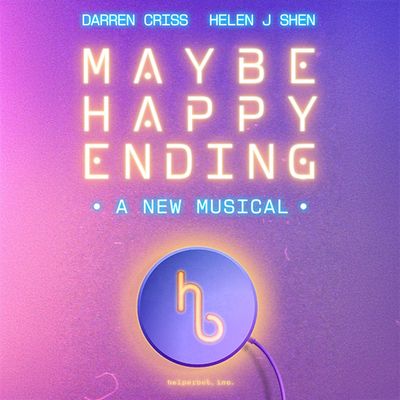
Darren Criss and Helen J. Shen, the stars of the new Broadway musical "Maybe Happy Ending," on cross-cultural storytelling, navigating their show's technologically complex set, and why robots are uniquely suited to telling a very human story... Read More
From the show: Stagecraft with Gordon Cox
Guests


Featured Shows
About
Darren Criss and Helen J. Shen, the stars of the new Broadway musical "Maybe Happy Ending," on cross-cultural storytelling, navigating their show's technologically complex set, and why robots are uniquely suited to telling a very human story.
Transcript
This transcript was automatically generated and might contain errors.
[0:00] Gordon Cox: Welcome to Stagecraft, Variety's theater podcast. Your backstage pass to revealing conversations with stars, creators, and industry leaders. On Broadway, off Broadway, and beyond. I'm Gordon Cox. On this episode of Stagecraft, I'm talking to the actors Darren Criss and Helen J. Shen of the new Broadway musical Maybe Happy Ending. Criss is a former Glee star who won an Emmy for his role in American Crime Story, The Assassination of Gianni Versace. And he's familiar to Broadway audiences from his runs in shows like How to Succeed in Business Without Really Trying, Hedwig and the Angry Inch, and the off-Broadway revival of Little Shop of Horrors. Shen is a fast-rising newcomer who makes her Broadway debut soon after appearing in the buzzy off-Broadway musicals Teeth and The Lonely Few.
These two actors lead the cast of the intimate musical Maybe Happy Ending, a new show with a striking premise and an unusual backstory. The musical is a near-future fable about two helper-bots who fall in love, and it's created by the cross-cultural writing duo of Hugh Park, who's Korean, and Will Aronson, who's American. The show is already a hit in Korea, where it premiered in Korean in 2016, and now this English-language American production, directed by Tony winner Michael Arden, comes to Broadway after it played Atlanta right before the pandemic with a different cast. Now, Criss and Shen are in the virtual studio with me to talk cross-cultural storytelling, learning their way around the technologically complicated and impressive set, and playing robots while telling a very human story. Hello, Helen and Darren. Thanks for joining me.
[1:43] Darren Criss: Thanks for having us.
[1:44] Helen J. Shen: Hi, thanks for having us. This is very cool.
[1:46] Gordon Cox: You're in the middle of a really busy production schedule. You pretty recently started previews. You're rehearsing all day during the day. How is it going? What are you learning about the piece as you're putting it up in front of audiences for the first time?
[1:58] Helen J. Shen: Sure. I was saying that I think the comedy of our show is what I'm learning about the most, and the speed and the timing of everything. It all feels like one big song, because the score is so perfectly matched with what's happening. So to be able to figure out what the timing feels like with all the units moving on, it's just all one big dance that we're doing on stage. So every day is different. And that is so exciting, and also very confusing for the brain.
[2:29] Darren Criss: Yeah, it's very thrilling for me, because this is the first time I've ever been in previews for a new show. And I should say, I should correct myself, it's the first time I've ever really had a true Broadway preview section of time, because I've only gone in for shows. Even though it was a new production of American Buffalo, that show more or less is like the play is the play. We know what it is, other than figuring out, like Helen said, that kind of dance between the audience and the performers, which is always what happens the first couple of performances. On a technical level, I've never had the thrill of figuring something out every single day in a new way. I mean, just last night was maybe the second night, we had an entirely different set.
Every night, there's different music cues, sound cues, different lines, and not a huge margin, but certainly on a technical level, there are big shifts that are happening. And so every day you rehearse and getting to do something new is a really cool experience, because I realize that down the line, if and when somebody goes into this, they're going to be learning what we're doing, much like I have for other people for many moons.
[3:43] Darren Criss: So that's an exciting process, because it's something I've never gotten to do before. There are so many times when you jump into a track going like, oh, why are we doing this? Why is this this way? And it's because of these many nuanced, complex rules and regulations and maximizations that are sussed out right now. I mean, anytime you have an audience come in, they're one of the main characters of a performance that you don't get to interact with until you get to performances and previews. So it's been really helpful, as perhaps disorienting as it has been for Helen and I, and for certainly I think that the technical team and for Michael Arden, but it's extraordinarily helpful and really, really exciting.
And audiences are so supportive. I think it's like getting to see SNL cast members break, you know, when things kind of go perhaps not the way we want them to. It's an exciting thing to be part of that creative process. So I'm really enjoying it. So it's a first for me.
[4:41] Gordon Cox: Darren, before we continue, what are you calling Helen? Is that a nickname or is that a?
[4:47] Darren Criss: Well, Shell can explain her.
[4:51] Helen J. Shen: Basically, it came out of my freshman year roommate at University of Michigan was also named Helen. And we had to figure out some kind of nickname. I always growing up never figured it out because Helen is famously not a very easy name to shorten. So basically, it's Shellenhen. And then you just shorten Shellen and now it's Shell. And it just stuck. And I love it.
[5:13] Darren Criss: And the two of you are University of Michigan alumni.
[5:16] Helen J. Shen: We certainly are. The Belasco Theater Marquee on West 44th Street is shared by two University of Michigan alums. We were in different departments. Not that there's anything wrong with that. But I'm somewhat notoriously effusive about my love for Michigan. And so I love the poetry of getting to share. I mean, I got to be on that marquee by myself once before, and that was almost 10 years ago. And so to return to it with Shell on the bill is very special to me and I think hopefully very special to the University of Michigan.
[5:52] Gordon Cox: And that was Hedwig and the Angry Inch in the Belasco, which was 10 years ago now, as you say. This show, Helen, when we first started talking, we talked about units coming on and sliding off. And for folks who haven't had a chance to see the show, it is a big technical production. It's super cool. It's doing a lot of cool things. The night I saw it, it ran perfectly smoothly, which was just last night as we're talking. But apparently, yeah, apparently there were a couple of hiccups the day before. But you know, that's what previews are for, right? But I imagine that must make your rehearsal and performance, this section of your schedule, particularly kind of hectic. You must be learning a whole lot of new things in terms of how the set moves and when you have to move to counter, you know, when the turntable moves and all that stuff.
[6:42] Helen J. Shen: There's a lot of technical jargon that we're talking through every day. But basically, there's pieces that have to interlock to make sure that it's safe for all of us. Because there's not only one, not only two, there's countless elements that are all speaking to each other in computer terms, I suppose. And so we have to learn what is the most efficient way to do that, what's the way that it takes the least amount of time to do, but also keeps everybody safe. So there's a lot of things that we're learning in real time about it.
[7:16] Helen J. Shen: It's so interesting to think about wanting to explain what this show is, because the people who have come who sit in the audience who have no clue what they're about to see, that is such an exciting element to relish in because I can't think about the last time that I sat in the theater and didn't have any idea what I was going to see. And that is so exciting and so magic to be able to reveal it to certain audience members who have no idea.
[7:45] Helen J. Shen: I'll say for me, every day, the least of my worries is the technological stuff. We're in such extraordinary hands. I do not think, and this is not a compliment, this is just straight up factual pragmatism. I do not think the show would have been able to be up and be pulled off by any other team. I know everybody in the creative space goes, Oh, we're the best team on Broadway. I will say it. And hopefully I do believe it and hope they believe me. But I think when you have somebody that, yes, it's one thing to have a visionary like Michael Arden and our stage manager, Justin Scribner.
[8:20] Darren Criss: This is the director Michael Arden, we should say.
[8:22] Helen J. Shen: Michael Arden. Our director Michael Arden and Justin Scribner, our stage manager. It's one thing to have vision. It's another thing to know how to hold a room and to be able to galvanize people's passion in a way that feels seen. And we can organize people's energy in a really kind, compassionate, considerate way. What we're doing, which stresses a lot of people out, and there's a lot of room for that to allow for more glitches and more personal things to get in the way. But they have, under a relatively small amount of time, been able to pull off so many incredibly difficult things that it's the least of my worries. I'm like, running around to do this backstage, that's the least of my worries.
Right now, my main focus is telling the story as efficiently as humanly possible. So every little tweak and beat and line and things that can be done differently, sung differently, felt differently, held differently. All of those massive amounts of little minute things that actually pile up to a lot every day as we get more and more and more notes. Those are the things that I'm stressing out about. If a piece of set stops, fine. The audience is with us if we've done our job. We're with the audience. The story's the thing. And one of the things that was so encouraging about this before we got to move to the theater is doing these invited, very bare bones dress rehearsals without costume or props or very much orchestra or technology.
And the play still moved us and moved the audience in a way that gives me a lot of hope for this show in perpetuity. Whether or not we have the technology of the Belasco Theater, the play is the thing. It's still in there. And I think there's an enduring quality to this music and this story that sort of transcends whether you saw it in South Korea or the United States or any other country, another time and space, any other kind of production value. I think it'll still have that heart and soul. So yes, the bells and whistles of Broadway make it wildly interesting and exciting and unique. But even without those things, I think there's a real heart there that we get to be a part of. I think the audience will feel behind all the bells and whistles.
[10:42] Gordon Cox: Yeah. This show has a really interesting backstory. It's sort of this cross-cultural collaboration between a Korean and an American writing duo. The show premiered in Seoul in 2016 in Korea, and it's been a pretty big hit there ever since. And this English language version, they also created, and that's what we're seeing right now on Broadway. Do you have a sense that that kind of cross-cultural sensibility shows up in the story and in the way the story is told?
[11:09] Helen J. Shen: So much. I think there's been so many elements. Specifically, I'm thinking about our video element to it. There are so many just smooth integrations of the language of Korean that doesn't feel like it doesn't apologize for it, and it just kind of is there. And so it's just a part of the world, which I think is really one. It's not trying to pander. It's not trying to dumb it down or feel like it is compromising for any other reason. It just is a part of the world building and a part of the DNA of the show. Their partnership is something that I observe and admire so much. I think they have their own kind of synergy with each other, and you can tell that they've been working with each other for years. It's just a part of the world, and I think it's
[12:29] Darren Criss: Cultivated her, you know, her abilities to be where she is now. And the same thing with Hugh and Will. Like, they've been doing all kinds of shows and perhaps not mainstream commercial Broadway spaces, but a lot of other kind of very important, significant places that enough people will come up to me going, Oh my God, Will and Hugh, they're amazing. Like, I'm so glad that this show is finally making it to Broadway. They have a really unique construct, which is usually when there's a show that is taken from another country, another language, there's a third party that comes in to translate. And what inevitably happens because of the elasticity of language, you know, there are varying degrees of the true meaning of the thing kind of coming through.
It's the sort of beauty, but also obstacle of translation. And so when you have the same people who wrote the, not only the lyrics and the book, but like, there is a, right down to the scansion and the cadence of lyrics matching. I mean, that's always a huge puzzle for any lyricist nerds. How do you translate the literal musicality of a language, much less the meaning of a language from one to the other? And they can do that seamlessly because they're masters of both languages. And so whatever might be lost in translation isn't. On top of that, the same guys also wrote the score and everything. So as Shel said, everything is really simpatico and super cohesive in a way that really doesn't happen often on Broadway.
When you have a lyricist, that's the same person as the person writing music, same person arranging. If you really want to get music nerd about this, usually there's another person arranging, but when you have somebody that has to be able to have a holistic understanding of the whole piece, you feel it. I mean, the whole thing is scored within an inch of its life. And that I think is very unique to the two of them. And yes, of course, the cross-cultural experience that both have as a Korean man who's an immigrant to the United States and an American man who is basically Korean and spends half his time in Korea. So there's a real understanding of, I think, every inch of the show between the two of them, which we're so lucky to have, because a lot of times we're not wondering, do they know what they're doing? It's like, no, they know exactly what's going on.
[14:50] Gordon Cox: I'll have more with Helen and Darren right after the break. And now here's more of my conversation with Darren Criss and Helen J. Shen, the stars of Maybe Happy Ending. I mentioned this to both of you before we started recording, but I was in Seoul over the summer and had a chance to see the show. It was the fifth production of the show since 2016, which means it's really popular. They run shorter runs, but they keep coming back if they're really popular. And I don't speak a word of Korean, and yet I cried like a baby at the end of it. What was your reaction to that? How did you, well, let's start with you, Darren. How did the piece first get to you? And what did you think of when you first read it?
[15:39] Darren Criss: This had been on my radar for a while via two men that I've been in the orbit of for a long time. Jeffrey Richards, who I did American Buffalo with, and we had had many conversations for almost over a decade. Yeah, he's the producer.
[15:56] Darren Criss: Yes, he's our lead producer for our listeners. Yes, Jeffrey Richards. And Michael Arden, who I've had more of a personal relationship than I have professional for also well over a decade. His husband, Andy, is my classmate from the University of Michigan. And so we've been friends for many years. And I've been so happy to watch his career blossom as a director. I used to go see him work as an actor. So I've seen a lot of the things that he's accomplished over the years. And what's cool about having friends in the industry, you get to see people build their thing. And I feel like I've been waving my go Michael foam finger for ages, never really thinking, oh, we're going to work together, maybe in the back of my mind.
So having the opportunity to work with your friends really is the dream, much less if they happen to be as incredible as Michael Arden. So the cocktail of both of these two people that I worked with before coming to me a few years ago with this thing pre-pandemic was very interesting. But the timing wasn't really great as these things tend to need to rely on as the timing. And I think about it often where things have to kind of fall into place, right timing. And Shell would have been in college or maybe not even in college yet when this was getting started. And I'm thinking about how hard it would have been to produce an original piece like right at the beginning or during the pandemic. That would have been a really tough sell as a producer.
Now there seems to be this, I think our biggest obstacles are biggest asset, which is an original musical that has no familiar IP, at least with the mass consumer. That is now exciting because now we are the opposite side of the pendulum that might have an appeal because of that. So they told me about it. I was always interested and sorry, short story long as my answers tend to be. I was sent the music and that was kind of it for me. I think musicals live and die by their score. As somebody who loves to write and create and consume many musical theater scores, I was very impressed with what they were doing. I didn't even see the production, the production value. I hadn't read much of the script yet, but the music, it was very clear to me very quickly that the writers knew what I like to call the natural laws of how to do this.
There are, I don't want to say rules, but there are natural laws that strengthen things in the theatrical space when you utilize music. And they seem to have a very, very keen understanding of what that is. And then from there, I got to watch a video recording of the Alliance Theater production, which was done in 2020 in Atlanta. And I was very taken with that. And from there, you know, that plus Michael plus Jeffrey equals no brainer. So here we are.
[18:51] Helen J. Shen: Yes, I just got a tape for it and taped. And then I got a callback, which was ended up being my only callback, which was the chemistry thing, read with Darren. Which is wild. I remember that. It was so wild. I was so nervous for you. Things are so intimidating. I was so scared. Because you knew each other.
[19:16] Darren Criss: Yeah, you knew each other before this.
[19:21] Helen J. Shen: We formally met, although we had probably bumped into each other at the University of Michigan at some point when I went back and, you know, talk to students or whatever. But let's just say I think the more formal meet cute was a very intense situation for Shelley. And for me, I was very nervous.
[19:40] Darren Criss: Yeah, it was it was very intense. I mean, to get that email of you got a callback. And you're also singing with Derek is a little bit strange. It's not normal. I had to sing with the University of Michigan musical theater graduate that's closer to the college experience than I was. So your chops were much more honed. And then the process after that was pretty fast as well. I was doing two productions off Broadway. I was rehearsing a production off Broadway and then doing shows at night. And then I was also understudying a part for the show that I was doing at night. And the day that I did my premiere as the show, the role I was understudying that night, I found out that I was going to be clear. And Will had actually seen that night.
[20:27] Gordon Cox: Oh my gosh. Tell the kind people listening what show that was.
[20:27] Helen J. Shen: It was Lonely Few to rehearse and then Teeth at night. And I remember in the callback Will saying, Oh, I'm seeing your show randomly tomorrow. Amazing. Can't wait to see you there. Can't believe that it was the night that I was on as the lead. So it just all really happened.
[20:46] Darren Criss: Yes. Yes. Oh, you can't write that shit. That's amazing. He kind of let the cat out of the bag a little early. Because no, but people had producers knew and stuff. And they had made the decision they were going to tell me after he after the show, and Will comes up to me and somebody that he was with was like, Oh, my gosh, are you working together next? And he looks at me, he goes, Do you know anything? I said, No. He goes, Okay, I'm leaving. Bye. And then it's not that moment. I mean, that's pretty much the head and nose were just sort of peeking out of the bag at that point.
[21:27] Helen J. Shen: Oh, that's a great story. Did you know anything about the show other than shy of an email for a job? It's like, I feel like when you get these auditions, you're like, Okay, great, cool. Like, if I get it, great, we can look into it. But I'm just trying to do my best. Like I had a thorough like, I researched on, you know, as much as I could and watch as much as I could have the, you know, productions in Japan and Korea. But I, you know, I got the script, like you didn't have anything, right?
[21:51] Darren Criss: I had nothing. But I, a lot of people in my life had seen readings and workshops of it, even 10 years back, or the more recent ones. And they said that it was a very special story. And I read the script. And it was so special. And to sing the music, even during in through the tape, I was it, there was something about it that felt like I knew how to sing it already. I didn't have to like, put on any mask or any kind of effect on my voice or kind of try to do something that I didn't already know how to do. It was very, it felt very natural.
[22:27] Helen J. Shen: Tell us a little bit about how you as actors and working with Michael, the director, how you thought about the idea of playing, you know, robots, artificial intelligence, how did you think about, you know, portraying that kind of roboticness, and while also underscoring the humanity in these roles?
[22:43] Helen J. Shen: I have a lot of thoughts about that. You know, Michael famously will say, when he got this, the first thing he said, like, this is the dumbest thing I've ever heard. That's so dumb. And then, you know, like many people who might not be, who on paper might be averse to this, this show, adverse to the show, you know, you kind of get into the world and the music and you go, Oh, no, this is wonderful. And so he'll be the first to tell you, you know, how wrong he was immediately after kind of experiencing the whole thing. My, you know, trepidation was like, well, how do we do this without it being too cartoony? You know, like people boop up are, for lack of a better description, technical jargon, a beeper boop up.
The irony of all this is that the more cartoony, quote, unquote, I think that's the incorrect adjective, but the more you lean into this sort of heightened boop up in this, the more believable it is, I find myself, you know, the more I guess, you know, after smoking a cigarette, being real, I try and do it, the less effective it is, there is a heightened sort of
[23:58] Darren Criss: You know, we're like, it's like a live animated film, and I'm playing almost like a, like a comedia character with these really heightened emotions. And what's so useful about that is that the convention of the show, of it being in the future, they're not human, allows this non-human display of reactions and emotions and inflections and expressions that actually aids the audience along in a way that is, I think, part of the universe we're in. The reason why I love animated musicals so much is that in a fraction of a second, you can tell an entire story in a way that human beings don't get to do in real life. So when you see an animated character, this is an audio thing, you can't see my face, but do some kind of exaggerated, sort of almost kabuki, you know, operatic Italian theatre look in animation that makes sense.
You can see how they're feeling immediately, and they don't need to write a monologue and explain the subtext. It's just in there immediately. Off you go, right? And now the scene is different because of this one, just one look to coin a phrase. So there's a level of theatricality that exists within these robots that actually helps us understand the story quicker. I mean, this is an hour and 40 show, or at least, you know, on a good day. So the more I've leaned into that, although it feels almost too much, is actually better for us in telling the story. I think Michael said, I've been writing down all these Michaelisms throughout this whole rehearsal process, and he said just because it doesn't feel real doesn't mean it's not true.
And there's a lot of things to unpack from that sentence. But yeah, just again, that initial trepidation of being like, oh, I don't want to be too much. And I found that the irony is the more that I lean into it, the more it actually makes sense and comes out in the wash in a really nice way. And for me, it actually juxtaposes myself as a Model 3 or as an antiquated being to the much more fun, delightful, perhaps more grounded Model 5. They didn't work that out yet for the Model 3s. And so I guess the more of a dichotomy Oliver and Claire have, the more the coming together is satisfying. So yeah, I know my answers are long, but I'm very passionate about this space. So that's all I got.
[26:38] Helen J. Shen: I think what I have learned from playing Claire is both of their aptitudes for learning and how new everything is. It's interesting because the roboticness of it is helped by going back to bare bones of what purest form of the emotion of the moment is. And to kind of distill everything into A to B, simple, no frou-frou in between. And I think that that is such an exciting acting exercise. I feel like, yeah, the wonderment is something that I'm really resonating with both these characters. They're living in these helperbot yards and they have been isolated for decades. So then to be able to connect with each other, connect with the world, see that the world is bigger than just this one window is something that I feel like we all can relate to.
But yeah, it's just been so wonderful to get to feel that awe every night and then to actually turn around and see an awe, what is it called? Just an amazing thing behind you. There's a specific moment I'm thinking about, but I don't want to spoil for the listeners, but to be able to see from our vantage point that moment. It's like what makes life worth living, to be dramatic about it. But yeah, it's learning and taking in stimuli and taking in information and processing that information. It's not dissimilar to how humans behave, I suppose.
[28:17] Darren Criss: Which is such a brilliant device, dramaturgically. I think they told us this, Will and Hugh were saying they wanted to write a really human story about love and loss. And if you do that literally with humans, it's too much. It's unbearable. You have one of the most difficult constructs of human existence, which is the end of things, the inexorable end of things. It's a really hard thing to talk about. Nobody wants to experience that. It's really not a musical comedy. So the displacement of that experience through Futurescape, through robots, is a really wonderful way to explore this in a way that's very kind and very fun and very hopeful. And I equate the story to just, it's essentially two elderly people breaking out of an old folks home to go connect with their children.
But that's a little much, and perhaps not as agile. So to displace that with this idea of robots, which has the same sort of driving idea, is a really great way for people to lean in in a way that perhaps the in-your-faceness of the more human version of that story would be a little off-putting, frankly, probably very depressing. So, yeah, they've done an excellent job by making this about robots, even though obviously it's a very, very human story.
[29:42] Gordon Cox: Yeah. Helen, you are pretty early in your career. This is kind of a big break early on in your career. Where do you hope things go from here? What do you feel like you want to explore when your career coming in the future?
[30:00] Helen J. Shen: I have lofty dreams and all this stuff, but I feel very much right now trying to stay present in this moment because even now the magnitude of all of it doesn't feel real. It feels beyond human scale. Even to see my name next to Darren's on that marquee, it feels so strange to bring my parents to first preview, to watch them screaming down the stairs like, this is a dream come true. It's all very beyond anything that I could have imagined. So, of course, I just want to keep doing things like this to tell stories with people who are passionate about it, who are brilliant and who care about collaboration because that's what brilliance is. That is something that I'm chasing. And I feel like I have since graduating.
All of the projects that I've done, I wouldn't be here without any of that. And so I just want to keep exploring and keep pursuing doing that and making art with people who I respect and adore. That's all I can ask for. And I'm doing it right now. And that is the best ever.
[31:14] Gordon Cox: And Darren, you come back to the theater pretty regularly and this time you're on board as a producer as well as an actor. Tell me a little bit about how you think about theater fitting into your overall career in terms of the work you're doing and why was producing something you were interested in adding to your resume?
[31:35] Darren Criss: First of all, I think theater is sort of the nucleus of everything that I do. As somebody that has probably spent the most of my education as an adult and as a student is within the theatrical oeuvre. Musical theater, classic theater, straight plays, etc. Out of college, my first springboard was a theater production company with my friends and putting theater together, writing theater, writing music for theater on a producing level. That's something that's always been part of my wiring and my interest. And so anything that I've done beyond that has felt like an arm of that. Recording music or putting music out, that's part of my understanding of how to create a theatrical experience. Having the great privilege of getting to do things like TV or film is an extension of my understanding of theater.
Everything comes back to theater. When you say things like, oh, coming back to the theater, to me, it's not really coming back. It's just kind of like this is like home base. Then any other place that I've gone from there is just like an excursion. And if anything, this is my safe place. I mean, to Shel's thing of wanting to, you know, this being the dream, this is the fucking dream, man. Like, this is it. And it is mind blowing because you like, what do you do, Shel? It's like, do I open a bottle of champagne every five minutes? Like, all you can do is just do it. Like, I've always wanted to do something like this show, but it is so hard to create in a lab. Like, how do you possibly make these things happen?
You kind of have to wait a lifetime. So Shel and I are both so lucky to get to be a part of this. This was great before we got here, before we got there, and would have been great without us. I thoroughly believe this. That's no faux humility or anything. Like, truly, this is a special piece. There's a reason for why people were excited about it overseas, at the readings, before we were ever a part of its existence. So getting the privilege to be a part of it is so exciting. So for me, you know, it's a no brainer to not only be part of this as a performer, but as a producer. I am interested in bringing as much life to pieces like this to as many other lives as possible. And so with whatever limited platforms and resources I have, with whatever career I've led thus far, you know, the producing angle is to maximize its reach and to figure out a lot of other pieces behind the scenes that can get this into as many hearts and minds as possible.
Like, I'm in the service industry. I'm here to serve the things that are bigger than me. And in this case, it is a wonderful story that I think can have an enduring, constructive, additive part of people's experience in life. So anything that I can do to uplift that is—I've used this word many times, but I mean it every single time—is a privilege.
[34:34] Gordon Cox: Well, welcome back to Broadway, Darren. Helen, welcome to Broadway. Enjoy the preview process. You know, ironing out all the kinks with the sets and making it into opening and everything. Happy opening. And thanks so much for joining me.
[34:48] Darren Criss: Thanks, bud.
[34:49] Helen J. Shen: Oh, go big blue. Did I say that right? Is that what I'm supposed to say?
[34:52] Darren Criss: Go blue.
[34:53] Helen J. Shen: Okay.
[34:54] Darren Criss: Go blue.
[34:55] Helen J. Shen: Just go blue.
[34:56] Darren Criss: Okay.
[34:57] Helen J. Shen: Okay.
[34:58] Darren Criss: Go big blue.
[34:59] Helen J. Shen: Yeah, okay. Go blue.
[35:00] Darren Criss: Go blue is right.
[35:01] Gordon Cox: Good job.
[35:02] Helen J. Shen: Thank you.
[35:03] Gordon Cox: Thanks, Gordon.
[35:04] ♪ Musical number: "Maybe Happy Ending" — performed by Darren Criss and Helen J. Shen ♪
© Broadway Podcast Network, All Rights Reserved