

Jennifer Smith is a legend of the Broadway stage. In the last 35 years, she originated and understudies more than 40 roles on Broadway... Read More
From the show: The Ensemblist
Featured Shows
About
Jennifer Smith is a legend of the Broadway stage. In the last 35 years, she originated and understudies more than 40 roles on Broadway. Back in 2016, she joined Ensemblist co-creator Nikka Graff Lanzarone and I in the studio to talk about creating ensemble roles in four of her Broadway shows: Tuck Everlasting, A Gentleman’s Guide to Love and Murder, The Producers and Victor/Victoria. Here’s our conversation...
Transcript
This transcript was automatically generated and might contain errors.
[0:00] Mo Brady: You're listening to Creating Characters from The Ensemblist, the only podcast that shows you Broadway from the inside out. Welcome, I'm Mo Brady.
[0:27] Mo Brady: From Nellie Forbush to Evan Hansen, the librettos of Broadway musicals have been filled with complex characters for almost a century. And while those roles were originated and revived by astonishing actors, much of what made those characters so fascinating is on the page, meaning written into the script itself. That's what makes the work of our guests for this miniseries so remarkable. They've taken small supporting parts and turned them into fully realized characters, ones that feel just as developed and grounded as their leading counterparts. And what makes them even more spectacular is that they're often doing this for multiple characters within the same show.
[1:05] Mo Brady: Jennifer Smith is a legend of the Broadway stage. In the last 35 years, she's originated and understudied more than 40 roles on Broadway. Back in 2006, she joined Ensemblist co-creator Nika Graf Lanzarone and I in the studio to talk about creating ensemble roles in four of her Broadway shows. First, Tuck Everlasting, then A Gentleman's Guide to Love and Murder, The Producers, and Victor/Victoria. Here's our conversation.
[1:44] Jennifer Smith: My name is Jennifer Smith. I live in Washington Heights. I'm still in Manhattan. When you're in the ensemble, it can be a tricky thing when you're developing these characters because it has to fall into the background. You want to make it real and full and interesting for yourself, but you can't at any point take away focus from what the audience is supposed to be watching. So it's a tricky, fine line, and I hate going to shows. And I see someone in the ensemble trying to pull focus or trying to make their character a little too interesting. It's a fine line, but I think a fun line to walk. Trying to think if I've ever done a show where I've been in an ensemble where I've been one character throughout and I don't think that's happened to me.
I think that's a lot of times why I'm hired is because I can play a lot of different characters. First of all, I love to do that. Second of all, I think it has to do with who I am physically. I'm a very average looking person. I'm not extremely tall, extremely short, extremely thin, extremely fat. I'm not an extreme character. I'm not a beauty. So I fall in between. So I can go a lot of different ways and sort of disguise myself easily. And I think that's part of the reason that I'm hired.
[3:10] Jennifer Smith: I'm working with Casey Nicholaw now. He's a friend. I've worked with him before. So he trusts what I will do. He doesn't love everything, but at least lets me go with it. The ensemble we play, it sounds dorky and it's not at all. We play sort of these forest characters, sort of these spirits in the forest, which makes it sound like, you know, Midsummer's Night Dream or something. But in fact, they're important. The people of the forest, they sort of represent time. They sort of represent history. They sort of represent forces of nature, but also townspeople. The townspeople aren't in the show a whole lot. Their interaction is mostly at the carnival, the fair. Justin Patterson that I'm with in the fair and I've decided that he's my son and I'm looking for a wife for him at the fair, which the possibilities are not great at the fair because it's just a lot of carny folks. So we're looking for a wife for him. I told him the other day, I don't think he knew for a while.
[4:21] Jennifer Smith: In my last show, Gentleman's Guide, I think I played seven or eight different characters. Started out as a mourner and then I was a tour guide and then I was an ancestor. Then I was a wedding guest. Then I was a traveler, Lady Hyacinth traveler. Back to being a mourner, I was a maid. Oh, I did a few maids. I'm good at maids. I'm good at domestic work. Phoebe's maid and then Selina Chard who was a maid in the Dysquith household. So at least that many. And then I understudied Miss Barley. I understudied Eugenia and I understudied Miss Shingle. So add all those onto it. It just keeps your creativity going. I love to do improv. So this is a good chance, especially if you have a director who trusts you and writers who trust you and just let you go with it.
Of course, we'll edit you and fine tune it, but it's nice when you're just, especially in a new show. I had one character. I had played a barmaid. It's there were just three of us on stage. It was the Better With a Man number. So you have the two male leads and me. So I had to justify me being on stage besides just, you know, they need drinks. So I have to serve drinks and to keep it interesting for myself and not go crazy over two and a half years, you know, but they let me go with that and I was able to develop this for myself. No one else noticed it, but for myself, just develop a whole private little storyline about how I felt about the other characters and how I was serving them drinks and why I was serving drinks and how I felt about their interaction.
I had to invent some sort of a storyline for myself. Props they gave me were the mugs of beer, a towel to wipe the bar down and a newspaper. So I watched their spacing and I tried to coordinate my reading of the newspaper to go with them. Like if the focus was on Jefferson, I was reading this page. If the focus was on Bryce, I was reading the other page. At one point there's a big where they fly out, you know, the choreography, they fly out. So I closed my paper and then reopened it. So I just sort of tried to match what I was doing to support their staging, not take away from it, but just to sort of support it. There was one day my terrific, terrific dresser forgot to set my props in my apron.
So I got out there, I didn't have the newspaper, I didn't have the towel, I didn't have anything. So I had to pretend that I had a pad of paper in my hand and I took inventory at the bar. So I was just counting the drinks in the bar the whole time because I didn't have anything else to work with. But I love that kind of, you know, when you have to improv something. And again, I'll be truly honest, 10% of it's for the audience, the rest, the other 90% is just to keep me, keep me invested in the show.
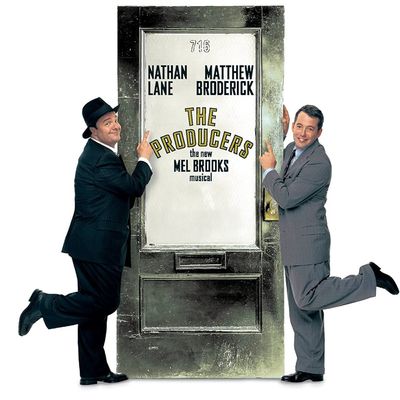
[7:21] Jennifer Smith: Producers play the usherette. Two usherettes come out at the top of the show and it was a Nazi tap dancer, paratrooper, a little old lady. Well, there were sort of three little old ladies at the beginning of that number. It was one of those, those little old ladies. Susan Stroman is so very talented and so organized. She has an entire vision of the show when she comes in. She gives you very specific things when she's blocking it, especially choreographically. And she, she's brilliant at seeing the whole picture. You're given sort of a structure, structure to work within. Like with the little old ladies, the three little old ladies, there was hold me, touch me, lick me, bite me. And I was lick me, bite me.
You know, in the movie and in the source material, really it was just hold me, touch me is the only little old lady you really knew. So we were given leeway to sort of explore. So I decided, I based my little old lady on a character from one of the soap operas. She was sort of a British little old lady. So I made her a little more like this. And they allowed that.
[8:25] Jennifer Smith: Oh, in Victor, Victoria, there were two things I did in Victor, Victoria. I know one of the, the maid in Victor, Victoria, it was a hotel. And so it was two levels. The set was two levels. Blake Edwards said, you're a maid, maybe you drink. So my maid would go and she'd start cleaning the room and she'd end up at the mini bar and she'd take a little tipple out of every room. And so by the end of the scene, I was drunk and I was falling off the bed and that was a lot of fun. That was a lot of fun. And also in that, I played this little, the theme here is little old ladies. But in one scene, I played this little cleaning lady and I'm all hunched over. They gave me this great fat suit with a hunchback and I was cleaning and Julie Andrews sings a high note and I fall over.
But that made, that was really fun to work that out because I was taking cues from, you know, cue lights and because I couldn't see, you know, it was all based, it was, we called it the cat and mouse scene. You know, I had to be doing something when someone was entering downstairs and I couldn't see them. I didn't know what they were doing. So we'd have cue lights, you know, so it was like, okay, I've got to take a drink with that cue light. That was really fun.
[9:53] Jennifer Smith: Well, I think it boils down to two things. What makes us feel better than to create something? You know, that we're creative artists. So that's part of our nature. That's part of our job. And the other side of it, quite frankly, is use this word and I don't mean it negatively, but it's, it kicks you into doing something is the fear of boredom, quite frankly, because if you're in a long running, if you're lucky enough to be in a long running show and you can, you can stand being in a long running show, I think you have to constantly be sort of challenging your creativity to keep yourself alive on stage and to keep you from going crazy. Again, you have to work within the confines and you know, you have to base it on the truth of the show and you have to fall into the big picture of the show.
But I think those two things for me are the motivating factor. That's just, that's my motor that runs me and the fear of boredom or fear of being boring. Maybe that's more it, the fear of being boring.
[11:08] Mo Brady: Thanks for listening, guys. Until next time.
© Broadway Podcast Network, All Rights Reserved