

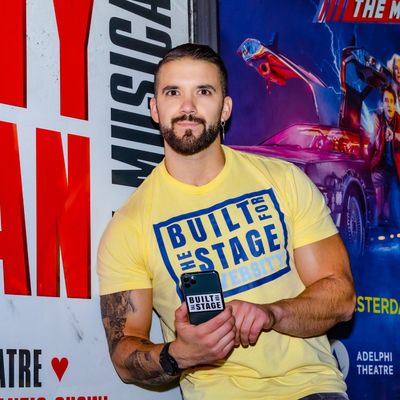
This week, we are pivoting our stories about the Coronavirus from how it caused theatre productions to shut down to what performing artists are doing with this time. Today, we speak to Joe Rosko, founder of Built for the Stage, an online training program that helps actors achieve their fitness goals... Read More
From the show: The Ensemblist
Guests
About
This week, we are pivoting our stories about the Coronavirus from how it caused theatre productions to shut down to what performing artists are doing with this time. Today, we speak to Joe Rosko, founder of Built for the Stage, an online training program that helps actors achieve their fitness goals. We spoke about how to stay mentally and physically fit during this time of isolation. Here's our conversation...
Transcript
This transcript was automatically generated and might contain errors.
[0:00] Mo Brady: Hi, I'm Brooke Wyndham, and welcome back to the Wyndham Workout Disc 2 Challenge and our daily commitment to being the best that we can be. You're listening to The Ensemblist, the only podcast that shows you Broadway from the inside out. Welcome, I'm Mo Brady.
[0:20] Mo Brady: As we are all getting used to life in self-isolation, we are trying to figure out ways to stay healthy and stay happy. One of the most important ways to do that, of course, is to stay physical. As theater artists, we are always trying to use our bodies to tell stories. We want them to be in tip-top shape, and so having a strong instrument is important. So I got one of my good friends, Joe Rosko, on the phone to talk to me about how to stay healthy and happy during this time when we're all being cooped up, as it were. Joe is the founder of Built for the Stage, which is an online training program that helps actors achieve the physical bodies they need to be able to perform eight shows a week. We chatted on the phone earlier this week about his tips and tricks to stay happy and healthy during this time. Here's our conversation.
[1:11] Mo Brady: Hi, Joe.
[1:12] Joe Rosko: Hi, Mo.
[1:13] Mo Brady: Would you introduce yourself and tell us what neighborhood of New York City you live in?
[1:17] Joe Rosko: My name is Joe Rosko, and I live in Queens, New York.
[1:22] Mo Brady: How you doing, buddy?
[1:23] Joe Rosko: I think I'm doing as well as we all can do, right?
[1:27] Mo Brady: Now, you have a pretty big online community of people who are Built for the Stage fans.
[1:32] Joe Rosko: Yeah, it's an interesting place and position for me to be in because I'm in contact with a lot of people from the fan, and I'm hearing so many stories.
[1:44] Mo Brady: What are you doing as a fitness professional to help us feel a little less crazy?
[1:48] Joe Rosko: New York closes gyms, and then I think 38 other states closed gyms. I have clients that work out at home always, but predominantly, my clients work out from the gym. I immediately started making new demo videos because in the app, everything's mostly based around them being able to see me do these movements, and also just making new programming so that literally everyone can work out at home.
[2:14] Mo Brady: What are you finding are some common issues that your clients are having right now because they can't get out of the house?
[2:22] Joe Rosko: Yeah, for a lot of us, our psyche, it's tough to be in your home where you eat, sleep, and lounge, I'll just say those three things, but yet get yourself to work out in that space. Same goes with it's tough to do work in your bedroom, on your bed. You just can't get in that frame of mind. You have to go to an office. That's the first thing. The second thing is that now that people are stuck inside and have time on their hands, they want to eat and eat and eat because their mind is wandering, or they're getting bored, or what I call snow day syndrome, which is like when you're a kid and you have a snow day, it's like all hell breaks loose. It's like, let's make s'mores and let's watch movies all day.
But the reality that the fam has to be aware of is that this isn't just going to be a snow day. Most likely, it's going to be the remainder of this week, maybe next week. We really don't know how long this tight lockdown type of situation will be. We have to find as much normalcy in this day-to-day as possible. What tips and tricks can you offer people who may be cooped up in a small apartment about finding the motivation to work out, making the space to have that happen?
[3:45] Joe Rosko: Well, if you'll let me just kind of go on a bunny trail about the psyche and the mental part of it, because really it starts there. The quote unquote motivation isn't really going to come until you get those prior ducks in a row. First, I'd say have a schedule. I've said that with the Corona thing going on and without. The schedule is important. Hey, I'm going to wake up from this time to this time. I'm going to get this done and this and this and that. So that it keeps you on track. If you're just kind of chasing your tail and wandering around aimlessly, the motivation's not really going to come. But if you say, hey, at this time, I'm going to do this, then hopefully it'll get done. So what are you doing to create structure in your life, in your New York City apartment, Joe?
[4:29] Joe Rosko: I know for me that if I can get my workout in first thing, it sets the tone to my day and gets the momentum rolling for me physically, mentally, spiritually. So I've been getting up earlier than usual because I've had a lot of extra work to do. So I've been getting up at 5:30 a.m. and getting my workout done. You don't have to do that. But once you get up, if you can try to get right to it. And then afterwards, I've been switching up my diet to a lower carb diet and doing higher fats because fats sustain us longer than carbs do. And carbs will make us hungrier, faster than fats.
[5:11] Mo Brady: If someone isn't used to working out at home, give us a guide. Give us like a 10-minute starter workout that can be like the first thing that's going to get us up off of the couch.
[5:18] Joe Rosko: Yeah, well, there's four primary functional movements that we all need to be able to do as humans, which is sit down and get up. We need to be able to pick something up off the ground and we need to be able to put something over our head. And then the fourth would be getting up, but instead of from sitting, from the ground. So a sit-up. So four basic movements would be a sit-up, a squat, some type of hinge where you're picking something up and then a press where you're putting something over your head. Those four things in some type of combination or different type of modality are important to be practicing. And for me, I'm always at the mindset of like, I have to go to the gym. Like I have to have these pieces of equipment and whatever. And then I just went live on Instagram and I started doing my bodyweight workout that I programmed and I'm like, F, this is hard.
[6:15] Mo Brady: I can tell you that those bodyweight workouts you program are hard.
[6:18] Joe Rosko: Yeah. So I go in it with the mindset of probably a lot of people are like, this is lame. I'm at home. I just stuffed my book bag with books and rice bags and my Hamilton book and Playbill binder. I literally, I literally did that. I had my Playbill binder and Hamilton book and my book bag with some rice and it was hard. It got difficult. If you have a book bag that can hold weight, your piece of equipment there as far as a weight goes. So you can pick that up, put it overhead. You can hold that to your chest and squat it. You can put it on your back and squat it. You can lay on the floor and floor press it. You can sit up and sit-ups. And then you can also hold the bag and do weighted sit-ups. There's a piece of equipment right there. It's just a stuffed book bag.
[7:05] Joe Rosko: And how long should we be working out at home? It could be literally seven minutes long if the intensity is high. And if the intensity is low, then you can be upwards of 60 minutes or more, but in a home workout, most likely when I'm programming for my clients, it's going to be somewhere between 20 to 40 minutes, some more controlled, isolated, stability movements. And then we'll do some more intense circuits to jack the heart rate. And then we'll do some type of restorative movements just to tune up the body a bit. 20 minutes of fitness in your day can have a positive impact on the 23 hours and 40 minutes of the rest of it. And that's what I think people need to hold on to is that if I just get moving and do this for myself and my health, that it's going to be a chain effect.
Okay, I just worked hard. I'm not going to pick to eat this pie or this cookie or whatever. Have it when it's appropriate. But at the moment, I'm going to fuel myself because I just put the work in. Or man, that felt great to achieve that. What's next? Oh, I've been putting this other thing off for three months and now I'm at home. Let me get to it. So those 20 minutes can be the deciding factor of the entire rest of your day because they're 20 minutes that you did it for you. You did it for yourself. It's something that you can instantly see that you're better.
[8:43] Joe Rosko: When I feel like I'm lost or don't know how to move forward in this, my fitness has kept me grounded in feeling sane and still capable to improve something. It happens to be myself because I'm working out myself, my body. But there's something mentally refreshing to know that I've bettered something, that I've moved something forward because I feel so helpless. And I want people to hear that and hear that I'm vulnerable. I know that we all are, or we're all pretending not to be or withholding things, but this thing can be scary or lift anxiety. And my fitness is one thing that I've been going to, to just have some type of groundedness as well as help it. I'm getting emotional as well as helping my clients because helping others is always, you know, you help yourself when you help others.
I just happened to do it through fitness, but I know that our talented community has a variety of ways of being able to contribute. And I see it every day already. And I can encourage people to do that as well, help yourself with your fitness and other things that you might have in mind, but definitely your fitness, and then look to see how you can help others because the only way and the best way we're all going to get through this is together.
[10:27] Mo Brady: Special thanks to Joe Rosko for sharing his stories with us today. The Ensemblist was produced today by me, Mo Brady. There are two great ways you can help The Ensemblist right now. The first is by leaving us a rating and review in Apple Podcasts. And the second is by becoming a Patreon member. You can do that at patreon.com slash The Ensemblist. Please make sure you're following our podcast on Apple Podcasts or Spotify, wherever you listen to podcasts, or you can find us at broadwaypodcastnetwork.com. And make sure you're following us on Instagram, where we are sharing the stories of artists dealing with the coronavirus and how to stay creative in its wake. Thanks for listening. Until next time.
© Broadway Podcast Network, All Rights Reserved