

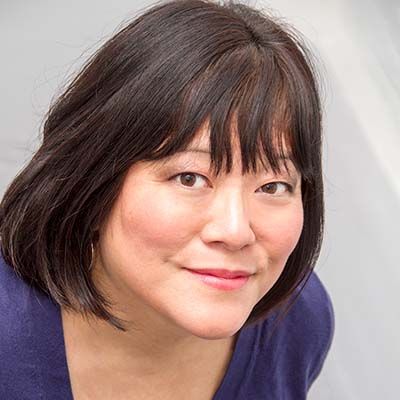
On this week’s episode, we’re sharing our favorite moments from our interview with Ann Harada. After getting her start as a PA and office assistant for theatrical producers, Ann Harada made her Broadway debut in M. Butterfly... Read More
From the show: The Ensemblist
Guests
Featured Shows


About
On this week’s episode, we’re sharing our favorite moments from our interview with Ann Harada. After getting her start as a PA and office assistant for theatrical producers, Ann Harada made her Broadway debut in M. Butterfly. She’s since performed on Broadway in Seussical, Avenue Q, Les Mis, 9 to 5, and Cinderella. From originating the role of Christmas Eve in Avenue Q to playing Linda on TV’s Smash, Ann’s career is one for the books. Here’s our conversation...
Transcript
This transcript was automatically generated and might contain errors.
[0:00] Jackson Klein: You're listening to The Ensemblist, the only podcast that shows you Broadway from the inside out. Welcome! I'm Jackson Klein.
[0:25] Jackson Klein: Welcome back to our re-release of Season 4 of The Ensemblist, Broadway at Every Stage. In this series, co-creators Mo Brady and Nika Graf Lanzarone sat down with six seasoned Broadway actors to dive into their decades-long careers. They discussed getting started in theater, the ups and downs of show business, and the longevity of their careers. On this week's episode, we are sharing our favorite moments from our interview with Ann Harada. After getting her start as a PA and office assistant for theatrical producers, Ann made her Broadway debut in M. Butterfly. She's since performed on Broadway in Seussical, Avenue Q, Les Mis, 9 to 5, and Cinderella. From originating the role of Christmas Eve in Avenue Q to playing Linda the stage manager on TV's Smash, Ann's career is one for the books. Here's our conversation.
[1:29] Ann Harada: My name is Ann Harada. I live on the Upper West Side. I graduated from Brown and I went off and I did non-equity summer stock where I made $40 plus tips a week and we wore like those dance skins with the wrap skirts. Those were our outfits when we served food. And when we did the cabaret show and then we did this main stage show. You can just imagine how great this evening was in the theater. So I was coming off of this experience thinking, okay, I'm making money as a performer, but I don't know if that's something I'm going to be able to do professionally in New York. I decided to intern for this Broadway producer who had gone to my college and was looking for a recent graduate to like type letters and answer phones.
That's how I learned about Broadway producing. And it was for a show called Sleight of Hand, which was a play by John Peelmeyer. And it ran one week at the court. And a lot of things went wrong with it scenically and dramaturgically. I was like, okay, I don't know that being a producer is really the greatest job I've tried to do, but it was interesting to sort of see a show from the ground up. So I went off and I did another summer stock job. And at that point I thought, I think I'm good enough to try auditioning for things. When I came back to the city, I started going out on auditions and my friend, she worked in casting for Manhattan Theater Club, and she was like, why don't you come in for this thing we're doing?
And it was 1, 2, 3, 4, 5 by Maury Yeston and Larry Gelbart. So I came in and I auditioned and I got the job. So now I'm doing this thing off Broadway with very high profile people. And I had to join the union and I was so happy. I ran down and I wrote my check for $800. 1, 2, 3, 4, 5 is a show that's basically based on the first five books of the Bible. Liz Calloway was in it and she was my idol. It was just so, so fun. Between 1, 2, 3, 4, 5 and Bring Me to Chicago, I go back and I work for my producer. Because of Sleight of Hand, I met the manager of one of the actors, Jeffrey DeMunn, and we became friendly. And then I did my club act at the duplex and I invited this manager to come see me.
And she said, I would send you out and I could help you. So then I got a call from Meg Simon's office and she was also working on Sleight of Hand and so I had known her. She called me in and I went in for M. Butterfly and I got it. And it was to replace one of the original cast members. So then I had the manager negotiate the contract for me. And I've been with that manager ever since.
[4:14] Ann Harada: When I first started going out on things, I would meet agents and nobody was ever interested in me at all because I'm sure it was obvious to them that I was a character actor waiting to get old. This was me at like age 24. I wasn't going to be of any use to anybody until about 36. But this woman really saw something in me and she thought I was talented. And she brought on her partner, this other agent, and he is currently my manager. She passed away a few years ago. So I've basically been with the same office since 1988 because they're the only ones who ever cared about me. There's a big trust. There's somebody who knows me, who's seen me grow up, like came to my wedding, visited me in the hospital when I had my baby, like seen all my life changes, basically.
The only reason I moved to Chicago is because I had met this guy who would eventually become my husband. And I met him here in New York and he immediately got this job that sent him to Chicago. And so we decided we were going to try to long distance our relationship for a while, which we did. And then I was like, this could be the guy, but I'm not going to know that unless I live with him and I have more flexibility than he does. So I'm going to move to Chicago and see how it works out.
[5:11] Ann Harada: Amazingly enough, it was the worst time work-wise of my life. Like I don't know if it was just me, my age, my type, whatever. But I went to Chicago and it was like nothing. To get any work at all, I had to be in New York because everybody knew me in New York. Nobody knew me in Chicago and nobody cared about me in Chicago because I had New York credits and they're very into their own scene. So I got literally one job out of an open call in Chicago and it was to go to Kansas City to do Song of Singapore. And I did that job and I had a great time, but I was like, this is not cutting it. I have to do more stuff. In New York, they would just call me in for stuff and I would fly in and do the audition and sometimes it worked out and a lot of times it didn't work out.
But ultimately it worked out and I kept my apartment so I always have a place to come back to. We were in Chicago for like a year and a half and then we moved to Boston, which is much easier to get to because it only involves a bus. But because of that, I was back and forth from Boston to New York constantly. I would be in Boston and I would get a phone call like, can you come in for an audition on Friday? Okay. I'd be on the bus learning my lines, whatever, come in, do the audition, stick around if I thought it would require a callback and then go home. But the whole thing proved to me was that this was the person that I was going to spend my life with. So I don't feel bad about making those choices and in a way it was good for me to know one way or the other, no, you need to be in New York. You can't actually get work any other place.
[6:36] Ann Harada: Other people could work fine and Harada could not work at all in Chicago or Boston really. Because a lot of the Boston jobs that I would have gone in for, which were equity jobs, they cast in New York. So what's the point of that? I thought because I was going to cities that I knew had theater communities, that I would be able to find my way into them somehow and it just never happened. I also think back in the nineties, people were just not as open to non-traditional casting. And most of my roles have always been non-traditionally cast because for whatever reason, I don't fit into the mold of Asian girl that people wanted to try to slot me into doing King and I's and whatever. I never ever have done King and I. Every once in a while, I would get a South Pacific and I would go do a South Pacific, but that was it.
You know, I had gone in for Miss Saigon and I sang fine and I got all the way through the singing, again, out because I cannot dance. And that's just sort of how it is. And that was true with all the other Asian-y shows then too, Shogun. I wasn't right. And I look back on it now, it's like, it's so obvious to me why I wasn't right for these shows, given what they needed. It was literally like, well, even if they thought like, she's great, I totally cannot use her.
[7:58] Ann Harada: My first Broadway show as an ensemble list was Seussical. And I'd gone into that because Stephen Flaherty had seen me do this all Asian production of Falsetto Land where I played Trina. And so he thought I would be good in the Seussical as a bird girl. And at the time when they conceived it, it was just like three girls who sang harmony. I was so happy to do that for him because I idolized him. So I was in the very first reading of Seussical and all the subsequent readings of Seussical. And then when it actually went to production, they were like, oh no, the girls should actually try to dance. And that's all of a sudden I wasn't a bird girl anymore. And they had to figure out if they could use me at all.
And they decided that I could cover Mrs. Mayer and that I would have to be in the ensemble. But it's not like I ever danced for Kathleen Marshall. And this is how I get all my ensemble jobs is I never have to dance for anybody. They think, oh, she'll cover so-and-so. And now we're stuck with her and she has to do stuff. I was the kind of person when somebody was sick and they would be like, Ann, can you reverse? I was like, no.
[8:53] Ann Harada: Cut me out of the number if you need me to reverse, because I absolutely can't do anything to the left. So they were like, okay, okay, just stand in a different place, and I was like, great, great, great. Similarly, in 9 to 5, I never auditioned to dance for Andy Blankenbuehler, who's like a serious choreographer, but he didn't have any choice. They had just called and offered me, will you cover Alice and Janney in this thing and be in the ensemble? Well, yes, of course I will, because you're asking me to cover a star that is so physically unlike me as to be comical. I think this would be a great learning experience. I'd be happy to do that. Oh, no, I have to be in the numbers. And so I got to rehearsal, and I was literally like, I can't do this.
I literally thought I was going to get fired because I don't think like a dancer. I don't know how to count very well, and Andy is the kind of person that is very brusque. He just assumes like everybody knows what he's talking about, and he was just like, and you go on the 13 and, and I was like, the 13 and? Like, I didn't know that you could count past 8, so I hadn't really been counting past 8. So I would be like counting really, really hard trying to get to 13 and to stick my arm out, and I was just like, I can't do this.
[10:00] Ann Harada: I think that Broadway success is such a weird, loaded concept. If we are in the show, and we worked on the show, and we developed the show, and we're proud of the show, of what we did and what we did together, that's the goal, right? You can't be sitting there going like, are we going to win the Tony? Are we popular? You just run around in circles with that kind of thinking, and it's not helpful. My goal as a young actor was to be on Broadway, and I've been privileged to do it six times in ways that I never thought that I could. So I'm like, yes, Seussical was a flop, but I remember those times when we were just first putting it together in a rehearsal room and thinking, this is the greatest thing ever, and we are so excited. You can't beat that. I was so proud, and I'm still really proud of what we did there.
[10:47] Ann Harada: All the things you can think, all the things you can think, all the things you can think, all the things you can think, when you think about it. I will do any reading in the world. If you have $100 and a week, I will do it. And I really believe in that process, because if I hadn't believed in that process, I wouldn't have done Avenue Q, because those were just two guys from the BMI workshop. I didn't know them from a hole in the wall. I got the material, and I was like, this is funny, and I was happy to be a part of every version of Avenue Q there ever was. Every BMI presentation, every table read, every let's do it for investors. I mean, we did this for three years until we went to the Vineyard. And also, you just don't know which ones are going to keep going. Nothing's a guarantee, and sometimes you just can't physically be there for every single time.
[11:33] Ann Harada: But it's so rare to me that you do readings, and then it goes to a production, and then you feel terrible when it actually does, and you can't do it. That happened to me with Freaky Friday. I couldn't go away to Cleveland and La Jolla and all the places it was going, because it was during the school year, and I have a kid. And I was like, I can't make that kind of commitment. How I feel about Avenue Q is like, not only did that show put me on a map, after that show, I never had to explain who I was again, but that it's been around long enough, and so many people have seen it, that they could put it in their mind as a dream role, in the same way that when I saw You're a Good Man, Charlie Brown when I was a little girl, I was like, I'm going to play Lucy, I'm going to play Lucy, that kind of a thing. It's very rare that people get the opportunity to originate a role, and to be associated so strongly with a role. So if you get that in your life once, you're very, very lucky.
[12:22] Ann Harada: To me, this is your legacy. It's all that we have, because we have no record of it. Theoretically, it just exists in people's memories, and it exists in your memories. So if somebody young has an attachment to it, because they like the material, they like the way that you did it, or they saw you once, that's how you live. That's how you go on. So that's pretty special. And I think that what's so great about theater for me, is that it's so transient. That recollection, it's like such a pure art form. Alice Playton, when I worked with her on Seussical, I just adored her. And she was in the first show I did, 1, 2, 3, 4, 5. And then we were in a Broadway show together, and I was her understudy. But just this past year, I did Dear World at the York.
And somebody came up to me and said, you remind me so much of Alice Playton. And I literally burst into tears. And she was so shocked, because she didn't think that I would even know who that was. But she had been a good friend of Alice's. And I was like, oh, you just couldn't have said anything nicer to me, because she felt alive again. And you know, that's that sort of thing. What else do we have? We're throwing our art into the air, and then it goes away. And hopefully somebody sees it and cares. But if they don't, that's that.
[13:39] Ann Harada: It's a no-brainer why I went back to Q after 9 to 5, because Q was closing. And they said, would you come back for the last three months? And I was like, of course, because I felt that I had learned new things when I was in London doing it with that cast. I just thought, I just want to try different and see what happens. And it was like my home. The reason I went to London was because they had lost their Christmas Eve to a TV show, and they needed somebody who knew the part already and could do it on a moment's notice. And I said, well, that could be me, but I have a family. And you know, my kid is like one, and I have my husband, and my parents are living with me. And they were like, well, bring everybody.
We will take all of you. We will get the visas, and we'll arrange it, and get you a flat, and do all this stuff. And I was like, oh, well, if you're going to do all that, great. So I just set my conditions. That's not anything that would ever happen to me normally. When they need you badly enough, stuff like that can happen.
[14:29] Ann Harada: What's great about Broadway is that people are so generous with their time, and they don't scream at you when you ask them, would you do this for me? That just doesn't happen on the West End. There's not that sense of community. I never got that feeling like, we're all going to work at the same time like you do here. I just think the fun part of Broadway is being able to have that sense of you can walk around and visit other shows and have that connection where you're all doing something together. It's made me a different actor in terms of I think harder before I say yes to things. And if I choose to go away for whatever reason, it has to be for something I really care about. It's such a sacrifice of time away.
[15:12] Ann Harada: The first time this was really an issue was when I did 9 to 5. I went out to California because we did it the first time out there. Elvis was maybe three. And I was away for like two months. And we planned one visit because it was so far. And I was just like, this is too long. Even now, even though he's older and theoretically more independent, I try not to go out of town unless it's vitally necessary, or it's a very short job because it's just too hard. It's not fair to my husband, who then turns into the single parent. So it's about choice. What is the trade-off here in terms of how badly do I want, need, care about this job opposite the well-being of my family?
[15:48] Ann Harada: The thing I would say to the girl in her 20s is go to dance class. There's no need to have been as terrible as you were. And if I had done it in my teens, maybe I would have actually had some level of skill, or at least try to practice sequencing because that was the part I could never get. Number two, and the most important thing for me, is you're not fooling anybody. You can put on your Spanx and you can put on your makeup and whatever, but you're still you. You might as well just be comfortable being you because that's ultimately what's going to get you the job or not get you the job. And if you're what they're looking for, then why pretend to be something else? And if you're not what they're looking for, then you're not what they're looking for, and there's nothing you can do about that. I can honestly say that I do bring myself to the table 75% of the time. And the other 25% is just trying to remember my lines.
[16:48] Ann Harada: Special thanks to Ann Harada for allowing us to reshare her stories this week. The Ensemblist was produced today by Mo Brady, Anna Altide, and me, Jackson Klein. There are two great ways you can be helping The Ensemblist right now. One is by leaving us a rating and review on Apple Podcasts. The second is by becoming a Patreon member at patreon.com slash The Ensemblist. Please follow The Ensemblist wherever you listen to podcasts, whether that be on Spotify, Apple Podcasts, or at our home on Broadway Podcast Network at bpn.fm. You can also follow us on Instagram. Thanks for listening. Until next time.
© Broadway Podcast Network, All Rights Reserved