

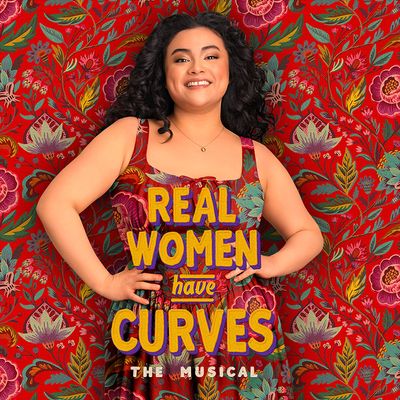
The cast and creative team behind Real Women Have Curves: The Musical gathered for an exclusive press day, and we were there to soak in the joy, passion, and powerful stories that define this new Broadway production... Read More
From the show: The Theatre Podcast with Alan Seales
Guests



Featured Shows
About
The cast and creative team behind Real Women Have Curves: The Musical gathered for an exclusive press day, and we were there to soak in the joy, passion, and powerful stories that define this new Broadway production. From bold choreography to songs that stick in your head long after the final note, this episode captures the spirit of a show that centers Latin culture, immigrant narratives, and shared humanity in a way that’s as timely as it is timeless. Whether you’re drawn to the musical’s universal themes or its deeply personal storytelling, every voice in this episode brings something heartfelt to the table.
We hear first from producers Barry Weissler and Jack Noseworthy about why this story matters now more than ever, followed by composer/lyricist Benjamin Velez, who shares how he and Joy Huerta crafted the musical world of 1980s East L.A. Alan Madagoitia then gives us insight into her powerful role as Itzel, an undocumented immigrant from Guatemala. Writer Nell Benjamin reflects on adapting a true story with timeless themes, and Sergio Trujillo dives into directing and choreographing something deeply personal. We also hear from cast members Carla Jimenez and Jennifer Sanchez, who infuse their characters with humor, heart, and lived-in truth. Finally, Florencia Cuenca shares her emotional journey as Estela, and how this role has transformed her both personally and professionally.
Visit https://www.realwomenhavecurvesbroadway.com/ for tickets and more info!
🎭 Interview order:
- Barry Weissler (Producer) & Jack Noseworthy (Producer)
- Benjamin Velez (Composer/Lyricist)
- Aline Madagoitia (Itzel)
- Nell Benjamin (Writer)
- Sergio Trujillo (Director/Choreographer)
- Carla Jimenez (Pancha) & Jennifer Sanchez (Rosali)
- Florencia Cuenca (Estela)
Connect with The Theatre Podcast:
- Support us on Patreon: Patreon.com/TheTheatrePodcast
- Twitter & Instagram: @theatre_podcast
- Facebook.com/OfficialTheatrePodcast
- TheTheatrePodcast.com
- Alan's personal Instagram: @alanseales
- Email me at feedback@thetheatrepodcast.com. I want to know what you think.
Transcript
This transcript was automatically generated and might contain errors.
[0:01] Alan Seales: Hey everyone, this is Alan Seales with The Theatre Podcast and Broadway Podcast Network. We are here on the press day of Real Women Have Curves. And we just had four exclusive performances and everyone around me is just still humming the song. It's incredible. Real women have curves. It's great. Can't wait to share this with you. Stay tuned.
[0:44] Barry Weissler: I'm Barry Weissler, the co-producer.
[0:47] Jack Noseworthy: I'm Jack Noseworthy, the co-producer.
[0:49] Alan Seales: And both of you have long careers producing some very popular things in the past. What makes you want to attach yourself to something like this now?
[0:56] Barry Weissler: Well, I mean, listen, I mean, we could have never imagined how important and how timely the story is that we're telling. And really just, I think, telling great stories and entertaining folks. I mean, I think most importantly, you want to do something that is commercially viable and socially relevant. And Barry does that incredibly well. So we're thrilled.
[1:15] Jack Noseworthy: The show is so universal. It's about mothers and daughters. It's about trying to achieve the dreams of your life. You know, in difficult circumstances that our people come through. Starting in 2019, 2020, we're talking about. And of course, workshops and readings and things evolve and whatnot. And then now, 2024 to 2025, this is a very weird, I'll use weird very lightly, political climate we are in. Has the show evolved based on what's going on outside of New York in the theater?
[1:48] Barry Weissler: It'll be interesting to find out. The creation of the show, what we've done is we have, we're making the best show we can. There's source material. You know, we've adapted this. We've adapted the play. We've adapted the movie. And we're creating the best show that we can create that we know how to create. But the outside hasn't influenced our creation, but the outside will influence how people view it, which I think is actually really exciting.
[2:14] Jack Noseworthy: Exactly. And would be like that on any show.
[2:16] Barry Weissler: Yeah. It's about respect for the human condition.
[2:21] Jack Noseworthy: Yeah. About people trying to achieve something, trying to make something of their lives. Let's hope it has resonance all over the United States.
[2:37] Benjamin Velez: My name is Benjamin Velez. I am the co-composer, lyricist of Real Women Have Curves. Co-composer, lyricist, and we just heard four amazing songs.
[2:46] Alan Seales: Thank you. I still got Real Women Have Curves stuck in my head. Love it. And so where are you drawing your inspiration for something that, it's been a book, it's been a movie, and now it's become a musical? And how much are you leaving out? How much are you putting in? Like where do you even start with this?
[3:01] Benjamin Velez: Yeah, it's tricky because you want to do something fresh. You want to bring something new to it since it's the third iteration of the story. I think what was really fun is that Joy and I, Joy is my collaborator, we each have lots of our own different musical references. So when we came together to kind of find the sound of this world, we were all pulling from all sorts of places. Like it's set in the 80s, so we wanted to bring a little bit of that. What would have been playing on the radio at the time. These women are working in a factory all day with music playing. So it's like you want to try to capture, music is just part of that world. The sound of the percussiveness of the sewing machines, and all kinds of ways that we wanted to build to make it feel organic, but also it's a musical, so it can't all just be music diegetic things. But Joy has her own style and her pop music, so we pulled from that. We really tried to dig into what does each character's sound feel like.
[4:03] Aline Madagoitia: Hi, my name is Aline Madagoitia, and I play Itzel in Real Women Have Curves. Tell me about your character, without giving away, no spoilers, what does she want in the show, what is her purpose?
[4:09] Aline Madagoitia: Yes, so Itzel is a girl from Guatemala that recently crossed the border. She is the newest arrival to the factory, the Garcia family factory. And she is 19 years old, she has lived a very intense life in Guatemala. Very intense life in Guatemala in the 80s, which was like a whole shit show. And in order to help her family, like so many immigrants, has to make this really difficult choice to cross the border, and to go make money so that she can support her family back home. And I think there's a really nice kind of parallelism between Itzel being the daughter of her family, Ana being the daughter of her family, Estela being the daughter, you know, it's all about these women that kind of have to take up the mantle to support their families because there are no other options.
So I was born in Mexico City, child of two actors and theater makers, so bit the bug in utero really, no choice in that matter. And basically we moved to the U.S. when I was 10 years old, so I've been here most of my life, but I have the great privilege of being able to travel back home, so my whole family's still there. I'm really lucky that I have a very strong connection, and honestly my immigration story is a little unusual, which is a whole other long, long story. But no, I have always felt like every immigrant has this what-if of what if I had grown up in my home country, what if we had stayed there? What if I had been born here and only known this? And I think every character in this show represents a different story, and we get into it, and I'm very honored to represent Itzel because Itzel's storyline, especially being from Guatemala, which being a Central American immigrant, especially at that time, it's a whole other thing.
And I think we are probably the first time that we are really kind of bare bones representing someone who is undocumented on a Broadway stage, and I have a lot of weight on my shoulders to do that, and I'm going to try my best to represent that with all of the humanity and dignity that I can.
[6:27] Alan Seales: Have you talked with your parents about this, specifically about what it means to represent Latin women and Latinx culture in general on Broadway here in New York?
[6:39] Aline Madagoitia: Yeah, I mean, we talk about it a lot, and I think as the months have gone on since I found out I had this job and the situation in our country has sadly gotten a lot more cruel and unjust, it has only gotten weightier, and I think by the time we open in April it's going to hit even more differently. So all I can do is just trust the writing. I mean, this amazing team has written a beautiful character that I think makes a really big impact, and I'm just going to do my best and just be ready to see how the audience receives it, because that's out of my control, but I hope that we can bring some compassion out of people.
[7:27] Nell Benjamin: My name is Nell Benjamin, and I'm one of the writers on Real Women Have Curves. This started in multiple different forms, right? It was a book, and it was a movie.
[7:35] Alan Seales: It was a play, it was a movie, yes.
[7:37] Nell Benjamin: Right, so then bringing this into current times, because it's been 15-something years, I think, since the movie even came out, right?
[7:45] Alan Seales: Yeah.
[7:46] Nell Benjamin: And so how did you start with adapting it for modern day, modern culture, or did you even start with that, or did you completely start fresh with just the storyline?
[7:53] Nell Benjamin: Well, it's set in 1987, but the storyline still resonates in a lot of ways to today, particularly to today.
[8:00] Alan Seales: Yep.
[8:01] Nell Benjamin: And I sort of came late to the project. I'm working with Lisa Loomer, who is an extraordinary playwright, and really, she lived in L.A., she knows these characters, and the original playwright, Josefina Lopez, this is her story. She lived it. She was the lead. And she worked in her family's dress factory and wanted to write and then wrote. This is based on a true story.
[8:22] Alan Seales: It is, yeah. I did not know that.
[8:24] Nell Benjamin: And so it's kind of, as it goes through its permutations, there is a certain amount of updating, but it's so universal, we don't necessarily need to do a lot of updating. So it's not like figuring out what's the part social media plays in this. It's more what's universal about it for all audiences.
[8:44] Alan Seales: There was no social media in the 80s.
[8:45] Nell Benjamin: No social media.
[8:46] Alan Seales: What did Facebook, what was it, Friendster?
[8:49] Nell Benjamin: Before for anyway.
[8:51] Alan Seales: Top five, top ten.
[8:52] Nell Benjamin: I'm going to pretend I have no idea what you're talking about.
[8:54] Alan Seales: Friendster is top eight, right? You'd be my top eight.
[8:57] Nell Benjamin: Thank you. So then bringing this today, what we saw today is just obviously a snippet of the larger story. And overall, from beginning to end, what do you hope people are going to walk away, people of all cultures, all races, all genders, what do you want people to walk away from after seeing this show on Broadway?
[9:15] Nell Benjamin: We have so much pride and joy in this room every day. We literally have joy. We have Joy Huerta. She's our composer. But, no, to be quite serious, it is a joyous show. It is about struggle. It is about the, excuse the pitch, curves that life throws you. But the way the women in this community handle it of all ages, I think just speaks to everyone. Carmen, who is the mom in this piece, she and I have very different life experiences, but we're both moms. I see in her the fear for your daughter's safety, the desire for her to do better. And I think there's nobody in the audience who isn't going to see a little bit of themselves in these amazing characters, especially as enacted by the cast you just saw.
[9:58] Jack Noseworthy: Right. Well, it doesn't matter what language you speak. It doesn't matter where you're from. Everyone has shared themes. It crosses borders. In fact, I can't think of anything more important to say right now than that we're all human and we have to be a community together. The fire that makes us survive.
[10:15] Sergio Trujillo: I am Sergio Trujillo and I am the director choreographer. And this show, we just saw four numbers that has some direction, some choreography, and some singing. And I'm still singing the songs. They were incredible. For you, you've had such a great career thus far and you've won all these amazing awards. What is important to you about how you pick your projects, your next projects, and then what is it about this specifically that you're like, I'm putting it all aside and this is what I'm doing right now?
[10:46] Sergio Trujillo: This particular show is the most personal show that I've done thus far, for many reasons. One of them being an immigrant. My mother, who was also an immigrant, was a seamstress, and I wanted to find ways in which I could celebrate her, I could honor her, and I could also honor the women in my family and my life who've made so many sacrifices so that I could have this moment. And that is more meaningful than anything else. So, when you're approaching choreography versus direction, is it two separate buckets in your head when you're doing a project where you are both? You know, I think ultimately, because this is an original musical, it was very important for me to keep my, I kept my director's hat on for a long time before I actually got sort of wrapped up with choreography, because I think one of the misunderstandings or the lack of knowing is that when you're directing an original musical, it's not just putting the show up.
It takes a lot of guiding the teams, the writers, the composers, the lyricists, you know, to be able to, you know, and you continue to work on the script, you continue to work on the music, you continue to work on the lyrics, and to this day, we're still working on it. And that is something that, as a director of a musical, is not just simply about designing it or directing the scenes. All of that, all of the other work has to come before you even step into the room. Then, you know, then I have to put on my choreographer's hat, which, you know, up until the A.R.T., at the A.R.T., I really just stayed, I kept my director's hat on, and now, you know, I'm full on with choreography, and now it's like, how do, you know, and also, like, figuring out, like, how do I find movement that is specific to the characters and not just, you know, because they're not dancers.
No one in the cast is a dancer. So I had to find ways to be able to take the best of them and be able, first of all, to give them confidence, because as actors, you know, some of them, you know, are afraid to dance.
[12:49] Alan Seales: Really?
[12:50] Sergio Trujillo: Yeah, yeah, yeah.
[12:51] Alan Seales: Okay. Well, so are you diving into the individual characters' backstories of, like, what countries they're from or whatnot to, like, incorporate that into just their overall blocking, or is it only, you're only layering that into the choreography and the dance side?
[13:04] Sergio Trujillo: No, no, no. The work, I mean, I think that there is, I think the thing that makes this show special is that every single actor in our show is authentically connected to the culture. Yeah. In general, right? Because, you know, you can't deny, you can't deny that truth. You know, you can't, no actor, no actor, I don't care where they're from, can bring that level of truth to material. And so those, the actors that are in this show are bringing all of that, and then, you know, some of them are from El Salvador, from Costa Rica, from Mexico, from Puerto Rico, from Colombia, and then, you know, it requires of, you know, like, just, like, figuring out, it's just, it's like a tailor, you know, you sort of have to, like, configure it all to the...
[13:51] Alan Seales: Just take the measurements, and then you gotta...
[13:53] Sergio Trujillo: That's right, yeah, yeah.
[13:54] Alan Seales: Then you gotta tweak it.
[13:55] Sergio Trujillo: Yeah, yeah, for sure. We would have never, we could have never predicted that our show would be produced at the time when our country and our world is going through what it's going through right now. And I'm specifically talking about immigration, and I'm specifically talking about how it affects the Latin culture, or the Latin community. You know, I think that it's important to address it, but our show's more, it's about more than that. And it's, our show is about finding ways in which our story can inspire, can ignite conversation that can inspire and ignite change, and, but also celebrate aspects of our culture that are transcendent to, and that are universal. Yeah. You know, that no matter what happens, regardless of the adversity that we're going through, somehow we manage to uplift ourselves. And that is inspiring.
[14:57] Karla Jimenez: I'm Karla Jimenez, and I play Pancha in the show.
[15:00] Jennifer Sanchez: And I am Jennifer Sanchez, and I play Rosalie.
[15:03] Alan Seales: And for the two of you, being here on Broadway, representing all sorts of cultures, identities, and sexualities and everything. What does this mean for the two of you to be here and bring your characters to life on the Broadway stage for everyone?
[15:19] Karla Jimenez: I think it's huge. I think it's really important to see representation. I think it's really important that an all Latino show is happening right now. And I think that it's moving the needle.
[15:30] Jennifer Sanchez: Yeah.
[15:31] Karla Jimenez: And it's, you know, every, and it's really special and rare to be able to do this. It's just been a really amazing, special thing coming from L.A. and getting to see a show that is set in Boyle Heights, and you've never seen that before.
[15:46] Jennifer Sanchez: She only does shows where she's from.
[15:47] Karla Jimenez: Yes.
[15:48] Jennifer Sanchez: Just kidding.
[15:49] Karla Jimenez: Exactly. I've been doing this for about four years I've been with this project. And I would always be doing my makeup and rehearsals, and then it actually made it into the script. So like, yeah. So when she says, you know, you need lipstick to iron, and I say, I need lipstick to live. It's because Jennifer needed lipstick and eyebrows.
[16:07] Jennifer Sanchez: I think my eyebrows are really under, are neglected in the storytelling of this show. But.
[16:12] Karla Jimenez: That is actually the sequel.
[16:13] Jennifer Sanchez: That's it.
[16:14] Karla Jimenez: Oh, you're right.
[16:15] Jennifer Sanchez: Real women have eyebrows.
[16:16] Karla Jimenez: I was going to say. Yes. Because you know, eyebrows and rain, they don't go together.
[16:20] Jennifer Sanchez: No.
[16:21] Karla Jimenez: That's a hardship.
[16:22] Jennifer Sanchez: That could be a whole play.
[16:24] Karla Jimenez: I play Pancha and she works. She works in the sewing factory alongside.
[16:31] Jennifer Sanchez: La Reina de la Plancha.
[16:32] Karla Jimenez: And I'm the Reina de la Plancha, ironing queen. And she's just sassy. She just says whatever she wants to say. And she has hopes and dreams like everyone else in that factory. And she actually has a lot of like heart and warmth for Anna and wanting her to go after her dream.
[16:54] Jennifer Sanchez: Yes.
[16:55] Alan Seales: So in the climate that we're in and the time we are in now, what do you want people to walk away from after seeing the show? What do you want them to hold with them?
[17:02] Karla Jimenez: Hope. That's like always the first thing that pops in my head because I feel like we need that right now. Right now I feel like the call to inspire, to move, and to hope and dream is so important.
[17:17] Jennifer Sanchez: I think I want people to walk away with knowing that like there's the shared humanity. Whether you are whatever culture you come from, whatever language you speak, like there's a shared humanity that we all have that we can all see in one another. And that it's up to us and our communities to hold each other up and to help each other when shit hits the fan. You know?
[17:41] Karla Jimenez: Like we have to be there for her.
[17:44] Jennifer Sanchez: Yeah.
[17:45] Karla Jimenez: And each other.
[17:46] Jennifer Sanchez: And each other.
[17:53] Florencia Cuenca: I am Florencia Cuenca and I am playing the role of Estela.
[17:57] Alan Seales: So tell us about Estela. What is her arc? What does she want? Without giving spoilers away.
[18:03] Florencia Cuenca: Estela is the older sister. Ana. Ana's sister. And she's the mera mera we say in Spanish. Like la jefa, the boss at the Garcia factory.
[18:15] Alan Seales: Is that a typical blue sister thing?
[18:16] Florencia Cuenca: Yes. Exactly. And she has dreams. She has so many aspirations. But because of her legal status she cannot pursue those. So you're going to meet her and you're going to fall in love with her. But also kind of hate her sometimes because she's kind of mean, kind of rude.
[18:35] Alan Seales: The older sister's going to have to be.
[18:36] Florencia Cuenca: I'm an older brother. I get it.
[18:37] Alan Seales: Yeah.
[18:38] Florencia Cuenca: You get me.
[18:40] Alan Seales: I get it. Are you an older sister in real life?
[18:42] Florencia Cuenca: I'm a real sister.
[18:43] Alan Seales: So you can identify.
[18:44] Florencia Cuenca: Exactly. The inspiration. I've been preparing my whole life for this. Well now that you're opening on Broadway soon, how does that make you feel? Like you personally, what's going through your mind right now?
[18:55] Florencia Cuenca: Oh my god. It's a wild ride. I moved to the States nine years ago. I came here from Mexico City. And I wanted to be on Broadway. When I came here I was like, okay, this is so tough. There's no place for me. I'm a Mexican, Caribbean immigrant with an accent. There's no way I can do it. But now look at this. And this is why representation is so important. So when you first got the notice for the audition though, were you like, is this real? Did you prepare for this in any sort of different way than you would for any normal audition?
[19:30] Florencia Cuenca: I remember I saw the audition and I was like, I'm Estela.
[19:33] Alan Seales: You knew right away.
[19:35] Florencia Cuenca: I knew from the very first time. And I was like, I am that character. And fun fact, we did the first 29-hour reading. And they asked me to be an ensemble member. And I was sure, but I'm Estela. You're like, guys, you need to see this. And thank goodness they switched casting directors. And now they got to see me as Estela. And I was like, I told you from the very beginning.
[20:01] Alan Seales: Well, how is the story that you're portraying on here, the arc of the character, the script, and just this beautiful music that we just saw. How has it changed you so far personally, like outside of rehearsal room and outside of the show itself?
[20:14] Florencia Cuenca: Well, first of all, it's so healing as a Mexican immigrant to get to perform in Spanish too. To sing my rhythms, my musical genres. To just be myself. I can be myself fully in this musical. And I think that's so freaking amazing.
[20:39] Jennifer Sanchez: Yeah, I hear that.
[20:41] Florencia Cuenca: I think because this show is about dreams and following your dreams. I hope they get that. In order to follow your dreams, you need your community too. And the community is the one who makes you fight even harder. And they will always be there for you, cheering for you. This is what is happening to me, right? The people in Mexico, mi familia, all my friends from Mexico. It's like, I cannot believe that this is happening to you. And I hope the audience, no matter who they are, they can relate to what it is to follow a dream.
[21:21] Karla Jimenez: Real women have dreams.
© Broadway Podcast Network, All Rights Reserved