

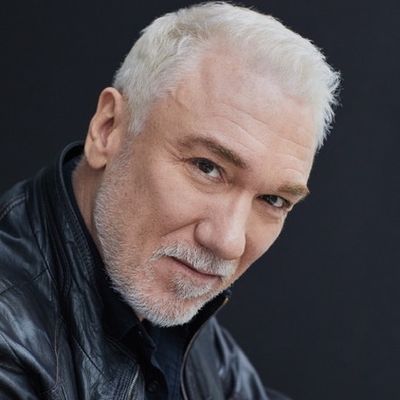
Patrick Page is a Grammy award-winning actor and playwright currently playing Hades in "Hadestown". He looks back on his early years growing up in Oregon and becoming a professional magician wherein he toured an illusion show and won awards... Read More
From the show: The Theatre Podcast with Alan Seales
Guests
Featured Shows

About
Patrick Page is a Grammy award-winning actor and playwright currently playing Hades in "Hadestown". He looks back on his early years growing up in Oregon and becoming a professional magician wherein he toured an illusion show and won awards. He shares how doing magic gave him the validation he needed and taught him about audiences and how to hold the stage. Patrick eventually got deeply interested in acting as a craft and pursued it as a career. While he decided to go for a Liberal Arts degree, he also spent his college years performing in plays. He shares his audition story for The Utah Shakespeare Festival despite being unqualified. Patrick shares how because he didn't go to acting school, he sort of learned by failing. He also talks about the first time someone told him his way of work was out of line and why he considers that a good thing. Apart from acting and writing, Patrick also has an acting studio in New York where he teaches. He talks about the importance of time management and knowing what you can do and offer, his hearing loss and the struggles that came along with it, including having to rely on muscle memory, and pursuing acting not because it's how you wish to be perceived but because it is who you are.
Patrick Page is an actor and playwright known for his role in "In the Heights", "Flesh and Bone", and "The Good Wife". His other TV and film credits include "Law & Order: Special Victims Unit", "The Blacklist", "Evil", "Chicago P.D.", "Elementary", and "Spirited". He originated the roles of Norman Osborn and Green Goblin in "Spider-Man: Turn Off the Dark", The Grinch in Dr. Seuss' "How the Grinch Stole Christmas! The Musical", and Hades in "Hadestown". Patrick's Broadway credits also include "Saint Joan", "Spring Awakening", "Beauty and the Beast", and "Lion King". His long list of stage credits also includes "Cymbeline" (New York Shakespeare Festival), "Richard II" (The Public Theatre), "The Sound of Music" (Carnegie Hall), "The Hunchback of Notre Dame" (The Papermill Playhouse), and "Rex" (York Theatre). He's an Affiliated Artist with The Shakespeare Theater Company in DC and The Old Globe in San Diego, has taught acting in numerous programs and classes and is the founder of The Patrick Page Acting Studio where he also teaches. Apart from acting, Patrick is also a playwright. One of his plays, "Swansong", was nominated for Best New Play by The American Theatre Critics’ Association and received many regional productions. In his early years, Patrick did magic and was honored by The International Brotherhood of Magicians as the “Best International Teen Illusionist” at their yearly convention in 1979. Patrick is also the recipient of The Grammy Award, The Tony Award nomination, the Helen Hayes Award, The William Shakespeare Award for Classical Theater, and The Emery Battis Award among others.
Connect with Patrick:
- Twitter: @pagepatrick
- Instagram: @pagepatrick
- Website: patrickpageonline.com
- Facebook: @thebigbrothertho
Connect with The Theatre Podcast:
- Support us on Patreon: Patreon.com/TheTheatrePodcast
- Twitter & Instagram: @theatre_podcast
- TikTok: @thetheatrepodcast
- Facebook.com/OfficialTheatrePodcast
- TheTheatrePodcast.com
- Alan's personal Instagram: @alanseales
- Email me at feedback@thetheatrepodcast.com. I want to know what you think.
Transcript
This transcript was automatically generated and might contain errors.
[0:00] Alan Seales: Hello, little songbirds. Welcome back to The Theatre Podcast. I'm your host, Alan Seales, and our guest today is none other than Hades himself, Patrick Page. As a teenager, did you know that he was a magician? He almost became a professional magician, but then went into acting, and we're glad he did. So, that's an interesting turn of events that he tells us all about. But ever since his late 30s, he's been kind of losing his hearing. Not kind of, literally. He's had some pretty severe hearing loss. So, only in the last couple of years, after Hadestown, after all these other TV gigs that he's known for, he just now recently started using hearing aids. And so, now he's using hearing aids on stage, and they're so, like, the technology has been so advanced, it's incredible.
But he tells this amazing story about working through rehearsals and performing and filming without being able to hear his other actors. It's just, it caused him so much stress. He has an amazing story about this. Before we get into it, as always, find me online on Instagram and Twitter, theatre underscore podcast. I'm on TikTok. I don't post much. If you want to help out with my TikTok, let me know. Like, I need somebody to help me out with this stuff. And everybody, please enjoy this episode with Patrick Page.
[1:31] Alan Seales: Today's guest is coming to us from way down underground, a Grammy Award-winning Broadway star continuing his amazing performance as Hades himself in Hadestown. Other Broadway credits include Beauty and the Beast, Spider-Man Turn Off the Dark, The Lion King, and Spring Awakening. And you could even see him on your screens in The Gilded Age on HBO, Madam Secretary, Law and Order, The Blacklist, and even on the upcoming second season of Schmigadoon, which I'm so excited about, among many, many others. Patrick Page, welcome to The Theatre Podcast.
[2:02] Patrick Page: Hi, nice to be here.
[2:04] Alan Seales: Oh, there's that voice. I love it that, like, I sound like that when I have a cold. So, like, when you get a cold, are you just, like, making dogs shake because you're speaking on a frequency that only they can hear?
[2:18] Patrick Page: Oh, my goodness. I'm so grateful. I haven't had a cold in the longest time, so I don't remember what happens exactly. You know what? To that point, now that I've been wearing a mask everywhere I go, especially on the subway, yes, and colds and sickness, I haven't been sick, and I haven't even got COVID, knock on wood. So, I've been, yeah, I've been, like, just great chilling here in my little studio and staying away from the world.
[2:50] Alan Seales: You haven't gotten COVID that you know of. You may have been asymptomatic and have great antibodies.
[2:55] Patrick Page: Very true, very true.
[2:57] Alan Seales: All right, well, this isn't about me. This is about you. So, I want to start, and we're going to get into so much good stuff because you've got an incredible career and are very transparent about so many things, but I want to start at the beginning of just, like, where did you grow up and what got you into performing in theater?
[3:14] Patrick Page: I grew up in Oregon. Most of my childhood in a little town of between two and three thousand people called Monmouth, Oregon, with one stoplight. It was a college town, and I went to high school at Central High School. I think there were 600 students, maybe. So, a small rural environment with a little college there, which is now a bigger university, and my father was a teacher at the college, and he taught theater, and so I became involved in theater from a very early age, from as early as I can remember. I think I did my first play. I wanted to do plays before I put them on in the basement of our house, but the first one I did with other actors was probably when I was like, you know, eight or nine years old, and then I went on to, you know, in the college productions and community theater productions, played the little boy roles, you know, like Winthrop in The Music Man and Henrik in Rip Van Winkle and so on, and, you know, that was a great source of joy for me and interest in a way of bonding with my dad, and then when I was in high school or shortly before high school, I suppose junior high school, I started to get very interested in magic, and I developed a magic show, and that was really instrumental for me because I became a professional magician when I was old. I suppose 13, 14 years old.
[5:02] Alan Seales: No kidding.
[5:04] Patrick Page: Yeah, and I toured a magic show, an illusion show, and won some awards for that and got some positive reinforcement, but it was, I think, very important for me. When I look back on it, maybe I haven't given it enough emphasis in interviews and things because it really taught me about audiences, about how to hold the stage. There were usually no microphones, so you had to be able to hold a large audience in an auditorium with your voice alone on stage, and yeah, I think a lot of my stage training sort of came from that, and then I kept that up, and it looked, it was quite successful, actually, in its little way in Oregon and the West Coast, the Pacific Coast, and so it looked like maybe that was what I was going to do with my life.
I think that's what all my classmates expected me to do because that's really what I was known for, but then I was accepted into the Pacific Conservatory of Performing Arts in Santa Maria, California, PCPA Theater Fest, and I began to study acting. This is when, after I graduated high school, I began to study acting and learn more about what acting really was. I think it was the first time somebody really took me through, Stanislavski, a teacher and director named Donovan Marley, took our class through the basics of it, and I was really, I think I locked into something that I was fascinated by, and I began to become more and more deeply interested in acting as a craft as opposed to as a form of self-display, although it was still very much a form of self-display for me, but I did become interested in it as an art form, and then the purpose of PCPA really in those days was to prepare a young actor to sort of be the bridge between high school and the great, at the time, they were called the league schools.
We don't have the league of professional theater training programs anymore, but it was about 10 schools, I think, and every young actor wanted to get into them. They included Juilliard, Yale, University of Washington, American Conservatory Theater in San Francisco, UC San Diego, and so on, and I auditioned after PCPA for some of those schools, but the ones that I really wanted to get into, Juilliard and so on, I didn't get into. I did get into a couple of the others, University of Washington and University of San Diego, but I decided instead to go for a liberal arts degree at Whitman College, which is a small but wonderful liberal arts college in Washington State in Walla Walla, Washington, so I went there and studied English literature and performed in the plays there as well, and we have this extraordinary theater professor named Jack Fryman who put on something like 14 plays a year, so you're just always busy.
Yes, you're just always busy doing plays. It's more than a lot. I mean, now you'd be lucky to do three plays a year, so 14 plays a year meant that you were always busy, whether you were making sets or performing or directing. I directed, I acted, and it was, I mean, Jack just really believed in hands-on training. It was no nonsense. He didn't teach acting per se in his class other than to say, I believe you or I don't believe you, you know, and that was what I needed at the time, I think, and then one day while I was there, not to get too deeply into this, but I saw a sign on the call board that said that the Utah Shakespeare Festival was looking for people, so I went to Jack and I said, and the Utah Shakespeare Festival in Cedar City, Utah had this and still does have a magnificent replica of Shakespeare's Globe Theater, and they had employed some actors that I really admired, members of, at that time, Actors' Equity Association, which I was far from being a member of.
I was at the time about 21, 22 years old, and I went to Jack and I said, do you think, you know, that if I audition for this, that I might have a shot, and as I said, Jack was no nonsense, and he said, no, absolutely not. They take their actors from the league programs. They take them from the league schools. Well, I had gotten into a league school, but I hadn't gone, so I don't know whether it was out of stupidity or arrogance. I can't remember which. I had a lot of both at the time, and I actually called the head of the professional theater training program at the University of Washington in Seattle, a man named Robert Hobbs, and I said, I know I didn't come to your program, but I was accepted, so you must see something in me, so could I audition with your students for the Utah Shakespeare Festival, and I think he was so blown away by the effrontery of this or the sheer stupidity of it that he didn't say no. He just kept saying, well, there won't be time, and I kept saying, well, if there is time, could I audition, and somehow I think he couldn't bring himself to say no, and so on the day, I drove five hours, and I crashed this audition.
Hobbs wasn't there. They told me I couldn't. I said Hobbs told me I could, and they didn't let me audition, as a matter of fact. They kept me outside the room. They kept me outside the room until finally the casting director, who was a man named Sanford Robbins, came out of the room, and he said, who's this, and I said, I'm Patrick. He said, are you here to audition? I said, yes, and they said, no, Sandy, he's not with the program, and he said, well, do you want to audition? I said, yes, and he took me in, and I remember at the time, I remember vividly that the person who was there with him from the University of Washington said, Sandy, you're late for your plane. You won't catch a plane if you see this boy, and Sandy said, there'll be another plane, and he auditioned me, and later that spring, on April 23rd, Shakespeare's birthday, I was offered a place in the Utah Shakespeare Festival, which was my first professional acting job, and I stayed there for six summers and played many of the great Shakespeare parts, Richard III, Macbeth, Iago, Brutus, and from there, I went to the Oregon Shakespeare Festival, where I spent a couple of seasons, and then from there, I began doing regional theaters around the country in Seattle Rep, Missouri Rep, Indiana Repertory Theater, etc., etc., and sort of built up my craft that way because I hadn't gone to acting school, so I sort of learned by failing and by doing it on the boards, but I got to play wonderful parts.
I played Hamlet in Indiana, and I played Henry V in Utah, I mean in Salt Lake City, and so on, and then as fate does, one day it sort of lifted me up and said, you're going to go to New York because I was in Seattle, and I had gone in to meet with Warner Shook, who was the artistic director of the Intermont Theater at the time. I wanted to work there, so my wife at the time, bless her, had set up a meeting because I was too shy to do that myself, and I went in for the meeting, and he talked to me and essentially broke the news to me that although he had heard I was a good actor, that he had nothing for me in this season, and then he had a second thought, and he said, wait a minute, maybe I do have something, and he went in the other room, and he got a script that looked like an old Yellow Pages directory.
It was that thick, and it was a play called The Kentucky Cycle, which ran about seven hours long. He said, I'm going to direct this on Broadway, and there might be a part for you in that, and I can get you an audition, and a bit later, I read the play, and a bit later, he did get me an audition. I did fly to New York. I did audition, and I was offered a place in that company, but that also has a little bit of a cautionary tale about it.
[15:36] Patrick Page: It was the first time someone had told me that my way of working was a little bit out of line, and it was a good thing to hear. So I did that show, and it brought me to New York, and then it closed, and then here I was in New York. And I said I had a bit of money saved because I was making a production salary contract, which I had never done before. So I was able to live on very, very little because I'd been making $400 or $500 a week all through my 20s and learned to live on that. Now I was making $1,000 a week, so I had half the money to save. So I'd saved it up, got an apartment, and had enough of, you know, the first, the last, and the deposit, which you needed, and began trying to make a career in New York. I said I would give myself five years, and now it's been 30. Yes, yeah, 30, three decades later.
[16:39] Alan Seales: Wow, I had no idea you were into magic. When you first said magic, I thought you were going to follow that up with The Gathering. Did you ever play Magic, The Gathering, the card game?
[16:49] Patrick Page: I haven't. I recently had an audition to do a voice work for it, but I have never played.
[16:55] Alan Seales: Oh, really? Yeah, I did that. That was my childhood jam. My kids are into Pokemon now. I was into MTG.
[17:07] Patrick Page: I don't know this. I know there's legitimate clown colleges, and obviously there's acting schools and conservatories and whatnot. Are there magic schools? Can you get a four-year degree in illusioning and magickalism?
[17:19] Alan Seales: When I was doing it, no. I believe there are such schools now, I think, in Las Vegas, but at the time, there weren't. But the man who owned the magic shop in Salem, Oregon, near where we lived, he gave magic lessons, and I took them. And, you know, it's really something that you pass on from one magician to another. You find out if somebody's serious, and then you teach them, you know, the basic sleight of hand that you need to know. You learn how to do a French drop. You learn how to do a backbone. You learn how to do a double lift. It's like skating moves.
[18:05] Alan Seales: It's like skating moves, right. And then out of those moves, then you can create something.
[18:13] Patrick Page: The triple sow cow. That's my favorite mentalist move. No, the mentalist side of things and the illusionist, like, that's so fascinating to me, and a good sleight of hand artist is incredible. But it's interesting to me that you went into magic, loved the performing, loved to be on stage, basically would not accept no for an answer when you saw the opportunity to audition for the Shakespeare Festival, but then became too shy to audition to go in for this Broadway role, right?
[18:44] Patrick Page: Well, you see, yes, I don't, I can't really explain that. I wasn't willing to make the call. And first of all, I didn't know it was a Broadway role. I just thought, sorry about that. I just thought it was a meeting to talk to Warner about the next season at Indemann Theater. I had no, in the back of my mind, I was quite ambitious and I think had an idea that at some point I hoped that destiny would move me toward larger cities. But I was a small town boy. All the towns that I'd lived in for any length of time, you know, when I was in Cedar City, I was there for six years, Cedar City, Utah. And I became also a part of that administration there, as well as being an actor there. I became the development director of that theater.
And I also taught acting in their program. But that was a little, tiny little town, I think even perhaps even smaller than Monmouth. No, around the same size, I imagine. Walla Walla, where I went to college was a tiny little town. So I was really terrified of the city. And it took something like the Kentucky Cycle happening to bring me here.
[20:12] Alan Seales: We're going to take a short break. Stay tuned for more of the episode.
[20:27] Patrick Page: That makes a lot of sense. And I hear a lot of stories similar where opportunities were given, presented, embraced, and as to something you said, failed upwards, like you kept failing, you kept failing into where you are now, which is a positive thing, because what you don't do leads to what you do. And it's interesting to me how many people come to New York, knowing that you have to be here, but then don't know what to do when you get here to New York, because there's the conservatories that train you on how to sing or how to act or teach you the craft. But then as a business entity, you are marketing yourself, you have to know how to create your own product out of yourself. And I think that's where a lot of the business is lacking.
Even with programs today, people come to New York as a big fish in a small pond, just a small town boy living in this lonely world. And then they get to New York, and they're like, all right, here I am. And then they don't work for a decade or more or two.
[21:31] Patrick Page: Yeah, I do think you have to be very proactive with that side of your career, if you want to work. And the fact of the matter is, the more you become known, the more you will work. The good news is, you don't have to be known by that many people. Right? If you're known and admired by a handful of people who make decisions, you're good. And you don't have to be world famous. You can be a casting director's favorite actor.
[22:05] Alan Seales: Now, how do you do that?
[22:06] Patrick Page: Well, I have an acting studio in New York. And one of the things I do in one of our first classes is I assign a scene or a monologue to the actors. And I have them bring it in at the next class. And the instruction I give them is bring it in as if it is your final callback for a Broadway show. Even the very best actors don't seem to understand the level of preparation that is necessary for that event. The director, the casting director, the producers, they can only make their decisions if you're prepared, if you can act. So people will ask me, well, do you need to be memorized? And I will say, well, the fact of the matter is, if you're not memorized, you will not have done enough work. If you've done enough work on it, you will know the words.
It is impossible that you will not know the words if you've worked on it enough hours to be competitive in a Broadway or in a television or a film audition. If you've worked on it enough to be competitive, you're going to know the words. How can you make decisions? How can you be free in the moment to play off the reader? How can you be free to take an adjustment from the director if you're still married to the text? So yes, of course you have to be memorized.
[23:44] Patrick Page: The other thing is when I was first in New York, and this is still something I do today, it's just become a habit with me. But at that time, it was the developing of a habit. I realized that I had poor time management skills. So I found myself a time management course, and the one I found I loved and still use today, which was created by Dr. Stephen Covey, who wrote The 7 Habits of Highly Effective People. It was about prioritizing your time, your day. And so every day, I would wake up, and then I would give myself office hours. So the office hours would be, say, from 10 to 1. And during that time, I would do things strictly to do with my career. So it would be writing letters. In those days, I didn't have email, writing letters, making phone calls.
Maybe if I didn't have any of that to do, I would be working on the monologue. But whatever it was, that there's some dedicated time to furthering your career, to do it. Like you say, you arrive in New York. Okay, I'm here. I'm talented. What do I do? Well, you begin looking through the trades, first of all, and see what's happening, see what's going on. The reason I'm playing Hades right now in Hadestown is because in those days, I developed a habit of reading the trade papers I read in those days. I think it was just backstage and variety. But every Thursday, backstage would come out, and backstage would have a listing of all of the auditions. And you would find them, and the ones that were open calls you could go to.
If they weren't an open call, and you had a relationship with an agent, I was freelancing with an agent at that time, you could call your agent and say, Hey, this thing is good for me. Do you think I can go in? Most of the time in those days, the agent would say no, but at least you'd made the effort. And so, yeah, with Hades, I was in 2016, or 2015, I can't remember, habitually going through the trades, and I saw they were looking for this character Hades, the god of the underworld, and that they might be looking for a base. So I called my agent and said, I think they might be looking for me, will you give them a call? They're looking for me.
[26:31] Patrick Page: Well, I thought they were. And that's a good thing to know about yourself. Like, you know what you do. Know what you do. I think they're looking for me. I think they are. And it turns out they were. But they didn't think I was available, you see, because by that time, I had been working on Broadway for quite a long time, and this was going to be a workshop off Broadway that paid very little. So my agent wouldn't submit me. They didn't think I wasn't really on their radar for it. So I had to say, I'd like to do this, and I did.
[27:06] Alan Seales: Huh. That's so cool that, I guess, yeah, know the type and know what makes you so unique and different. I've heard that a lot from various people on the podcast, where just embrace what makes you different and go for that. But actually, that brings me to the 2015-16, that time frame. I remember reading, that's when you started to discover you were having hearing loss, which your age is unusual. You're young to have significant hearing loss. So I remember reading, too, that you were having trouble hearing Anais and others during Hadestown and through other productions. And so how did you start working through this? And what was going on?
[28:02] Patrick Page: Yeah. Okay. Let me try to think back. I've been losing my hearing since at least my late 30s. And I knew that I couldn't hear some things that I would frequently have to ask people to repeat themselves. But I think it's quite normal for people with hearing loss to think, oh, it's just not a big deal. And you just don't think your hearing loss is going to be a thing. And so I was just really in denial of it for a long, long time. And then it basically got to the point where I really couldn't hear anymore. I certainly couldn't hear on a television set. I couldn't hear the other actors at all. But I blamed them. I thought, oh, it's this horrible, terrible fashion in television that everyone whispers all the time and I can't hear them. And I remember that I was doing A Christmas Carol in Pittsburgh, and I couldn't hear the other actors on stage at all. They just sounded like everyone was at the bottom of a swimming pool. And finally, I went to an...
[29:12] Patrick Page: Audiologist did the tests. Oh yeah. You have quite significant hearing loss. Um, and prescribed my hearing aids, which then completely transformed my life. To be able to hear again was, I mean, I don't know how to describe it. It was, uh, I can't think of a proper way around it. It's, uh, it changed my life. I wouldn't be able to work now. I, with the progression of my hearing loss, I certainly would not be able to work at all now as an actor, if I, if I didn't have the hearing aids.
[29:48] Alan Seales: So what, what, um, do you know what caused the hearing loss? Is it just hereditary or was it some sort of, uh, something else that was going on?
[29:57] Patrick Page: We don't know what caused it. Uh, there, there's a possibility that being in shows with highly amplified sound had something to do with it. Um, and I've been doing that for, you know, I didn't, I started doing my musicals in 1995 and have done a pretty much almost continually since then. But I think also there, I, I was addicted for about 10 years to a painkiller and, uh, one of the side effects of it is, uh, hearing loss. And so, uh, I, I think that may have been, may have been the culprit, although it seems to keep progressing. And of course I haven't taken this painkiller for many years, for 10 years, I guess, 12 years, so, um, maybe it's not that, I don't know.
[30:51] Patrick Page: I love the, uh, the advancements in, in hearing aid technology. My, my mother who has yelled for quite a long time, just because she has also denied her, her hearing loss finally went to an audiologist and she's like, would you believe it? I can pair my hearing aids to my phone and use them as Bluetooth speakers. And I was like, I did not know that. And I'm a technophile, right? So I'm like, I did not know that because my hearing, fortunately knock on wood is still okay. Uh, but just the advancements in this stuff is incredible. And I, I feel like also they've got to be discreet because you're on set, you're on camera, you don't want to have like your character shouldn't have hearing aids for, for better, for worse.
Right. So I feel like there's a lot of, uh, a lot of, of, I guess, technological integration into keeping your career alive. I, and like you said, you can't describe what it was like to be able to hear again and be able to continue, but it's literally your livelihood. It's, it's really important.
[31:56] Patrick Page: Yes. Yes. Uh, yeah. I mean, I feel so fortunate to be living at a time when that is the case. Um, I think, you know, I, I was watching recently a wonderful documentary on Beethoven and as he's losing, he's hearing the letters that he's writing because he, he realizes that what he loves most, he's, he's becoming unable to do the way he wants to do. And I, uh, you know, for a long time when I was losing my hearing, I thought I was losing my voice because where I first, where I first experienced it was in a lack of resonance of hearing myself and people would tell me my voice was fine and I would say, no, it isn't. I can, I, I, I can tell it's very different than it was. It wasn't any different when I put the hearing aids in, I realized, no, it's what it is, but, um, so I can imagine the terror of, oh, that there's no solution.
Similarly with depression, but for years and years and years, well, hundreds, you know, millennia, people live with this illness, which is very frequently fatal. And there was no recourse. I mean, you would go and you, you know, you'd go summer in the South of France or you'd go to the South of France or whatever to try to get vitamin D and it might have some effect, but the fact of the matter is, you know, your brain's not producing the chemicals it's supposed to, um, or it's overproducing some other chemical and, and now we live in a time when those things can be, uh, remedied most of the time. So, uh, uh, again, I just feel so fortunate.
[33:47] Alan Seales: So talking specifically about the hearing aids, is there, is there any particular like brand that you would recommend for anybody who may be experiencing something similar?
[33:58] Patrick Page: The ones I wear are called Widex. I think they're called Widex Moment and, um, they're very small, very discreet. So they're the ones that I wear on stage, for example, in Hadestown and they do a great job. They have a number of settings. So there's a setting that will help screen out background noise. If you're in a restaurant, um, and, or on the streets of New York or something. Uh, and then they have a setting, which is a more, more, takes in all of the sounds. And, uh, I changed it up actually during the show, depending on where I am in the show. I changed the settings, um, and sort of adjust my own sound, working with the sound designer and the sound designers on Hadestown did an extraordinary job working with me and my particular disability.
Um, and, uh, yeah, they've been really great for me. And they also have a lot of fun little, you know, gadgets with them. For example, I'm wearing, uh, I can wear them and, uh, I can, if I'm out and about, I can take a phone call. Uh, the phone will go directly into my hearing aids, which is very helpful because, uh, I can't use the phone in a normal way, um, because of my hearing loss, so, or I can listen to a podcast, for example, um, so I might be sitting with you smiling and, uh, uh, you might think that we're having a very interesting conversation and I'm, I'm really listening to meet the press.
[35:34] Alan Seales: I was going to say, like, you can only do this in New York city because you can walk around like you're talking to yourself and nobody bats an eye, but anywhere else, I love it.
[35:45] Patrick Page: Well, the, um, I don't know if you're, if you're comfortable kind of going down this path and feel free to stop me if you're not, but you mentioned being addicted to painkillers and depression, and you've been outspoken, um, about mental health, uh, been an advocate for mental health. Um, and like, I see a therapist and I think everyone should see a therapist, but I can imagine that your, your livelihood, right? You're realizing, finally accepting that hearing is going away, realizing there's something going on, or maybe, you know, like you said, your voice originally, you thought your voice was leaving you, but at what point does this become, um, more of your identity changing and not knowing who you are anymore versus, uh, versus just something technical that can be fixed or updated.
[36:33] Patrick Page: Yeah. Yeah, it does. And, uh, I, I think that it's, it's a very sneaky thing. Like the, I don't know what the relationship in my case is for sure, between, let us say, hearing loss and anxiety and depression. I know that I have a tremendous amount, I've had a tremendous amount of social anxiety. I also know that when I'm in social situations, I have a lot of difficulty hearing people. So, uh, that causes anxiety. And then there's this kind of circular effect. And if you're in a group situation, which, which you're frequently in sort of, uh, in the Broadway community, let us say you have to do a gala or you have to do the Tony circuit or, and you know, you're going to be in this room and the room is going to have a lot of ambient noise.
Um, and you know, you're going to be lost. You know, you know, you're going to make mistakes. I know I'm not going to hear someone's name. I'm going to get the name. They may tell me something that I don't hear. And then I asked a question about, so they tell me what show they're in or what show they've seen me in. And then I, I haven't heard it. So I bring it up in conversation in a different way. And it's, it can be very, very disorienting. So my wife's really, really helpful with that with me, Paige Davis. She likes is in my ear and says, uh, okay, they just said this or, um, she helps me out a lot and she also helps me, uh, negotiating sort of the, the, the outer world in New York, like if we're at a grocery store and a pharmacy, she'll.
Hear them for me because I can't hear them, especially now behind the glass and behind the mask, there's no way, right. Um, even with hearing aids that I'm going to be able to hear, uh, what they're saying. So it, it, it, it is, um, it does create anxiety. And as you say, therapy can help. Uh, I have a good psychiatrist. Very good. Um, who, uh, then helps with like, okay, you have anxiety. Let's sit with that. You know, um, um, for me, I dealt with it for a long time with alcohol and then that gets out of control. You become addicted to that substance in trying to deal with the anxiety. Now you've got two problems. You've got the anxiety and you brought the alcoholism. So, um, so yeah, it's been two years now since I stopped drinking, but that would be a way that I could manage in a, let's say an after show situation where you go out for drinks with someone I could manage with alcohol. Um, and, uh, and now I don't, obviously I don't have that anymore. I tend not to go out after shows very much for that reason.
[39:42] Alan Seales: We're going to take a short break. Stay tuned for more of the episode.
[39:45] Patrick Page: Yeah. Do you find your emotional sweet spot on stage? Is that part of what draws you to the theater? Cause I've heard both sides of it is that, you know, for example, Patti Murin has always been very outspoken about like having panic attacks. In the middle of solos during frozen. Right. Just being on stage. And then there's other who are like, I have panic attacks off stage all the time, and then on stage is my Zen spot. So for you and especially to Hades gets to watch so much from, from your perch up there, right? Like, I think, I guess, so I guess there's two questions. One is in general, are you finding your sweet spot on stage? Is that part of what you love about the craft? And then specifically for Hadestown to getting to watch as, as a viewer of this show for so much of it, is this a different experience for you than other shows?
[40:52] Patrick Page: In general, I'm comfortable on stage. That's where I would be comfortable. That's not where I would have a panic attack. Um, however, I have recently within the last year had moments of extreme anxiety, near to panic on stage when I'm not able to hear, um, and something happens either in my brain or in my hearing aids, I'm not quite sure what it is, and all of a sudden, all the sounds mixed together as if you'd taken a bunch of individual lines of paint and smeared them all with your hand and now they're no color. And, uh, and then I'm simply relying on a muscle memory as to where vocally I I'm supposed to be. And that's very, very terrifying because I know I'm making mistakes. I know I'm, I'm not on the correct pitch, but I, I can't correct it because I can't hear it.
Um, but that hasn't happened that often. It's probably happened about a half a dozen times and I don't know, I don't know what the variable is. I usually go and talk to the sound department and ask them if there's something different. Sometimes, you know, with a long running show like Hadestown, we have a lot of sub players, substitute players, or not the original band members. And the, it's a band, it's not an orchestra. So there is some leeway for the players as to what they're playing. And I think if my ears hear something unfamiliar, maybe it all washed. I don't know exactly what happens. But that does cause a lot of anxiety. And, uh, and I do, yeah, I worry about that. I worry about that with musicals in general, um, about how long I may be able to continue doing them.
Um, but, uh, it is what it is, you know, um, you work with whatever, whatever your instrument is at the time. My instrument, um, you know, I don't hear, uh, I don't hear well. Um, as, as far as like, when you say the sweet spot, yeah, the stage is that for me, the stage is a place to be completely present. Um, and yet within the safety of knowing that it's going to turn out this way by the end, it's these things are going to happen. It can be present and different moment to moment, to moment, to moment, different every night, and yet the outline of it, of the game, the rules of the game don't change as far as observing the show. I don't really observe it.
[43:47] Patrick Page: I sit with my back to the audience and to the stage during the 20 or 30 minutes before I enter, and I meditate during that time. So I don't have any response to that.
[44:08] Alan Seales: Oh, so I mean, let's be real. You're up there playing Angry Birds.
[44:14] Patrick Page: I know, I know. You're just up there swiping. I'm kidding. I'm sorry, I couldn't quite hear what you said.
[44:18] Alan Seales: No, I was making a joke. I said, you're really playing Angry Birds on your phone up there.
[44:23] Patrick Page: No, but one time I did have, I used to bring my phone with me on in my pocket because it controls my hearing aids. There is a control for my hearing aids and I have them turned on for the opening number and then I turn them off until I enter again because it's too much noise. And someone in the balcony saw me do this once and they got very angry about it and I got a note from stage management. So now I have a tiny remote control that I can use to control it rather than my phone.
[44:57] Alan Seales: Oh, that's interesting. Yeah, okay. So if you're listening, he's not playing Angry Birds. He's controlling his hearing aids.
[45:02] Patrick Page: Yeah. Is there a moment from Hadestown that you're listening to either on or off stage that, like your favorite moment in the show that is not directly involved, that you're not involved with, that doesn't have to do with Hades?
[45:18] Alan Seales: Yeah, there's so many of them. I think probably Eva Noblesada singing Flowers in the second act. It's just so raw and beautiful and she gives her whole soul to it every night and every day which I admire tremendously.
[45:39] Patrick Page: Yeah, and she's outspoken against the eight show schedule too. It's hard like to do that every single night. I've said it so many times on this podcast that Broadway is the Olympics of theater. You're top of your game and to maintain that takes intense training and intense discipline.
[45:59] Alan Seales: So, I love...
[46:06] Patrick Page: Yes, however, I disagree with you that the eight show week is punitive. The eight show week is challenging but there was recently an article in the New York Times and this, of course, this conversation has been going on about 10 out of 12s in the eight show week and so on. I'm afraid I feel quite differently about it. I think the emphasis when we have that conversation is in the wrong place. I don't think the emphasis should be on us. I think the emphasis should be on the audience. The audience has come. They very frequently have saved. It's an expensive event to come, let us say, on a date. You've spent at least $400 on tickets. Then you've gotten dinner. You've traveled in from wherever you travel. Frequently, there's air travel involved. This is a huge event in their lives and it's our job to be there 100% every time, eight shows a week.
[47:12] Alan Seales: I don't find that punitive. I think I knew that perfectly well when I got into the business. I never complained about it. I did 1,200 performances of The Lion King wearing 45 pounds of Julie Taymor on my back. I did 1,200 performances of Lumiere and Beauty and the Beast wearing 45 pounds of Anne Huld Ward on my back. I spent a lot of time maintaining my body for that purpose, a lot of time in physical therapy, a lot of time resting. No, I did not go out after shows. No, I did not have a big day before the shows. I made a decision not to have children because I knew that my particular calling was very challenging on its own. My very well-required travel certainly required me resting during the day. I believe the emphasis of the conversation is wrong.
[48:18] Patrick Page: When it doesn't include the audience, we've all had that feeling when we open the program, having looked forward to a show for months, having spent a two-month salary on getting the tickets for the show, to have that white paper flutter out and for our hearts to break in that moment that we're not seeing the actor that we thought. Now, if that actor has a good reason for not being there, then I absolutely think, great, on with the show. The understudy is no doubt quite brilliant, and on with the show. But if the actor just needs a bit of a rest, thinks it's all a bit onerous being in this business, thinks they deserve a better life than the one they've been given by Broadway with their six-figure salary and their 30-hour work week, then no, I don't have a great deal of sympathy for that.
[49:11] Alan Seales: Well, you've given me quite a little bit to think about there. I appreciate that. So, I want to wrap up with the three closing questions I ask everybody to end the episodes. The first one just simply is, what motivates you?
[49:24] Patrick Page: It's a very deep question, so I don't know I have an immediate answer. I think I'll generalize, because if I don't generalize, it's going to sound egotistical. I think we all have in us a seed that wants to grow. A calling, a direction, somewhere we're headed, something we're good at. It can be a simple thing. You might be fabulous at bagging groceries. You might, I mean, if you have the person who's there who bags your groceries, who when they do that, gives you energy for the rest of your day, that's an extraordinary thing. So, whatever that is, that little seed that's been growing since I was a little boy, of the full expression of that gift, because it is a gift, something that you're given.
You don't create it, but you steward it. You are the steward of it. You are the person who parents that gift, who brings it, who raises it. I think that's what motivates me. I'd like to get better at what I do. Therefore, I'd like to play roles which allow me to get better at what I do. I'm fully aware that I'm not always the best judge of that, that I may think I want to go in a certain direction, but that the full expression of that gift or that blessing that's been given to me may take me in another direction. So, things that can seem to be impediments, like hearing loss or depression or anxiety, may be the actual doorways, thresholds that just point you at where you should be. So, that perhaps sounds like a pretentious and a complicated answer, but it is true for me, and it's, I think, the best I can do right now.
[51:25] Alan Seales: No, I like it. It's watering the seed that is going to grow who you are on the inside, and there's a lot to unpack with that. But, yeah, I really love that, and that's why, I mean, make it egotistical again. That's why I do these podcasts. I love to talk. I want to grow, and I want to learn from everybody and just continue down the path of being a better person and learning always. So, I get you. I'm not explaining it well either, probably, but I get you.
[52:00] Patrick Page: Well, it's maybe something that's just a little beyond language. It does sit a little bit in an area that we don't quite have language for.
[52:07] Alan Seales: Yeah. All right. So, the next question, then, is what advice would you give to your younger self and younger people listening now starting out down a similar path?
[52:15] Patrick Page: I would, again, the question is a little bit tricky because I have a belief, which is based on observation and experience, that everything that has happened to me has brought me to where I am, and I like where I am. So, in that way, I wouldn't be so bold as to give my younger self any advice, even though my younger self was, you know, stupid and arrogant and unkind and selfish. But I guess what I would say is, if you now frame the question and say, okay, let's take Patrick out of it. Let's say, what advice would you give younger people? Then, suddenly, I become able to answer the question, and what I would say is, you are entering a field which is a very, very long game, very short in other ways.
You know, you turn around. I turned 60 this year. I remember being 22 like it was yesterday, right? It seems like it was yesterday. So, in that way, it's very, very fast, but in another way, it's long, and you must do it because it is who you are, not because it is how you wish to be perceived or any other motive. In other words, Van Gogh would paint regardless of the circumstances. Picasso would paint regardless of the circumstances. So, if you're an actor, you must act. So, you create spaces in which to act. That space might be your living room by yourself with a monologue by Tennessee Williams on a Monday night at 9 o'clock p.m. for nobody but, you know, yourself, but you do it because it's who you are.
You do it because it's what's growing in you, and it's what you're nurturing, and then when you do go out to share that with the world, understand that what is coming for you will come in its time, and that when you, let's say, when you walk into an audition room, if you walk in with the energy of, I must get this role, well, you are then walking in with an energy of, I want to take something from the people here. I want to extort. You're walking in with an energy of need, and that's an energy that's going to push everything away from you. If instead you walk in with the energy of, today, I'm going to be able to show my work. Today, I'm going to, let us say, I'm meeting a new casting director or a new director, new choreographer.
Today, I'm going to begin a relationship. I don't know when this relationship will come to fruition. It might be this show. It might be 15 years from now, but today, I begin a relationship with that director, with that choreographer, with that producer. If you walk in with that energy, which is a giving energy as opposed to a taking energy, I think you'll be all right.
[55:52] Alan Seales: So then, if you thought those two questions were hard, this one's going to be a doozy. If you can only see one show for the rest of your life, but you can see it as many times as you want, what would you see?
[55:55] Patrick Page: Well, I have no idea. I really don't. I don't know how to answer that because it's probably something that I'm unaware of. If I had to put one play in a time capsule, you know, I would be hard-pressed to choose between, let us say, Hamlet and King Lear. I'd like that. So, imagining the ideal production of one of those plays, which I haven't seen, I might choose that. But I don't know if that's really what you mean.
[56:35] Alan Seales: Oh, yeah. I mean, if...
[56:35] Patrick Page: An experience I've already had.
[56:38] Alan Seales: Well, just basically, what was your favorite show that you could watch on repeat over and over again? A lot of people...
[56:44] Patrick Page: That I've ever seen?
[56:45] Alan Seales: Sure.
[56:46] Patrick Page: My favorite show that I've ever seen, they tend to be moments of acting that, because I'm an actor, they tend to be moments of acting that have blown me away. So, when I saw Janet McTeer play Nora in A Doll's House, I was absolutely flabbergasted. When I saw Ron Liebman play Roy Cohn in Angels in America, I was blown away. When I saw George Hearn play Sweeney Todd, I was amazed. They tend to be individual performances. I suppose if I was the director, I would see the whole more. But as an actor, I tend to see individual moments of accomplishment.
[57:35] Alan Seales: So then, are you on social media? Where can we connect with you?
[57:38] Patrick Page: Yeah, I have an Instagram account, which is pagepatrick, at pagepatrick. And then I'm at pagepatrick everywhere, on Twitter, on Cameo, et cetera, et cetera.
[57:50] Alan Seales: Awesome, awesome. You can get more of me at thetheaterpodcast.com. I'm on Instagram and Twitter at theater underscore podcast. I'm on TikTok. I don't know what I'm doing there, but it's the theater podcast. Leave a rating and a review wherever you're listening now. This has been edited by Well-Rounded Hoodlum Productions. Jukebox the Ghost is giving us the music you're hearing right now. And Patrick Page, thank you for having such a great, authentic conversation.
[58:13] Patrick Page: Thank you for having me.
© Broadway Podcast Network, All Rights Reserved