

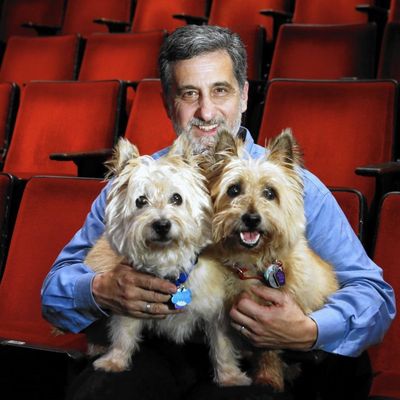
Bill Berloni has dedicated nearly five decades to bringing animals to life on stage and screen, all while championing rescue work and humane training practices... Read More
From the show: The Theatre Podcast with Alan Seales
Guests
Featured Shows


About
Bill Berloni has dedicated nearly five decades to bringing animals to life on stage and screen, all while championing rescue work and humane training practices. From his semi-accidental start training Sandy for the original production of Annie to working with a menagerie of animals for Broadway, film, and TV, Bill’s journey is as heartwarming as it is inspiring. In this episode, Bill shares stories of training everything from dogs and cats to butterflies and snakes, and how he has created unforgettable moments in productions like Gypsy, The Greatest Showman, and Legally Blonde. He also discusses his groundbreaking work with Naomi Watts in The Friend and how this movie is redefining animal performance in film.
Bill’s commitment to treating animals with respect and compassion shines through as he recounts the joys and challenges of working in theater and entertainment. Whether it’s training an actor to command a dog or preparing a cat to handle audience applause, Bill’s creative solutions and passion for storytelling offer invaluable lessons for anyone working in the arts—or with animals. With humor, honesty, and insight, this episode is a tribute to the deep connections we share with our animal companions and the magic they bring to the stage.
Bill Berloni is a Tony Honoree for Excellence in Theatre and the founder of William Berloni Theatrical Animals, a company that provides trained animals for theater, film, and television. His career began in 1977 with the original Broadway production of Annie, where he trained Sandy, a rescued dog. Since then, he has worked on countless productions, including Legally Blonde, The Ferryman, Gypsy, and The Leftovers. Bill is an advocate for animal rescue and humane training practices, and his work has been featured in books, television, and film.
This episode is powered by Welcome to Times Square, the billboard experience that lets YOU be a star for a day. Learn more: https://welcometotimessquare.com/
Connect with Bill:
- Instagram: @berlonitheatricalanimals
- Website: berlonianimals.com
- Learn more about The Friend: https://www.rottentomatoes.com/m/the_friend_2024
Connect with The Theatre Podcast:
- Support us on Patreon: Patreon.com/TheTheatrePodcast
- Twitter & Instagram: @theatre_podcast
- Facebook.com/OfficialTheatrePodcast
- TheTheatrePodcast.com
- Alan's personal Instagram: @alanseales
- Email me at feedback@thetheatrepodcast.com. I want to know what you think.
Transcript
This transcript was automatically generated and might contain errors.
[0:00] Bill Berloni: Hi, I'm Bill Berloni, and welcome to The Theatre Podcast with Alan Seales.
[0:30] Alan Seales: So, in this conversation, we dive into Bill's fascinating journey from a 19-year-old apprentice to a Tony honoree for excellence in theatre, and we hear about his humane training practices, the challenges of working with everything from dogs to butterflies, and his unexpected adventures, including collaborations with, you know, little people like Mike Nichols, Tom Hanks, Naomi Watts, you know, the list goes on. If you're watching this episode on Patreon or Spotify, you'll see I'm in a studio again for the first time in years. I've partnered with an amazing team over at Welcome to Times Square, the premier billboard experience that lets you be a star for a day, so check the show notes for more information about that, or visit welcometotimesquare.com. And don't forget to follow me on social media and support the podcast on Patreon. Now, everybody, please enjoy this episode with Bill Berloni. Here you go, one, two, three.
[1:46] Alan Seales: We're going to get this intro going while I have a dog trying to lick my face. Today's guest is someone who has spent decades creating some of the most unforgettable stars of the stage and screen, many of them with four legs and, oh, there goes one, four legs and a wagging tail. This gentleman is a legendary animal trainer whose incredible journey began at the age of 20 when he trained Sandy for the original production of Annie. That experience not only launched his career but also sparked a lifelong commitment to rescuing and training animals for the stage and screen, and now with a 48-year career and dozens of Broadway show credits to his name, spanning from Annie, of course, in 1977 to the current productions of Left on Tenth and Gypsy here in 2025.
I can't believe that's the year now. He has brought a menagerie of animals to life in iconic productions. He currently has four dogs starring on Broadway, including in Left on Tenth and Gypsy, and his company, William Berloni Theatrical Animals, provides a wide variety of trained animals for theater, film, television, all while championing rescue work and humane training practices, something that with three words I've not heard together that I'm excited to get into. From The Greatest Showman to Disenchanted, Bill's influence extends far beyond Broadway, proving that talent truly comes in all shapes, sizes, and levels of hair. Bill Berloni, holy cow, man, welcome to the theatre podcast.
[3:08] Bill Berloni: Thank you. I'm so happy to be here.
[3:11] Alan Seales: Anyone who's watching on camera right now, we're actually coming live from the Welcome to Times Square studio here in the Paramount building. It's beautiful. Who do we have in your lap right now?
[3:21] Bill Berloni: We have Nessa Rose. She's playing Honey in Left on Tenth, but she's actually our number one Toto. She plays Toto all over the country, so she's an old pro.
[3:32] Alan Seales: Do people come to you for dogs to do specific parts, like I need a Dorothy dog?
[3:38] Bill Berloni: Now, it seems that our canon of hits are Annie, The Wizard of Oz, and Legally Blonde, so regional theaters all over the world call us for animals for those productions.
[3:48] Alan Seales: That's crazy. Is Charlie standby for Left on Tenth?
[3:53] Bill Berloni: No, Charlie actually has a role in the show as well. He plays the role of Charlie because there's two dog characters in that. They understudy each other, but they play two different roles.
[4:03] Alan Seales: That's what I was going to ask. What happens when an animal gets sick during a production? Are there standbys and understudies for the animals, too?
[4:10] Bill Berloni: Well, when the producer says, the budget's too small and we can't afford backup dogs for the dogs, they'll have to understudy each other.
[4:19] Alan Seales: What can I say? Charlie's at my feet now. I love you, Charlie. I'm going to take you home with me.
[4:24] Bill Berloni: You can't go to Left on Tenth.
[4:29] Alan Seales: Currently on Broadway, you have these two in Left on Tenth, and then there's one in Gypsy?
[4:33] Bill Berloni: Two.
[4:33] Alan Seales: Two in Gypsy.
[4:35] Bill Berloni: There's a one role and an understudy dog for that.
[4:37] Alan Seales: There is an understudy there. Walk me through training an animal for the stage and for something because I assume you're not going to have a set wherever you're training them, and I want to get into that, too. But when you start to train them, at what phase do they get on stage? And then when they start working with the leads? And then what about the understudies and the standbys? And how does everybody get to work with all of these individual animals?
[5:01] Bill Berloni: Well, it's kind of a crazy thing. It's sort of a hybrid of dog training and theater rehearsal. First, producers, writers will call me with a script. Bill, we have dogs in a play. What do they have to do? And usually, I'll sit down with the director and the writer and actually figure out things that dogs can do eight times in front of a live audience because often, what they're dreaming of is things that they've seen on TV, things they've seen on YouTube, but you may not be able to do that on a live theatrical stage. So once we agree what the behaviors will be, we start a casting call. And basically, my wife and I start going to shelters all around the country looking for the dogs for that particular show that they're casting for.
We'll find some candidates. I'll go out and temperament test them. And if I feel that they'll be good for the show, we'll adopt them. So once we have the dogs, I mean, it's usually six months to a year out to train these dogs to be ready for Broadway.
[5:56] Bill Berloni: It takes that long. I mean, first, we have to heal them emotionally and physically. And then we just start training them. And a highly trained dog will work on stage and Broadway, Times Square. They'll work anywhere. So we just really start working them in our training room at home. Once they get used to that, we take them out. We take them walking through towns. We take them to Home Depot. We take them to all these places where we have them do their behaviors. So it becomes normal for them to go to Home Depot and do their show. They don't know. Ultimately, when we do get to rehearsal, that's where it gets sort of tricky because I realized as a young actor with Sandy, Sandy couldn't look off into the wing and get the command and do the behavior.
It had to come from the actor who was there. So we had to train little girls how to be animal trainers. And little girls love being animal trainers. And that sort of created the model where whoever's acting on stage with the animal, we train them to be animal trainers. And they're controlling the animal's behaviors. So they have to have an affinity for animals. They have to love animals. We have to build a bond. And they have to be able to do the commands right. And for the majority of my career, that has been a successful thing. Ultimately, what the audience sees on stage is a real relationship. And I'm in the wings, just sort of supervising.
[13:02] Bill Berloni: I ran back to the opera house. Michael Price was out of town. The producer, Martin Charnin, was out of town. There was nobody there to okay this dog. And so, I left thinking this dog was going to die because I couldn't do anything to save him. And so, as I bemoaned that all night long at the show, my roommate at the time said, "Idiot, here's the four bucks. Go back tomorrow morning and get the dog before they open," which is what I did. And that's how we got the original Sandy. And he was pretty severely abused. So, I got back to the shop and I'm dragging this scared dog into the shop going, "Hey guys, I found Sandy." And they thought I was out of my mind. They're like, "How are you going to get that dog on stage?"
And being Italian, I'm like, "Well, we'll feed him a little bit. Maybe he'll come around." And that's sort of what we did. He lived with us. He worked with us. He went to the theater with us. The theater became his home. People became his family. There were treats everywhere. So, he really started to come around. And then, of course, the first day of rehearsal, he met a little girl and kids and dogs—that wonderful thing happened. So, I just watched what happened. And ultimately, the very first show, when I let Sandy go, he was going to the actress Kristen Bygaard. Not because I told him to, because he wanted to. And he stayed with her because he wanted to. And then he came off to me when I called him.
So, it was just sort of a positive reinforcement. "Hey, let's put on a show. Hey, let's get a dog and move forward." And that's how it started. And that summer, I was moving to New York. I'd enrolled at NYU, and I was studying with Stella Adler when she was alive. So, Sandy and I moved to New York, a five-story apartment in Greenwich Village that didn't allow dogs. And I snuck him up one night and used to walk him on the roof so the super wouldn't know we had a dog. And after my first semester there, Mike Nichols' office called. And he said, "Martin Sharn is insisting that we use you and your dog for the Broadway production. Are you interested?" And I thought, any way to work with Mike Nichols and Broadway?
Yeah, I'll be a dog trainer. And so, that's how it all started. And in April of 1977, Annie opened on Broadway with Sandy and Andrew McArdle. And I became a world-famous animal trainer at the age of 20. And Sandy never missed a show in seven years of the production, correct? He never missed, not because of illness. When Andrea left the show, this is a crazy story. She was hired by Liberace. Like you do. Yeah. I mean, he had this big Vegas show and he had these upcoming stars. So, he asked Andrea to be in his Vegas show. And of course, he was so nice and he said, "I'll give you anything you want. You know, what do you want?" And she said, "I'd like to do Tomorrow with Sandy." I mean, she was joking.
Somehow, Mike Nichols' office called me and said, "You're going to Las Vegas for three weeks to do, you know, Andrea's act. You've got to put the understudy dog on." With Liberace. With Liberace. And so, yes. So, Sandy and I were floored. I lived in one of his guest houses. He was a wonderful, sweet man. And Andrea and I got to do, you know, another three weeks being together. She would just sing Tomorrow as the finale and the understudy dog went on. So, Sandy never missed because he was ill, because he was bought out by Liberace for three weeks. True story.
[16:20] Alan Seales: Well, I think that's fair and a good reason to call out. But then at some point, you said, "All right, I'm going to lean into the dog training," because you originally said you wanted to be an actor. So, like at what point and how old were you in this journey of your life, right? Was it the Liberace moment where you're like, "I think I can do this?" When was dog number two or animal number two?
[16:38] Bill Berloni: Animal number two actually came right away because for the Broadway production, they said, "You know, you've got to work with the understudy." And I said, "Well, I'll work with the understudy kid." And they said, "No, understudy dog." And I was like, "Oh, yeah, I think we have to have another one." And so I went to the shelter and I adopted a dog named Marf, who became the second one. Well, ultimately, there were numerous touring companies of Annie. So at two touring companies touring with two other sets of Sandys, I was asked at that point to do the revival of Camelot with Richard Burton. Now, the first three years of Annie, I was still taking tap dancing lessons. I was taking singing lessons.
I was still thought I wanted to be a performer and then got the chance to sit in the room with Richard Burton, you know, and Alan J. Lerner was directing. And I thought this is great. And I went to that show and I, after three and a half years, I looked around at all the men around me, realized I wasn't as tall, wasn't as good looking, couldn't dance or sing as well. And so I probably was not going to work a lot as an actor. And I realized I probably was good at this and decided I would be an animal trainer.
[17:46] Alan Seales: Well, I'm glad you did. I think Broadway as an industry is glad you did. I want to, okay, I want to read the list of animals you have trained, because some of these are a big old WTF and I guess why dogs and cats, of course, and then horses, donkeys, cows, pigs, sheep, goats, llamas, ducks, chickens, rabbits, hamsters, guinea pigs. These are things that I've seen trained before. Rats, mice, macaws, parrots, cockatoos, parakeets, finches, canaries, pigeons, doves, owls, hawks, falcons. Yes, crows. Now we get into the reptiles, snakes, lizards, frogs, turtles, iguanas and spiders and butterflies and cockroaches. How the hell do you train a spider or a butterfly?
[18:31] Bill Berloni: You hire an expert. One of the things I learned very early on in my career, because once Annie opened, I started getting calls for other animals and I really didn't know anything about horses or whatever. And I, one of the biggest forms of cruelty is ignorance. You know, people adopt a dog and don't really investigate what they need to do with it or buy for it. And then they end up. So I thought it would be cruel for me to get an animal and try and learn everything about it for a job. So I started hiring experts.
[19:04] Alan Seales: Don't go anywhere. We'll be right back after this break.
[19:09] Bill Berloni: The expert comes in. And again, I'm the conduit between the animals and the design team. It's like, what do you need the animal to do? What's the shot? And then I go to the expert, just like with the dogs. What can these animals do? How do we get them to move or stay or whatever, and then put that together? You know, a lot of reptiles are cold-blooded. So if you put them in a situation where it's cooler, they slow down. And so you could place them places and they'll stay. And if you wait 30 seconds, they'll start to warm up and start to move. And if you have a food source for whatever that is, the snake, the whatever, it'll go in the direction that you need it to. So there are a lot of little tricks to that sort of stuff.
[19:45] Alan Seales: I always wonder about the big tarantulas that you see crawling on people's faces in movies. I mean, those animals are hard to work with the actors. I mean, a lot of people have fears with those animals.
[20:01] Bill Berloni: I've got a crazy story about a snake. The first my first snake drop. Annie opened, Vogue wanted to shoot Dorothy Loudon, and all the orphans, and Sandy. So Richard Avedon was going to shoot a show, and he had just shot the Brooke Shield Calvin Klein ad jeans. I mean, he was hot. So we go in, Sandy's there. He sees this guy and this dog. About two weeks later, he called me and goes, "I have a job where I need a snake to just be draped on a model. Can you do that?" And I was like, "Oh, yeah, I can do that. Take it till you make it." So I called the exotic animal consultant at the ASPCA. They turned me to a snake handler who lived in Brooklyn. He said, "Oh, yeah, I'll do that." So he had a big boa.
So the day of shoot and I charged Richard two hundred and fifty dollars, two hundred and fifty dollars in 1977 was a lot. And I gave the snake handler a hundred. And I'm just going to be the agent standing there. So we go and comes in with a cooler and he's this sort of hippie dude, long hair. So Richard brings the model out and it's Natasha Kinski in a bathrobe, this teenage girl and talks to her and she's sitting on a table and he turns to me, goes, "She's going to be naked and you have to put the snake on her body."
[21:24] Alan Seales: Okay.
[21:24] Bill Berloni: I turn to the guy and Richard comes back and goes, "You know, Natasha doesn't feel comfortable with that, gentleman. Can you do it?" And I had never touched a snake. And it was one of those moments where do I run out screaming or do I suck it up? And I was like, "Okay." And I turned and you open the cooler and I picked up this large, heavy, cold snake and I'm trying to relax. And I turned to put it on her. And I'd never seen a naked woman in like full light. And it had to be draped over her breasts and between her legs. And I didn't know what I was more afraid of touching, her body or the snake. And so I'm like, I put it on, push it there and he starts shooting. And then it warms up and we put it back on ice.
Well, after an hour, it's like, "Oh, yeah, lift up your arm." And I just like slap it on her, lift up her leg. I mean, it was like one of those crazy things where it became this famous print of the woman who's lying on her side. Yeah. Yeah. And that was my view. That was my first snake job.
[22:30] Alan Seales: Holy cow. Look at my producer, Sarah, right? Wow. That's incredible. What has been the hardest thing to train, like to do a specific movement on stage?
[22:41] Bill Berloni: Yeah, either, either. It's like on stage, stage is less, much less forgiving, which makes live theater incredible. Right. Right. Well, theater in and of itself is always more difficult because you train for it to happen every time in front of a live audience. So there's many more variables where on film you get many takes. I did a commercial with butterflies. I told the butterfly story, Huffman Coos, which is a furniture store in New Jersey, had this idea for a butterfly to fly in and land on a couch in a penthouse overlooking Central Park and then fly out the window. They called me. You know, you take the call and you go, "Oh, okay, sure." And I called the entomologist at the Museum of Natural History.
Never seen a full piece of furniture in full light before. So, yeah, yeah, yeah, I get that. No, I've never been in a penthouse in Central Park West. That's that. I walked into that room. So I go there and this and this is he was a bug guy. He's like the speckled, very nice man who sits in categories, butterflies there. And I told him the thing. He said, "Oh, that's no problem." I said, "Really?" He goes, "Yeah, that's very easy to do." I'm like, "Sure. Okay." So again, I put my whole career on the line. We show up and he shows up this little briefcase set up and the director shows him where it is. So he goes over, takes an eyedropper and puts a drop on the couch, comes back, pulls out a butterfly and goes, "I'm ready."
He lets the butterfly go. It lands on the couch and it flies out the window. The set erupts. It's like they're screaming and they got it. And he says, "Do you want to do it again?" Like, "Yeah, the director just fly out the window." Well, he had another one. So and this is where, again, experts are so important. He had hatched the butterflies that the day before. So he knew they were ready to fly. They were day-old butterflies. He created a sex potion that they would go over and lick. And the more he put there, the longer they would stay. And then he knew they'd go to the air and fly out. I mean, it was magic. And monarchs are indigenous to Central Park. So we weren't releasing species that, you know. And it's that sort of thought that needs to go into animal training for entertainment. And it's not always that way.
[25:05] Alan Seales: Welcome back to The Theatre Podcast. Today, I am thrilled to have Bill Berloni with me. Bill has dedicated nearly five decades to bringing animals to life on stage and screen, all while championing rescue work and humane training practices. Bill, it's such a pleasure to have you here.
[25:35] Bill Berloni: Thank you for having me, Alan. It's great to be here.
[26:05] Alan Seales: You have such an incredible journey, starting with your work on the original production of Annie. Can you tell us a bit about how that all began?
[26:35] Bill Berloni: Absolutely! It was a bit of a happy accident, really. I was just a young guy looking for work, and I ended up training Sandy, the dog for Annie. That experience opened up a whole new world for me, and I realized how much I loved working with animals in the theatre.
[27:05] Alan Seales: That’s amazing! And since then, you’ve worked with so many different types of animals. What has been one of the most memorable experiences for you?
[27:35] Bill Berloni: Oh, there have been so many! I think one of the most memorable was working with a cat for a production of Cats. Cats can be quite challenging, but when you see them shine on stage, it’s incredibly rewarding.
[28:05] Alan Seales: I can only imagine! You’ve also worked on some big films like The Greatest Showman. How does training animals for film differ from training them for live theatre?
[28:35] Bill Berloni: Great question! In film, you have the luxury of multiple takes, so you can really refine the performance. In theatre, it’s all about getting it right in the moment. Each medium has its unique challenges, but I love them both for different reasons.
[29:05] Alan Seales: That makes sense. You’ve also been a strong advocate for animal rescue and humane training practices. Can you share why that’s so important to you?
[29:35] Bill Berloni: Absolutely. I believe that every animal deserves a chance at a loving home and a fulfilling life. By using rescue animals in productions, we not only give them a second chance but also raise awareness about the importance of adopting rather than shopping for pets.
[30:05] Alan Seales: That’s such a noble cause. You’ve created unforgettable moments in productions. Can you tell us about a specific challenge you faced and how you overcame it?
[30:35] Bill Berloni: One challenge that comes to mind was training a dog to handle audience applause. It can be overwhelming for an animal, but with patience and positive reinforcement, we were able to create a calm environment for the dog, and it ended up being a star!
[31:05] Alan Seales: That’s fantastic! It really shows the bond you create with these animals. What do you think is the most important lesson you’ve learned throughout your career?
[31:35] Bill Berloni: I think the most important lesson is to always treat animals with respect and compassion. They are not just props; they are living beings with their own emotions and needs. Building that trust is key to a successful performance.
[32:05] Alan Seales: Such a valuable lesson for anyone working in the arts or with animals. Thank you for sharing that, Bill. It’s been a pleasure having you on the show today.
[32:35] Bill Berloni: Thank you, Alan! It’s been a joy to talk about my passion for animals and theatre.
[37:38] Bill Berloni: I went back, you know, crying to my horse trainer, and he went, don't worry about it. And he took his belt off and he put it around the horse's neck. He put Natalie on the horse, and he had some treats, and he led the horse. And he said, ask Mike if you and I can be on stage in costume, because we'll train it to come to us for some candy. And that's what we did. But every night I was fearful that this horse was going to rear and throw Natalie Portman in the leg and my career was going to be over. But yeah, for that production, I was on stage calling the horse.
© Broadway Podcast Network, All Rights Reserved