

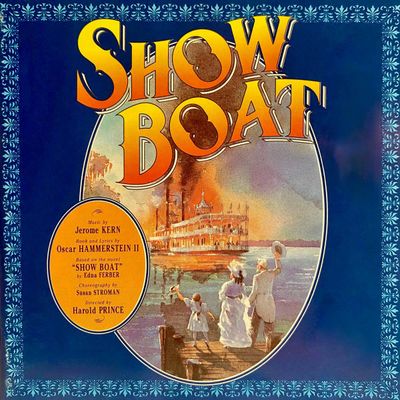
A look at The Art of Orchestration, featuring four of Broadway’s greatest: Robert Russell Bennett (Show Boat, Oklahoma), Hans Spialek (Anything Goes, On Your Toes), Jonathan Tunick (Company, Pacific Overtures), and Michael Starobin (Falsettos, Sunday in the Park with George)... Read More
From the show: Anything Goes
Featured Shows

About
A look at The Art of Orchestration, featuring four of Broadway’s greatest: Robert Russell Bennett (Show Boat, Oklahoma), Hans Spialek (Anything Goes, On Your Toes), Jonathan Tunick (Company, Pacific Overtures), and Michael Starobin (Falsettos, Sunday in the Park with George). The four artists describe their different techniques and discuss their collaborations with writers and performers to bring out the best in a score for a show. Featured songs: “Overture to CAROUSEL,” “Four Jews In A Room Bitching,” “March of the Falsettos,” “Overture to THE KING AND I,” “A Terrific Band and A Real Nice Crowd,” “The Twenty-Fifth Annual Putnam County Spelling Bee,” “There’s A Small Hotel,” “Overture to NINE,” “I Happen To Like New York,” and “I Never Wanted To Love You.”
Originally produced and broadcast in 1986. For more information go to AnythingGoesPL.com or BPN.FM/AnythingGoes. Theme music arranged by Bruce Coughlin. Sound mixing by David Rapkin. Associate producer Jeff Lunden. Anything Goes – Backstage with Broadway’s Best – is produced and hosted by Paul Lazarus.
Transcript
This transcript was automatically generated and might contain errors.
[0:00] Paul Lazarus: Hi, this is Paul Lazarus. In the 1980s, I produced and hosted a radio series called Anything Goes, a celebration of the American musical theater. Now, the Broadway Podcast Network is bringing back these shows. Today, The Art of Orchestration, featuring Jonathan Tunick, Michael Starobin, Hans Spialik, and the words of Robert Russell Bennett. This program was originally broadcast in 1986.
[0:46] Paul Lazarus: This is Anything Goes, a celebration of the American musical theater, past, present, and future. I'm your host, Paul Lazarus. Today, a look at The Art of Orchestration, as practiced by four of Broadway's best, Hans Spialik, Jonathan Tunick, Michael Starobin, and Robert Russell Bennett. I sit at the same cluttered-up desk hour after hour, almost unconscious of the thousands of movements of the pen in my hand. I am not tired, I am excited. I vaguely hate the symptoms of sunrise that show at the east window, but it has no chance to get much attention from me. I'm not even conscious of the reasons for being here. The recording session five hours from now, the music copyist who'll be here any minute for another ten pages of score, the money I'll get from the job, the ears waiting to hear the sounds I'm conceiving.
None of these are what has kept me awake since 6 a.m. yesterday, but the sound of those violas, cellos, and horns is doing something I never heard before, and I'm excited. Their sound must be captured and put into a language that the players can understand and translate into live music. If I don't get these marks on paper, no one else will ever hear what I'm hearing. The words of veteran orchestrator Robert Russell Bennett, read by Herb Foster. The orchestrator's contribution to musical theater has traditionally been undervalued. Hans Spialik's work wasn't even acknowledged in theater programs until 1926, when he orchestrated the review Americana. And it was the first time I had my name on the program.
[2:36] Hans Spialik: As orchestrator? And yeah, as orchestrator, nobody had a name on the program. And you know where under the credits at the end, I'm Miller Shoes, orchestrations by Hans Spialik.
[2:52] Jonathan Tunick: Jonathan Tunick prefers the term arranger to orchestrator as being more comprehensive. Arranger is a musician who uses the same skills as a composer to either finish a piece of music that is incomplete in some way, or to adapt a piece of music that is finished to some other medium. That adaptation can take any form. It can be transferring it from one performance medium to another, or you can arrange a piece that was written for string orchestra, for organ. Now when we move that definition over to the specialty of orchestration, which means specifically applying these skills to adaptation for orchestra, well I guess I've defined it.
[3:39] Michael Starobin: Michael Starobin's work is an expansion of the composer's intentions. A composer or a songwriter writes his song sitting at a piano, playing the piano. It's written for the piano, which is a rhythm instrument, which doesn't sustain, has pretty much a similar color over the whole keyboard, though that color can be changed. You then take that song and as a designer respond to it, to the emotional nuances of the song, or lack thereof, or if you're asked to, you go against the emotional nuances that are in the song and respond to it by placing what the composer's written into the instruments, additional material if what he's written is so pianistic it can't fit other instruments, or just added material that responds to what he's doing and supports it.
[4:42] ♪ Musical number: "Four Jews In A Room Bitching" — performed by Michael Starobin ♪
[6:32] Michael Starobin: A really important thing for orchestration is to play different instruments. And I'm a pianist, basically, not a particularly good one. But in the past, when I was younger, I played flute, tuba, bass, a teeny bit of viola, percussion, timpani, playing all those things, even the little bit, helps you understand how they work, how to get the colors out of them.
[7:01] Paul Lazarus: Robert Russell Bennett is best remembered for his orchestrations of Rodgers and Hammerstein musicals. In his book, Instrumentally Speaking, he described himself as the missing part of the composer. You are engaged to work with a composer and put his melodies into shape for a performance in the theater. Your task is to be a part of him, the part that is missing. He may be capable of doing the whole score himself, or he may not know a G clef from a gargoyle. Your job is to bring in whatever he doesn't and make it feel like it belongs there.
[7:33] Michael Starobin: Michael Starobin puts it another way. As I'm working on a piece, I don't feel like I'm doing something separate from what the composer has done. I feel like I'm continuing a job they've done, and in a well-orchestrated work that's well composed, too, you really don't hear the seams. I mean, they are the same thing.
[7:52] Jonathan Tunick: I like to sit down with the composer and lyricist and just have them play through everything and talk about it, whatever questions come up, which are usually dramatic questions. If the music is literately written and notated adequately, then there are very few questions to ask about that. I mean, I might ask, I mean, if there's some discrepancy in the notation, I'll check on that. But usually what you want to know is what are the dramatic elements here, and what are our intentions dramatically, which may not always be apparent.
[9:19] ♪ Musical number: "A Terrific Band and A Real Nice Crowd" — performed by Jonathan Tunick ♪
[10:03] Michael Starobin: Michael Starobin claims that his responsibility is to deal with words as well as music. The one thing that's hard to learn to do is to support a lyric without getting in the way of it, and as an orchestrator you don't deal with words directly but very indirectly you deal with them constantly and that's something where yes all composers will say to you that's too busy and I tend to get a little too busy sometimes.
[11:29] Jonathan Tunick: Jonathan Tunick feels an important part of his job is to support the singer. You hear a voice and you get to know that voice and what kind of background suits that voice and will show you off best and it's possible to really enhance a voice to make dull notes brighter to make notes that are too bright smoother with an appropriate background. Having an orchestration written for you is a very important part of your performance.
[12:21] Hans Spialik: Hans Spialik, famous for his work with Rodgers and Hart and Cole Porter agrees. I always ask please tell me are you really comfy? So you really think the orchestration should really make the singer? Oh it makes the singer, makes the singer gives a certain inspiration to divert sometimes to wait for certain figures and when they go on and tell me they're showing the flute player where the thing doesn't play it they ask what happened to that thing?
[13:05] ♪ Musical number: "There's A Small Hotel" — performed by Hans Spialik ♪
[14:51] Paul Lazarus: This is Anything Goes with Paul Lazarus.
[15:00] Jonathan Tunick: The old theater orchestra is changing fast. The hip sound now is electric, and conventional instruments are quaint. We have a whole generation that's never heard an orchestra, that's perhaps heard a recording of an orchestra, but's never heard an orchestra, or perhaps has even heard an orchestra mic'd and coming through a speaker in a theater. Those are the parents of the people who have never even heard that. They've only heard synthesizers.
[15:30] Michael Starobin: The synthesizer is, to me, one of the most powerful tools, because it can change its personality so quickly. Its personality, one has to grant, is an electronic one. It's not nearly as warm as a live musician playing an instrument. It can never replace that, and its value in those areas is not high, but its value as a source of color to support live musicians, to create color, to create really magical sounds, is invaluable. And for theater in particular, it's a wonderful instrument, because that quick change of color and personality is what orchestration in the theater needs.
[16:18] Unknown Speaker: Each of the orchestrators I spoke to described memorable shows he'd worked on. Hans Bialik recalled working with Cole Porter in 1930 on The New Yorkers, which featured such great songs as "Love for Sale" and "Let's Fly Away." He also had a song, it was called "I Happen to Like New York."
[16:37] Hans Spialek: Yes, I love that song. Now, this I did strictly, and it was written that way, in the Ravel style, you know. He was crazy about the orchestration, and you know what he did? He hired the orchestra after rehearsals for half an hour, and he sat on the stage with a glass of, you know, he drank, he had a glass, and had the orchestra play "I Happen to Like New York." He himself, sitting on the bass, played it himself. Cole Porter, sitting on the stage, listening to his own song with champagne. That's tremendous.
[17:20] ♪ Musical number: "I Happen to Like New York" — performed by Unknown ♪
[19:06] Jonathan Tunick: I met the challenge of orchestrating Stephen Sondheim-specific overtures with its Japanese influence score by preparing in an unusual way. Maybe I shouldn't admit this. My research consisted of the following. I have a friend who's a percussionist who has a large collection of exotic instruments from all over the world, from Japan and every other country in the world. And he gave me a guided tour of his collection. I took notes and ordered some of these instruments to be used. Relatively few of them were Japanese. I bought a book on Kabuki theater and read it. And I got some records of Kabuki music and I read the liner notes. That was my research.
[19:54] Michael Starobin: I've also worked with Sondheim on Sunday in the Park with George, where I acquired both contemporary and period sounds from the orchestra. The orchestration was determined for Sunday in the Park without any of the 20th century music having been written. And when that came along, I just sort of had to find a way to get that out of... Basically what I did is I asked the reed players at that point to switch to saxophones. I gave the drummer a hi-hat to play to imitate a drum set. With the synthesizer, I then switched from more subtle sounds to more electronic sounds. Orchestration is a desk job. It's theater work, but it's a desk job. There's something wonderful about sitting in your own space with your materials around you at your desk, with your piano there, and discovering something and creating something at that desk.
To me, sometimes the most profound, wonderful moment is the realization of the players playing it. But finding that texture, like, yes, I can do that here, yes, I can do that there, at the desk, and hearing it, hearing the orchestra at your desk, that can be, to me, the most exciting moment of theater.
[21:10] ♪ Musical number: "I Never Wanted to Love You" — performed by Unknown ♪
[23:22] Hans Spialek: I recalled the first orchestra run-through for On Your Toes in Boston. As he remarked, orchestrators rarely get noticed by anyone. The only real appreciation as an arranger and that concerns newspapers, composers and all that, I got in On Your Toes and neither from the composer, nor from the papers, nothing but I'll show you what happened at the reading rehearsal at the orchestra reading in Boston. No actor was supposed to be on the stage, nothing. Unknown to us, I didn't notice much and I didn't know him that time either. And then they play "Small Hotel." Then I found out, I said, hey Ray. He was crying, he was very angry. I said, what's the matter, you don't like it? Because he sang it, not in the show he or she sings it first.
In the original, he sang it first. I said, what's the matter, you don't like it? He said, no Dick, it's so beautiful. That was the only real appreciation as an arranger among all those billions of notes I wrote through the years. I got nice ones, I got wonderful, but as soon as I got bad ones, you have to take it whatever you get.
[25:02] ♪ Musical number: "There's a Small Hotel" — performed by Unknown ♪
© Broadway Podcast Network, All Rights Reserved